
Musk: unscripted Optimus demo in 1–2 months, chores in 12–18 months
Elon Musk said Tesla will show an unscripted Optimus demo within one to two months and that the robot should handle household chores within 12 to 18 months — but homes come last, after heavy industry.
📊 Scorecard: our Bullish call on $TSLA is scored from $374.41, the last close before it ran. Its first result comes after the next close.
The News
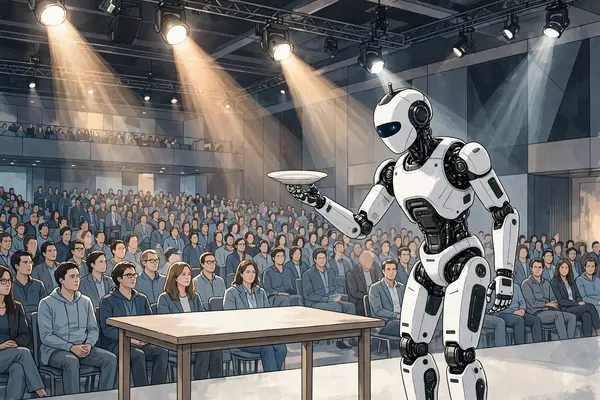
Elon Musk said in a video interview at the TomorrowX Summit, reported on November 19, that Tesla will show an Optimus humanoid demonstration within the next one to two months — December 2026 to January 2027 — and that it will be unscripted, showing the robot as it behaves in everyday interaction rather than a curated highlight reel. The Humanoids Summit in San Mateo, California, on December 1–2, where Optimus Gen 3 is slated for a live demonstration, falls inside that window.
Musk said Optimus should be able to handle household chores such as taking out the trash, washing dishes and clearing tables within 12 to 18 months, roughly November 2027 to May 2028. But deployment will start in heavy industry — mining, smelting and other operations that run 24 hours a day — and only reach households after the robot has proved itself there.
Early production of Optimus Gen 3, which has 37 joints and new dexterous hands, has run at Tesla's Fremont factory since the third quarter of 2026. Tesla is also building a dedicated Optimus facility of more than 7 million square feet at Giga Texas, with main-structure assembly about 65% complete as of November 18. These are Musk forecasts, and his Optimus timelines have slipped repeatedly, and external deliveries are still targeted only for around the end of 2027.
Musk has put a date on the demo — now the robot has to perform live, unscripted, in front of an audience.
Why It Matters
A demo date matters because humanoid robots are easy to promise and hard to show. Most robot videos are edited highlight reels, cut to hide the failures. An unscripted, live demonstration removes that safety net: the robot either does the task in front of people or it does not. Musk choosing that format, and naming a window of one to two months, is a bet that Optimus is ready to be judged in real time.
The deployment order matters because it tells you where the money is first. Heavy industry runs 24 hours a day and pays for machines that work without breaks; a robot that can survive a mine or a smelter is a robot that can earn its keep. Homes, by contrast, are full of surprises — stairs, pets, clutter — and a robot that fails there fails in public. Starting in industry is the cautious, commercial choice.
The factory numbers matter because they show Tesla is spending real money, not just talking. Early production at Fremont since the third quarter of 2026, plus a dedicated facility of more than 7 million square feet in Texas that is about 65% assembled, is the kind of investment a company makes when it expects to build robots at volume. The counterweight is the track record: the Gen 3 unveil has already slipped from early 2026 to no date, so the demo window is a promise to check, not a result to bank.
Analyst's Take
Our call is Bullish. A dated, unscripted demo is the strongest kind of promise a robot maker can make — there is nowhere to hide if the robot stumbles on stage. Musk naming a one-to-two-month window, with the December 1–2 Humanoids Summit sitting inside it, gives investors a concrete event to watch rather than another vague "coming soon." The production facts back the talk: Gen 3 is already in early production at Fremont, and a 7-million-square-foot factory in Texas is about two-thirds built.
The heavy-industry-first plan is sensible, and that is itself a good sign. Musk is not promising a robot in your kitchen next year; he is promising chores in 12 to 18 months after the robot proves itself in mines and smelters that run around the clock. That order — hard, controlled work first, messy homes later — is how a serious robotics programme behaves, and it makes the household timeline more believable, not less.
The honest caveat is Musk's own record. His Optimus timelines have slipped repeatedly, and the Gen 3 unveil moved from the first quarter of 2026 to mid-2026 to no date at all. External deliveries are still only targeted for around the end of 2027. So treat the demo date as a test, not a guarantee: if Optimus performs live and unscripted in December or January, it is a real step; if the date slips again, it is the same old story. Reader poll: Will $TSLA show a live unscripted Optimus demo by January? Vote: Believe it, Too optimistic, Wait for the demo.
Are you bullish or bearish on this story?
By The Numbers
FAQ
What is a humanoid robot?
A humanoid robot is a machine built roughly in the shape of a person — two arms, two legs, a head — so it can work in places designed for people, like factories and homes, and use tools made for human hands.
What does unscripted mean?
Unscripted means the robot is shown doing things live, without a pre-planned routine or edited video. The audience sees what the robot actually does, including any mistakes, rather than a polished highlight reel.
What are dexterous hands?
Dexterous hands are robot hands that can grip, pinch and handle objects with fine control, more like human hands. Optimus Gen 3 is described as having new dexterous hands and 37 joints, the moving points that let its body bend and reach.
Why would a robot start in heavy industry?
Heavy industry — mining, smelting and factories that run around the clock — is a controlled place where a robot can do the same task over and over and be watched closely. Homes are messier and less predictable, so companies usually prove a robot in industry first.
👁