
Tesla's Cybercab reaches Dallas, its second city, with new V1.5 hardware
Tesla opened public rides in its purpose-built Cybercab in Dallas on Thursday, its second city after Austin, with a new V1.5 version of the car that riders say carries a Starlink dish and a trunk camera.
📊 Scorecard: our Bullish call on $TSLA is scored from $374.41, the last close before it ran. Its first result comes after the next close.
The News
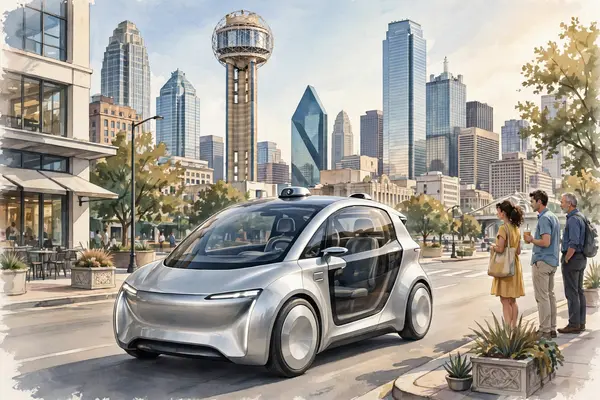
Tesla opened public rides in its purpose-built Cybercab in Dallas on Thursday, November 19, the second US city where the public can ride in the car after Austin, where public rides began in early September. Tesla's Robotaxi account announced the launch with a post saying, "Howdy Dallas. Cybercab has arrived in your city," and riders can book the two-seat, steering-wheel-free vehicle through the Tesla Robotaxi app. Dallas is not new territory for Tesla's driverless service — unsupervised Model Y robotaxis, ordinary-looking Tesla cars with no driver, have run there since April — but this is the first time the purpose-built Cybercab itself has carried passengers in the city.
The Dallas cars are a new version of the vehicle that Cybercab chief engineer Eric Earley has called "Cybercab V1.5." Riders have already spotted a Starlink dish built into the rear roof and a camera in the trunk lid, details reported by Not a Tesla App from Earley's post and rider sightings rather than confirmed by the company itself — though the Starlink panel had already appeared on Cybercabs in drone footage in September, so it is not necessarily new to the V1.5 cars. Tesla has not said how many Cybercabs are running in Dallas, and it has not published a service map showing only where Cybercabs go; the wider Dallas Robotaxi area covers about 81 square miles after an expansion in August.
Tesla has also begun inviting select customers to buy a Cybercab for personal use, priced at $29,990 plus a $299-a-month Autonomy Subscription, with deliveries targeted before the end of the year. That turns the Cybercab from a vehicle only Tesla operates into a car a customer can own — and pay a monthly fee to let it drive itself.
A second city and a buy-it-yourself price turn the Cybercab from a demo into a product — now Tesla has to show it can run the fleet at scale.
Why It Matters
This matters because a robotaxi service is only real when it works in more than one place. Austin was the proof that the Cybercab could carry the public; Dallas is the proof that Tesla can repeat the trick. Every new city is also a new set of streets, traffic patterns and local rules the system has to handle, so a second launch is a genuine test of whether the technology travels.
The hardware update matters too. A Starlink dish would give the car a satellite internet link, useful if mobile phone coverage drops, and a trunk camera adds another set of eyes at the back of the car. These are small changes, but they show Tesla is learning from real rides and updating the car rather than freezing the design.
The personal-sale offer matters for the business model. Until now the Cybercab was a vehicle Tesla owned and operated. Selling it to customers at $29,990, with a $299 monthly fee for the self-driving service, opens a second source of money — car sales — and could put far more Cybercabs on the road than Tesla could afford to buy itself.
Analyst's Take
Our call is Bullish. A second city is the clearest sign yet that the Cybercab is moving from a single-city showcase to a service Tesla intends to spread. Austin proved the car could carry paying riders; Dallas, a city where Tesla already runs driverless Model Ys, shows the company can add its purpose-built vehicle to a place where the service already exists. The V1.5 hardware — a Starlink dish and a trunk camera spotted by riders — suggests Tesla is still refining the car in public, which is how a new product gets better fast.
The personal-sale price is the bigger signal. At $29,990 plus $299 a month, Tesla is testing whether people will buy a car that has no steering wheel and pay a subscription for it to drive itself. If even a modest number of buyers sign up before year-end, Tesla gains a second way to make money from the Cybercab — selling the car as well as running the rides — and a fleet of owner cars that could one day join the robotaxi network.
The watch items are scale and proof. Tesla has not said how many Cybercabs are in Dallas or shown a Cybercab-only map, so we cannot yet tell whether this is a handful of cars or a real fleet. What to watch next is the fleet count, whether the Dallas service area grows past 81 square miles, and whether the first personal deliveries land before year-end as targeted. Reader poll: Would you ride in a steering-wheel-free $TSLA Cybercab? Vote: Ride one soon, Wait and see, Buy one.
Are you bullish or bearish on this story?
By The Numbers
FAQ
What is a robotaxi?
A robotaxi is a taxi with no human driver. Sensors and software steer the car, pick up passengers and drop them off, and a rider books the trip through an app instead of hailing a cab.
What does steering-wheel-free mean?
It means the car has no steering wheel or pedals at all — there is nowhere for a human driver to sit and take over. The car is designed from the start to drive itself.
What is a Starlink dish?
Starlink is SpaceX's satellite internet service, and a dish is the small antenna that connects to its satellites. A Starlink dish on a car would give it an internet link from space rather than relying only on mobile phone networks.
What is an Autonomy Subscription?
It is a monthly payment Tesla plans to charge owners of a Cybercab for the self-driving service. At $299 a month, it is the fee for the car to drive itself as a taxi, on top of the $29,990 purchase price of the car.
👁