
Tesla plans a steering-wheel-free Model Y for six or seven riders
Elon Musk said at the DealBook Summit that Tesla plans an autonomous Model Y with no steering wheel or pedals, sized for six or seven riders — extending the no-controls design from the two-seat Cybercab to its best-selling nameplate.
📊 Scorecard: our Bullish call on $TSLA is a miss so far: from $383.72 to $374.41 at the latest close (-2.4%). Against QQQ the call is wrong: the stock is 0.2 points behind the index.
The News
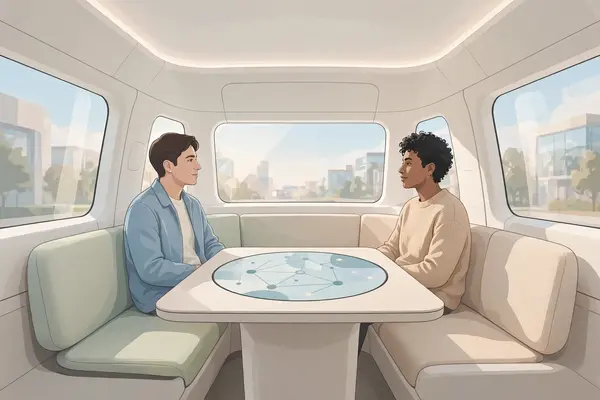
Tesla chief executive Elon Musk said on Wednesday, November 18, that Tesla plans an autonomous version of the Model Y with no steering wheel or pedals, sized for groups of six or seven people. He made the remarks at The New York Times DealBook Summit, speaking by video from China. The vehicle would be a self-driving Model Y built without any human controls at all.
Musk said the two-seat Cybercab, Tesla's purpose-built robotaxi, will cover roughly 90% of passenger miles — the short trips for one or two people that make up most travel. But families and larger groups still need a bigger autonomous vehicle, and that is the gap the steering-wheel-free Model Y would fill. The plan extends the no-controls design philosophy from the Cybercab to Tesla's best-selling nameplate.
Musk gave no launch date, no price, no production site, and no detail on whether the vehicle would be sold to owners or run only in Tesla's Robotaxi fleet. Tesla has not posted details about the plan on its official channels. Tesla shares closed Wednesday at $383.72, up 0.95%.
The Cybercab covers most trips. The family trip is the gap — and Tesla just said it plans to fill it.
Why It Matters
The plan matters because it closes a real gap in Tesla's robotaxi pitch. A two-seat car handles most trips, but it cannot carry a family of four, a group heading to the airport, or anyone travelling with several children. Those trips are exactly the ones where a taxi is most useful, and they are the trips the Cybercab cannot serve. A larger autonomous vehicle turns the robotaxi from a car for solo riders into a service a whole household can use.
It also matters because of which car Musk chose. The Model Y is Tesla's best-selling nameplate, which means the company already builds it at scale, already has the parts supply, and already has a vehicle buyers recognise. Putting the no-controls design on an existing high-volume car is a much shorter path than designing a second purpose-built vehicle from scratch — if Tesla can get the regulators to agree.
That regulatory question is the reason to keep the excitement in check. US federal safety standards were written for cars with a human driver, a steering wheel and pedals. NHTSA is already auditing how Tesla certified the Cybercab, which has no controls either. Until that audit and the wider rules are settled, the steering-wheel-free Model Y is a stated intention, not a car on a production line.
Analyst's Take
Our call is Bullish. This is a plan, not a product, but it is a plan that widens Tesla's robotaxi story in the direction that matters. The Cybercab seats two people; a six- or seven-seat Model Y would let the same self-driving system serve families, airport runs and group trips that a two-seater simply cannot. And it does so on the Model Y, the car Tesla already sells in huge numbers, rather than on a brand-new vehicle that would need its own factory and supply chain.
The caveats are large and they are all on the record. There is no date, no price and no production plan, and Musk did not say whether owners could buy one or whether it would live only in Tesla's Robotaxi fleet. The bigger hurdle is regulation: federal safety standards still assume a human driver is in control, and NHTSA is already auditing how Tesla certified the Cybercab, under audit query AQ26002 opened on September 3, 2026. A steering-wheel-free car needs regulators to accept a vehicle with no human controls at all, and that permission does not exist yet.
What to watch next is whether any of the missing pieces arrive: a launch window, a price, a production site, or word on whether the car is for sale or fleet-only. The NHTSA audit of the Cybercab's certification is the other thread to follow, since its outcome will shape how quickly any no-controls Tesla can reach the road. Reader poll: Bullish or bearish on Tesla's steering-wheel-free Model Y plan? Vote: Bullish, Bearish, Mixed.
Are you bullish or bearish on this story?
By The Numbers
FAQ
What is a robotaxi?
A robotaxi is a car that drives itself with no human driver, picking up passengers like a taxi. Tesla runs a Robotaxi service in some cities, and its purpose-built Cybercab is designed with no steering wheel or pedals at all.
What is NHTSA?
NHTSA is the National Highway Traffic Safety Administration, the US federal agency that sets vehicle safety rules and investigates safety problems. Its rules were written assuming a human driver is in control, which is why a car with no steering wheel faces a regulatory question.
What are passenger miles?
Passenger miles are a way of measuring travel: one passenger mile is one person travelling one mile. When Musk says the Cybercab covers about 90% of passenger miles, he means most trips people take are short trips for one or two people.
👁
Source: InsideEVs