
Asia rout: KOSPI plunges 5.21% as Samsung, SK hynix and SoftBank tumble
Asia's chip rout deepened on Friday: the KOSPI plunged 5.21% to 4,869.96 and the Nikkei fell 5.06%, with Samsung down 7.01%, SK hynix down 5.92%, Kioxia down 11.66% and SoftBank down 14.48%.
📊 Scorecard: our Bearish call on $000660.KS is scored from ₩1,113,000, the last close before it ran. Its first result comes after the next close.
The News
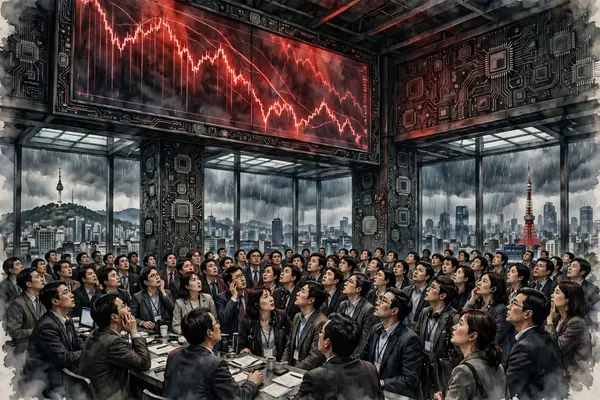
The KOSPI plunged 267.93 points, or 5.21%, to 4,869.96 on Friday, its lowest finish since January 20 and its first close below 4,900 in 10 months. The drop wiped out the entire two-day rebound. Samsung Electronics sank 7.01% to ₩183,100 and SK hynix shed 5.92% to ₩1,113,000, while Samsung Electro-Mechanics plunged 12.54% to ₩774,000. The smaller KOSDAQ index fell 5.71% to 645.68, and both markets triggered sell-sidecars, the circuit breakers that briefly pause trading when selling gets too fast; the KOSPI 200 futures curb fired at 11:54 a.m., the first time both markets' curbs fired together since November 6. Foreign investors net sold ₩1.588 trillion of KOSPI stocks and institutions ₩1.242 trillion, while retail investors bought ₩2.3159 trillion, according to MoneyToday's close report based on Korea Exchange data.
Tokyo was no better. The Nikkei tumbled sharply, with SoftBank, Advantest, Kioxia and Tokyo Electron all falling hard. MoneyToday cited three drivers for the Seoul selloff: funds rotating into Anthropic after its US listing, the Hunterbrook short report on AMD, and tighter US export rules — plus worries the Federal Reserve could raise interest rates.
The rout rolled in from Thursday's US session, which set the tone. The Nasdaq fell 2.25% to 23,879.20, the Dow dropped 1,101.11 points, or 2.19%, to 49,097.06, and the S&P 500 lost 2.02%. Chip funds fell with them: the iShares Semiconductor ETF dropped 2.75% to $137.95 and the VanEck Semiconductor ETF fell 2.62% to $447.48. One note on the numbers in this story: MoneyToday's own Friday piece gave different Seoul closes — Samsung at ₩182,500 and SK hynix at ₩1,105,000 — but this story uses the Yahoo Finance, AjuPress and Korea JoongAng Daily price set, which agree on ₩183,100 and ₩1,113,000.
Asia paid for Thursday's US selloff in full on Friday — and the memory names fell hardest even though the demand story behind them has not broken.
Why It Matters
The scale of the day is what makes it the lead story. A 5.21% fall is the worst day of this rout so far, and it came with the market's own safety valves tripping: sell-sidecars fired in both Korean markets, the KOSPI 200 futures curb went off for the 31st time this year, and foreign investors sold ₩1.588 trillion of stocks in one session. Retail investors bought ₩2.3159 trillion, but that was not enough to hold the market up.
The drivers matter because they show how connected the AI trade has become. MoneyToday named three: money rotating into Anthropic after its US listing, the Hunterbrook short report on AMD, and Samsung and TSMC halting some shipments to Chinese customers under the new US export rule, plus Federal Reserve rate-hike worries. None of those is a Korean memory problem on its own, yet together they knocked 6 to 7% off the two companies that make most of the world's AI memory.
The context that keeps this from being a simple panic story is the demand underneath. Korea's chip exports hit $396.8 billion in January to October, up 193% from a year earlier, according to the trade ministry via Seoul Economic Daily, and SK hynix is still expanding HBM4 capacity for delivery in early 2027. The market is pricing fear about the AI trade's valuation, not a collapse in orders — which is exactly why the analysts quoted in Seoul are split between calling the pessimism near its peak and saying valuation simply is not working right now.
Analyst's Take
Our call is Bearish. A 5.21% day on the KOSPI, a first close below 4,900 in 10 months, circuit breakers firing and foreign investors selling ₩1.588 trillion in a single session is a market in full retreat, not a routine dip. The damage spread across every big Asian chip name at once — Samsung, SK hynix, Kioxia, SoftBank, Advantest — which tells us this is a repricing of the whole AI trade, not a problem at one company.
The uncomfortable part is that none of the three drivers MoneyToday named is a memory fundamental breaking. Anthropic's listing pulled money out of other tech stocks, the Hunterbrook report hit AMD, and the export-rule pause hit shipments — but HBM memory is still sold out and priced sharply higher. That gap between the tape and the fundamentals is why KB Securities thinks pessimism on Samsung and SK hynix is approaching its peak, and why Kiwoom's advice is simply to hold on rather than sell into the panic.
What to watch next is whether the selling finds a floor or feeds on itself. The week's catalysts ahead are Dell earnings, US PCE inflation data and the Bank of Korea meeting, and the US session tonight will show whether Thursday's fade was the start of something bigger. Reader poll: Is the memory selloff overdone? Vote: Overdone, buy the dip, More downside, Too soon to tell.
Are you bullish or bearish on this story?
By The Numbers
FAQ
What is the KOSPI?
The KOSPI is South Korea's main stock market index, a basket of the country's biggest listed companies. When it falls 5.21%, it means the average value of those companies dropped by that much in a day.
What is a sell-sidecar?
A sell-sidecar is a circuit breaker for the stock market. When futures prices fall too fast, trading is briefly paused to slow the selling and give investors a moment to think.
What does net sold mean?
When investors are described as net sellers, they sold more shares than they bought that day. On Friday, foreign investors net sold 1.588 trillion won of KOSPI stocks, meaning their sales outweighed their purchases by that amount.
Why did Seoul fall if memory demand is still strong?
The selling was driven by fear and fund flows, not by a collapse in memory demand. Memory demand for AI memory is still sold out, but investors sold Korean chip stocks to fund Anthropic share purchases, reacted to the Hunterbrook report on AMD, and worried about new US export rules and interest rates.
👁
Source: AjuPress