
Counterpoint: memory is now 43% of a flagship phone's cost; premium flagships up 30%+ by year-end
Counterpoint Research said Friday that memory will account for 43% of a flagship phone's total cost by year-end, up from 13% in early 2025, with premium flagship prices expected to rise more than 30% — while a separate November 12 finding puts memory at 54% of a budget phone's parts cost.
The News
The memory squeeze has reached the phone in your pocket. Counterpoint Research said in a report on Friday, November 20, that premium flagship smartphone prices are expected to rise more than 30% by the end of 2026 versus 2025, with memory expected to account for 43% of a phone's total cost by year-end, up from 13% in the first quarter of 2025. Oppo flagships have risen 82–87% year on year; iPhone prices are up 20–22% year on year.
Samsung recently raised prices ₹2,000–₹4,000 apiece in India after Diwali, after raising the Galaxy S26 by 17% before Diwali, and Xiaomi raised prices in the same range. The makers are passing the cost on because they have little choice: Samsung, SK hynix and Micron make over 90% of the world's memory, and all three are selling most of their output to AI datacenters first.
The budget end is worse — and it comes from a different Counterpoint cut, reported November 12, not the November 20 report. That finding puts memory at 54% of a budget smartphone's bill of materials, up from 20% in the third quarter of last year. Global average retail smartphone prices have risen 20% this year while third-quarter shipments fell 20% year on year, the lowest third-quarter level in 14 years. Counterpoint expects mobile memory prices to hold relatively steady in the fourth quarter but rise sharply again in first-quarter contract negotiations.
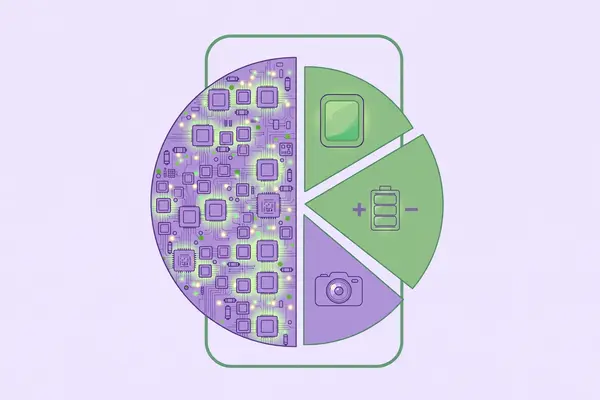
Memory is now nearly half the cost of the phone in your pocket.
Why It Matters
This matters because it shows the memory shortage is no longer just a datacenter story. When memory goes from 13% to 43% of a flagship phone's cost in less than two years, the phone in your pocket becomes a memory-price story too — and the makers have started passing the cost to you. A 30% rise in premium flagship prices is the consumer paying for the AI boom.
The read cuts both ways, and that is the point. It is pricing power for the three memory makers — Samsung, SK hynix and Micron make over 90% of the world's memory, and datacenters are buying most of it first — and it is demand destruction at the consumer edge. People who would have upgraded their phone this year are keeping the old one, which is why shipments fell 20% in the third quarter even as prices rose 20%.
The budget end is where the squeeze bites hardest. At 54% of a budget phone's parts cost, memory leaves almost no room for the screen, the battery, the processor or the maker's own margin — and budget buyers are the least able to pay more. That is the segment where a further price rise in the first-quarter contract round would do the most damage, and it is the segment the memory makers can least afford to lose.
Analyst's Take
Our call is Mixed. For the three memory makers this is pricing power in its purest form: when your product goes from 13% to 43% of a phone's cost and buyers still pay, you are in charge. But the other side of the same number is demand destruction at the consumer edge — the segment that has to absorb the cost — and third-quarter shipments already fell 20% year on year, the lowest third-quarter level in 14 years.
What to watch next is the first-quarter contract round, when Counterpoint expects mobile memory prices to rise sharply again after holding relatively steady in the fourth quarter. If phone makers cannot pass the next increase on, they will buy less memory — or build fewer phones — and that is the point where pricing power turns into lost volume. Watch Samsung's own phone pricing in India, where it has already raised prices twice around Diwali, as the live test.
The two Counterpoint cuts must not be confused: 43% is the flagship figure from the November 20 report, and 54% is the budget-phone figure from the November 12 finding. Both point the same way — memory is eating the phone — but they describe different phones, and the budget end, where buyers have the least room to absorb a price rise, is where the damage shows first. Reader poll: Will you pay 30% more for a flagship phone? Vote: Yes, need it, Wait for a deal, Keep my phone.
Are you bullish or bearish on this story?
By The Numbers
FAQ
What is a bill of materials?
A bill of materials, or BOM, is the list of every part that goes into a product and what each one costs. When memory is 43% of a phone's total cost, it means almost half of what it costs to build the phone is just the memory chips inside it.
What is a flagship phone?
A flagship is a maker's top-of-the-range phone — the most expensive model, with the best camera, screen and chips. Premium flagships are the priciest tier, and Counterpoint expects their prices to rise more than 30% by the end of 2026 versus 2025.
Why are memory prices rising so fast?
Memory makers are selling most of their output to AI datacenters, which pay more and buy in bulk. That leaves less supply for phones, laptops and cars, so the price of the memory left over has climbed — Counterpoint puts it at nearly six or seven times higher, in Intel CEO Lip-Bu Tan's words.
What is demand destruction?
Demand destruction is when prices rise so high that buyers stop buying. If a phone costs 30% more because of memory, some people keep their old phone instead — which is good for memory makers' prices in the short term and bad for their sales in the long term.
👁
Source: The Hindu BusinessLine