
Seoul readies a ₩10.76T stabilization fund — and Monday still falls 3.31%
South Korea's government held an emergency market review on Sunday and decided to begin preparations to activate a ₩10.76 trillion stabilization fund — but Monday still fell 3.31%, with Samsung down 3.06% to ₩177,500 and SK hynix down 2.52% to ₩1,085,000.
📊 Scorecard: our Bearish call on $000660.KS is scored from ₩1,085,000, the last close before it ran. Its first result comes after the next close.
The News
South Korea's government held an emergency market review — the F4 meeting — on Sunday, November 22, chaired by Deputy Prime Minister and Finance Minister Lee Hyoung-il with the Bank of Korea governor and both financial regulators, and decided to begin preparations to activate the Securities Market Stabilization Fund — ₩10.76 trillion, about $8.0 billion, pledged — so it can be deployed as soon as market conditions require. No deployment has been decided and no purchases have been announced, and the fund has not been tapped in the 18 years since ₩515 billion was injected in the 2008 crisis.
The same package eases the daily cap on listed companies' share-buyback orders for three months from November 24 and steps up surveillance of illegal short selling for three months. It did not hold the market: on Monday the KOSPI closed down 3.31% at 4,708.54 — its lowest close since January 13 — after falling as much as 5.81% during the session, to an intraday low of 4,586.80, with Samsung down 3.06% to ₩177,500, its third straight decline, and SK hynix down 2.52% to ₩1,085,000. The won weakened 9.7 won to 1,345.9 per dollar.
Finance Minister Lee said Monday the authorities had a contingency plan beyond the fund, though he was cautious about using it. The fund is small against the market it would defend: KOSPI market capitalisation is about ₩4,147 trillion, so the ₩10.76 trillion pledge is about 0.24% of it, down from about 1% when the fund was formed in 2020. Foreign investors sold a net ₩4.52 trillion of Korean equities in the week to November 20, per Aju Press — Samsung ₩1.79 trillion and SK hynix ₩940.1 billion of it.
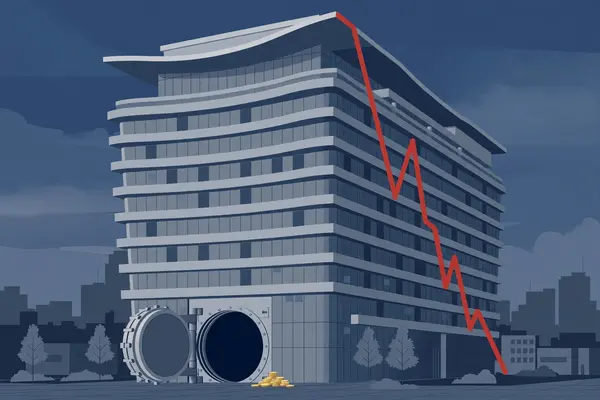
Seoul readied its biggest market weapon in 18 years — and the market fell anyway.
Why It Matters
This matters because the fund is Seoul's strongest signal that it thinks the selling has gone too far — and the market ignored it. A stabilization fund is supposed to work partly by existing: investors who know the government stands ready to buy are less likely to panic-sell. On Monday, that signal failed on day one, which raises the question of whether the government will have to spend real money to be believed.
The size is the problem. At about 0.27% of KOSPI market capitalisation — about ₩3,991 trillion at Friday's close — the ₩10.76 trillion pledge is roughly a quarter of the relative firepower the fund had when it was formed in 2020, when it was about 1% of the market. Against that, foreign investors sold a net ₩4.52 trillion of Korean shares in the week to November 20 alone — Samsung ₩1.79 trillion and SK hynix ₩940.1 billion of it. One bad week of foreign selling is nearly half the fund.
The package's other levers are slower. Easing the daily cap on share buybacks from November 24 gives companies three months to support their own shares, and stepping up surveillance of illegal short selling may deter some bearish bets — but neither puts a buyer in the market on Monday morning. The fund has not been tapped in 18 years, and the finance minister was cautious about using it even now, which leaves the market guessing whether the pledge is a promise or a bluff.
Analyst's Take
Our call is Bearish. A government that prepares its emergency fund on a Sunday and still watches its market fall 3.31% on Monday has a credibility problem, not a liquidity problem. The fund's size tells the story: ₩10.76 trillion is about 0.24% of the market it would defend, and foreign investors sold a net ₩4.52 trillion of Korean shares in a single week — nearly half the fund's entire pledge.
What to watch next is whether the fund is actually deployed, and what the Bank of Korea says at its meeting this week. The buyback easing starts November 24, so the first test of that lever comes Tuesday. Also watch the foreign flow: if overseas selling continues at last week's pace, no fund of this size can hold the line on its own.
The contrast with Taiwan is the uncomfortable part. Taiwan's short-selling curbs passed their first test on Monday — the Taiex rose 2.16% — while Seoul's fund preparation did not stop the KOSPI's slide. Different tools, different first days, and for now the market-mechanics measure is the one that worked. Reader poll: Will Seoul deploy the stabilization fund this week? Vote: Yes, soon, Only if it falls more, No.
Are you bullish or bearish on this story?
By The Numbers
FAQ
What is a stabilization fund?
It is a pool of money set aside to buy shares when a market falls sharply, to calm the selling. Seoul's Securities Market Stabilization Fund holds ₩10.76 trillion pledged for that purpose, but no deployment has been decided and no purchases have been announced.
What is a share buyback?
A buyback is when a company uses its own cash to buy its own shares back from the market. Fewer shares in circulation can support the price, and the buying itself adds demand. Seoul eased the daily cap on buyback orders for three months from November 24.
What is the KOSPI?
The KOSPI is South Korea's main stock market index, a single number that tracks the combined value of the country's biggest listed companies. Its close of 4,708.54 on Monday was its lowest since January 13.
What does 'foreign investors sold a net ₩4.52 trillion' mean?
It means overseas investors sold ₩4.52 trillion more Korean shares than they bought in the week to November 20. Net selling on that scale is a headwind for the market, because it means more shares are being offered than demanded.
👁
Source: Seoul Economic Daily