
SoftBank's Son shopped a $1 trillion SK hynix buyout, then shelved it
SoftBank chief Masayoshi Son sounded out Wall Street about financing a buyout of SK hynix that could have reached about $1 trillion — roughly nine times SoftBank's own market value — then shelved the idea before any formal offer. SK hynix says it has no knowledge of the matter.
The News
SoftBank Group chief executive Masayoshi Son recently approached Wall Street institutions about financing a possible trillion-dollar buyout of SK hynix, The Information reported on Friday, November 20, citing people familiar with the matter. The deal could have reached about $1 trillion — about ₩1,346 trillion, according to Reuters' account of the report — roughly nine times SoftBank's own market value of about $109 billion, and about 1.7 times SK hynix's Friday value.
It went nowhere. A SoftBank spokesperson told The Information the idea is "no longer under active consideration" — in the spokesperson's words, "SoftBank explores many opportunities, and this one is no longer under active consideration" — and SoftBank says Son is no longer considering such a deal. No formal offer was ever disclosed, and SK Group, which controls SK hynix, has given no indication it plans to sell.
SK hynix said in a statement it has no knowledge of the matter, and noted that any foreign acquisition would require prior Korean government approval. The episode matters for the memory read even as a non-deal: one of the three suppliers of high-bandwidth memory for AI accelerators was shopped at a trillion dollars, and the same weekend SK hynix moved to become Kioxia's top shareholder — consolidation talk is circling the sector even as the stocks fall. SK hynix closed Friday at ₩1,113,000, down 5.92%.
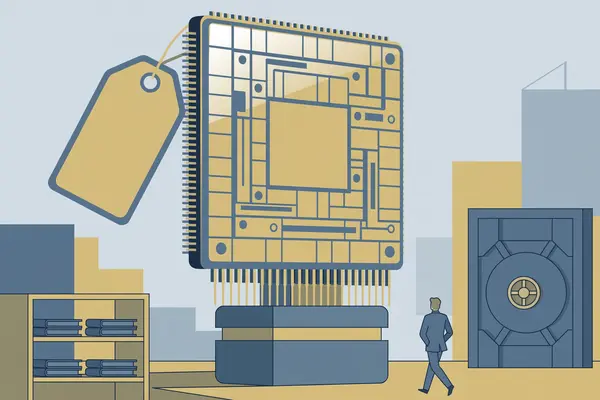
A trillion-dollar idea for the world's biggest AI-memory asset — tested, then shelved before it began.
Why It Matters
This matters because of what the number says about SK hynix, not because a deal happened. A trillion dollars is not a casual price — it is roughly nine times what SoftBank itself is worth, and about 1.7 times what SK hynix was worth on Friday. Somebody at the top of SoftBank thought the company's memory business, above all its high-bandwidth memory for AI chips, might be worth testing at that level. Even shelved, that is a signal about how the industry values AI memory.
The financing question is why it stayed an idea. Buying a company nine times your own size means borrowing enormous sums, and lenders have to believe the deal can be repaid from the target's earnings. Son only sounded out Wall Street — he asked whether the money could be raised — and the answer, whatever it was, did not turn into an offer. The spokesperson's line, that the idea is no longer under active consideration, is the closest thing to an official end.
The Korean government hurdle is the other wall. SK hynix makes some of the world's most advanced memory, and South Korea treats that technology as strategically important, so a foreign buyer would need prior government approval. SK hynix flagged that itself. Between the financing scale, the approval hurdle and a controlling shareholder that is not selling, the path to a deal was narrow from the start — which is why the story is best read as a valuation signal, not a missed takeover.
Analyst's Take
Our call is Mixed. On one side, the episode is a striking vote of confidence in what SK hynix owns: its position as one of the three suppliers of high-bandwidth memory, the expensive chips that feed AI systems, was worth testing at a trillion dollars — a price about 1.7 times the company's Friday value. That is the kind of number that says the asset is seen as strategically priceless. On the other side, there was no deal: no formal offer, no financing agreed, a spokesperson saying it is no longer under active consideration, and the target saying it has no knowledge of the matter.
The scale is also the reason it died. A $1 trillion buyout would be about nine times SoftBank's own market value, which means borrowing on a scale that would strain even the boldest buyer — and a foreign takeover of SK hynix would need prior Korean government approval, a hurdle SK hynix itself flagged. Add that SK Group has given no sign it wants to sell, and the idea looks less like a near-miss and more like a trial balloon that popped on contact with reality.
What to watch next is whether the idea resurfaces in a smaller form — a stake, a partnership, or another buyer — and what happens with SK hynix's Kioxia move, which closes in December. For now, the trillion-dollar number tells investors how valuable AI memory is seen to be, and the shelving tells them nobody is paying it today. Reader poll: Is SK hynix worth $1 trillion — yes or no? Vote: Yes, worth $1T, No, too rich, Too early to tell.
Are you bullish or bearish on this story?
By The Numbers
FAQ
What is a buyout?
A buyout is when a buyer purchases a whole company, usually paying shareholders a price per share, often with borrowed money. The buyer then owns and controls the company. No formal offer was ever made for SK hynix, so this was an idea being tested, not a deal.
What is market value?
Market value, also called market capitalisation, is the price of one share multiplied by the number of shares in existence. SoftBank is worth about $109 billion on that measure, so a $1 trillion purchase would be about nine times its own size.
What does sounding out financing mean?
It means asking banks and investors whether they would lend the money for a deal, before committing to it. Son approached Wall Street institutions about financing a possible SK hynix buyout — a first step that tests whether a deal is even fundable.
Why would a foreign buyer need Korean government approval?
South Korea treats advanced chip technology as strategically important, so a foreign takeover of a company like SK hynix would need prior approval from the Korean government. SK hynix itself flagged that hurdle in its response to the report.
👁
Source: Seoul Economic Daily