
DRAM spot: DDR5 firm near its highs, DDR4 down a fifth straight week; NAND gap over 20%
The spot market's weekly update keeps the split the pipeline has tracked all month: DDR5 is holding near its highs at $60.49, DDR4 is down a fifth straight week to $45.86, and the NAND spot-contract gap is over 20%.
The News
The spot market's weekly update, published November 23, keeps the split the pipeline has tracked all month: DDR5 is holding, DDR4 and NAND are sliding. DDR5 16Gb spot averaged $60.49 for the week, up 0.5% week on week and only 1.5% below its 42-week high, with DDR5 modules up 0.7% to $244.89. GDDR6, the graphics memory used in gaming and AI cards, averaged $12.54, up 0.2%.
DDR4 16Gb averaged $45.86, down 1.4% week on week — a fifth straight weekly decline, down 5.6% over four weeks and 12% below its high. TrendForce's November 18 spot update has the mainstream DDR4 1Gx8 chip at $44.25, down 1.43% on the week, with buyers on the sidelines despite suppliers offering lower prices. The older memory is not finding buyers even at a discount.
In NAND, weak demand has sellers cutting prices to clear inventory while spot buying stays subdued, leaving spot and contract prices more than 20% apart, TrendForce's November 18 spot update reports — a gap that constrains contract negotiations. Contract benchmarks remain stale: the latest SO-DIMM contract print is still September 30, 53 days old. The spot tape says the AI-memory shortage is a DRAM and high-bandwidth-memory story, not a NAND one — the same split behind KB's call for DRAM up 40% and NAND up 30% in 2027, published November 22, and TrendForce's NAND-bearish call, published November 20.
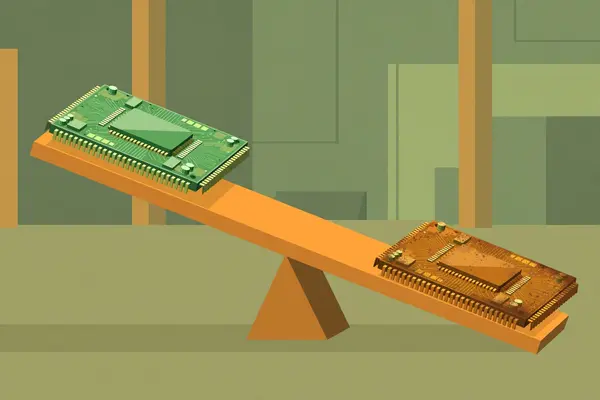
DDR5 holds near its highs while DDR4 slides — the memory split, in one week of spot prices.
Why It Matters
This matters because the spot market is the memory industry's fastest signal. Contract prices move slowly and are negotiated months ahead; spot prices move daily and show what buyers will actually pay right now. When DDR5 spot holds within 1.5% of its 42-week high, it says the AI-driven shortage in the newest memory is real. When DDR4 falls for a fifth straight week, it says the older market is still unwinding.
The NAND gap matters because it freezes the contract round. A gap of more than 20% between spot and contract prices means buyers and sellers disagree sharply on what the chips are worth, and neither side wants to sign the next deal at the other's price. With the latest contract print 53 days old, the industry is negotiating in the dark — and the longer the gap lasts, the harder the eventual settlement will be.
For the memory makers, the split is a warning against treating the sector as one trade. Samsung, SK hynix and Micron all sell both DRAM and NAND, but the profits sit in different places: DDR5 and high-bandwidth memory on one side, DDR4 and NAND on the other. SanDisk, the pure NAND name, is the most exposed to the weak side, which is why its Friday close of $79.24 on a split-adjusted basis deserves to be read against the NAND tape, not the DDR5 one.
Analyst's Take
Our call is Mixed. The spot tape is good news for the newest memory and bad news for the rest of it. DDR5 holding within 1.5% of its 42-week high says the AI-driven shortage is real where it counts, but DDR4's fifth straight weekly decline and NAND's gap of more than 20% between spot and contract prices say the older and storage markets are still sliding. One market, two directions.
What to watch next is the contract round. The latest SO-DIMM contract print is 53 days old, from September 30, and the NAND gap of more than 20% means buyers and sellers are far apart on what the next contracts should say. If contracts settle near spot prices, NAND makers take the hit; if they settle near the old contract levels, buyers keep paying more than the market thinks the chips are worth.
For investors, the split is the point. Micron is the US read-through here — it closed Friday at $594.51, down 13.89% — and SanDisk, the NAND name, is the most exposed to the weak side of the tape, closing Friday at $79.24 on a split-adjusted basis. The DRAM story and the NAND story have diverged, and the shares should be judged on the right half of the split. Reader poll: Is DDR5 the only strong memory market? Vote: Yes, DRAM only, NAND catches up, Both fade.
Are you bullish or bearish on this story?
By The Numbers
FAQ
What is the spot market?
The spot market is where memory chips are bought and sold for immediate delivery, at prices that change daily. Contract prices are set in longer deals between makers and big buyers, and they move more slowly — which is why the two can drift far apart.
What is DDR5 and DDR4?
DDR5 and DDR4 are generations of the memory inside computers. DDR5 is the newer, faster type used in new machines; DDR4 is the older type still in millions of existing PCs and servers. DDR5 prices are holding up while DDR4 keeps falling.
What is a spot-contract gap?
It is the difference between the spot price, for immediate delivery, and the contract price agreed in longer deals. A gap of more than 20% in NAND means buyers and sellers disagree sharply on what the chips are worth, which makes the next contract round hard to settle.
What is a 42-week high?
It is the highest price a product has reached in the last 42 weeks — about ten months. DDR5 spot is only 1.5% below that level, which means it has held almost all of its gains.
👁
Source: DDRWatcher