
Korea's chip exports hit a record $38.5B — and the shares fell anyway
South Korea exported a record $38.5 billion of semiconductors in the first 20 days of November, up 294.4% from a year earlier, the Korea Customs Service said Monday — yet SK hynix fell 2.52% to ₩1,085,000 and Samsung fell 3.06% to ₩177,500 as the KOSPI slid 3.31% to its lowest close since January 13.
The News
South Korea exported a record $38.5 billion of semiconductors in the first 20 days of November, up 294.4% from the same period a year earlier, the Korea Customs Service said on Monday, November 23 — the most for any 20-day period. Chips were 49.7% of everything the country shipped abroad, up from 25.4% a year earlier, and accounted for roughly three-quarters of the $39.0 billion rise in total exports, which reached $77.4 billion, up 101.5%. Computer peripherals, which include storage products, rose 330.6%. The agency's stated rise of 294.4% is used here; the reporting outlet's own chart table computes 292.9% from the chart data, and the agency figure governs.
By destination, shipments to China rose 145.6%, to the United States 142.7% and to Taiwan 149.7%. The same day, the shares fell again: SK hynix closed 2.52% lower at ₩1,085,000 and Samsung Electronics 3.06% lower at ₩177,500, Yonhap reported, and the KOSPI fell 3.31% to 4,708.54, its lowest close since January 13. There was no new US session — American markets were closed for the weekend — so Micron's latest close is still Friday's $594.51, down 13.89%, though Micron rose about 5% in overnight trading on Monday as Nasdaq futures climbed about 3%.
The divergence is the story. Twenty-day chip exports have risen 51% since June, while SK hynix is about 63% below its June peak close of roughly ₩2.92 million on June 22 and Samsung about 51% below its June 18 peak of ₩362,500. The export figures count shipments at prices agreed earlier; share prices are a bet on profits years ahead. The data do not settle whether today's record shipments are demand strength or a peak before new capacity lands. Seoul also readied a ₩10.76 trillion market stabilization fund over the weekend — covered in a separate story today — but it did not stop Monday's slide, and no deployment has been decided.
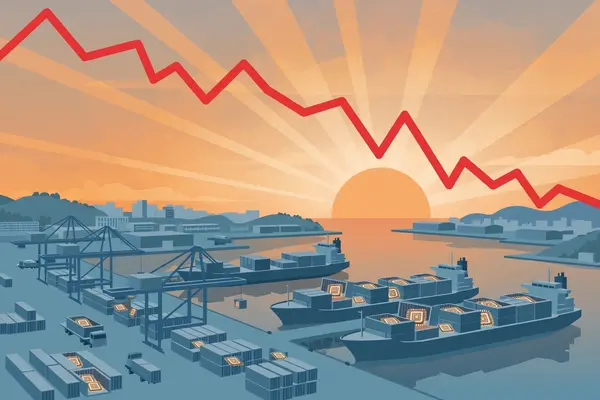
Record exports, falling shares — Seoul's chip boom and its stock market are telling two different stories.
Why It Matters
This matters because chips are now half of what Korea sells to the world. At 49.7% of total exports, semiconductors are no longer one industry among many — they are the economy's engine, and the country's trade surplus, its currency and its stock market all ride on them. When chip exports rise 294.4% and the market still falls 3.31%, something deeper than a bad day is going on.
The gap between exports and shares is really a gap between the past and the future. Export figures count goods shipped at prices agreed weeks or months earlier, when memory was at its scarcest and most expensive. Share prices are a bet on the profits of the next few years, and right now investors are betting that new memory capacity coming online will push prices down and profits with them. Both numbers can be right at once: the shipments happened, and the future may still be worse.
For memory investors, the read runs through all three makers. Micron is the US read-through here — it fell 13.89% on Friday to $594.51, and its overnight bounce of about 5% on Monday is only a hint, not a session. The counterweight to the gloom is Citi's worst-case maths, covered in a separate story today, and the open question of whether Seoul's stabilization fund gets deployed. Until one side of that argument wins, the divergence between the export data and the share prices is the market's central fact.
Analyst's Take
Our call is Mixed. A record $38.5 billion of exports in 20 days is genuinely strong demand on paper, and the shares falling anyway is genuinely weak sentiment on the tape. Both facts are true at the same time, and neither settles the question that matters: whether today's shipments are the peak of the memory boom or the middle of it.
What to watch next is whether Seoul deploys the stabilization fund it prepared over the weekend, what the Bank of Korea says at its meeting this week, and whether Taiwan's short-selling curbs keep working — the Taiex rose 2.16% on Monday, the mirror image of Seoul's slide. On the company side, Micron reports fiscal first-quarter results on Thursday, December 17, the next hard numbers in the memory story.
For now, the market is pricing a future in which memory prices fall hard enough to shrink the profits behind today's record shipments. The counterweight is Citi's worst-case maths, covered in a separate story today: even a complete halt to Nvidia-linked financing would cut DRAM demand by only about 12% and NAND by about 7%. If Citi is right, the tape has overshot the fundamentals — but the tape has been wrong before, in both directions. Reader poll: Are Korean chip shares a buy after the record exports? Vote: Buy the dip, Wait and see, Stay away.
Are you bullish or bearish on this story?
By The Numbers
FAQ
What does a 294.4% rise mean?
It means exports were nearly four times as large as in the same 20 days last year. A 100% rise would double the figure; 294.4% means the new figure is the old one plus almost three times the old one again.
What is the KOSPI?
The KOSPI is South Korea's main stock market index, a single number that tracks the combined value of the country's biggest listed companies. When it falls 3.31%, the market as a whole has lost about that much value in a day.
Why would shares fall when exports hit a record?
Exports count shipments at prices agreed earlier, so they describe the recent past. Share prices are a bet on profits years ahead, so they describe what investors expect next. The two can point in opposite directions when investors think today's boom will not last.
What is a stabilization fund?
It is a pool of government-backed money set aside to buy shares when a market falls sharply, to calm the selling. Seoul has prepared its ₩10.76 trillion fund for use but has not decided to deploy it, and has not announced any purchases.
👁
Source: TECHi