
Waymo resumes Bay Area service after storm pause; freeway ban stays
Waymo's robotaxis are back on Bay Area streets after Wednesday's storm pause, but the ban on driverless freeway driving stays in place, with no date for its return.
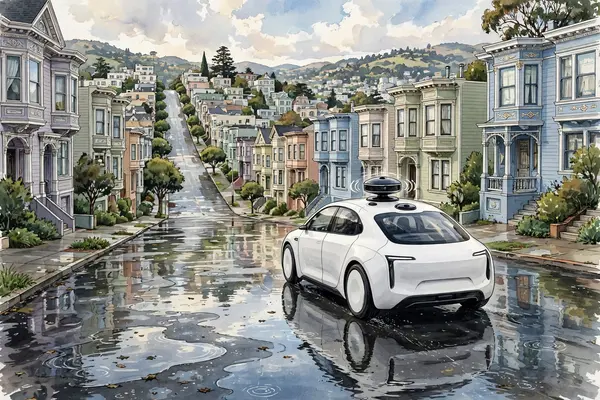
The News
Waymo announced on Thursday, November 19, that its cars are back on the roads in the San Francisco Bay Area, resuming ride-hailing service after pausing it across the region on Wednesday, November 18, amid heavy rain and flooding. The storm pause is over, but more storms are forecast for the region. Yesterday's post covered the Wednesday suspension; this is the genuinely new Thursday resumption.
The resumption comes with a limit that has not moved. The separate California DMV restriction on driverless freeway operations — imposed after three Waymo vehicles entered a US 101 construction closure on November 5 and another encountered a California Highway Patrol traffic break on I-280 on November 6 — remains in force, with no date given for a return to freeway service. Waymo has also voluntarily paused commercial driverless freeway trips in its other markets while it evaluates performance.
City-street service continues, and Waymo says it provides more than half a million rides per week. For Bay Area riders, that means the cars are back where they were before the storm — on surface streets, not on the freeway.
The cars are back on city streets, but the freeway question — the one that decides how far robotaxis can really go — is still unanswered.
Why It Matters
A quick resumption matters because it shows Waymo can stop and restart a whole region's service safely. Pausing for a storm is the right call — a driverless car stalled in a flooded intersection helps nobody — and getting back on the road the next day, before the next storm arrives, shows the operation is run with discipline. Riders can trust a service that stops when it should and returns when it can.
The freeway ban matters more, because freeways are where a robotaxi service grows up. City streets are slow and short; freeways are how a car gets across a metro area quickly, and how a service reaches airports and suburbs. The ban followed two incidents in two days — three cars entering a construction closure on US 101, then another meeting a highway patrol traffic break on I-280 — and the regulator has given no date for lifting it. Until that changes, Waymo's Bay Area service has a hard limit.
The voluntary pause elsewhere matters because Waymo chose it. Nobody ordered the company to stop freeway trips in its other markets; it did so while it evaluates performance. That is the cautious move, and it may be the right one, but it also means the freeway question is now a company-wide issue, not a California-only one. A service restart is worth a Mixed call: the storm is over, the restriction is not.
Analyst's Take
Our call is Mixed. The resumption is good news for riders and for Waymo's reliability story — a one-day pause for a storm, then back on the road, is exactly how a mature service should handle bad weather. But the freeway ban is the bigger issue, and it has not moved: no date, no timetable, and a voluntary pause in other markets on top of the California restriction. A robotaxi that cannot use the freeway is a service with a ceiling on it.
The two halves of this story pull in opposite directions, which is why the verdict is Mixed rather than Bullish. On city streets, Waymo is running at scale — more than half a million rides a week — and it handled a storm shutdown cleanly. On freeways, it is stuck, after two separate incidents in two days in early November, and it has chosen to pause freeway trips elsewhere too while it checks its performance. That caution is responsible, but it is also a delay to the wider service Waymo wants to offer.
What to watch next is the weather and the regulator. More storms are forecast for the Bay Area, so the resumed service will be tested again quickly. And the freeway question now sits with the DMV: until it sets a date for a return, Waymo's growth in its home market stays on surface streets. Reader poll: Will $GOOGL Waymo return to Bay Area freeways this year? Vote: Back to normal, Freeway ban matters, Wait for storms.
Are you bullish or bearish on this story?
By The Numbers
FAQ
What is a robotaxi?
A robotaxi is a taxi with no human driver. Sensors and software steer the car, pick up passengers and drop them off, and a rider books the trip through an app instead of hailing a cab.
What is the DMV?
The DMV is the California Department of Motor Vehicles, the state agency that licences drivers and regulates vehicles. It also sets the rules for driverless cars, including where they may and may not drive without a human at the wheel.
What is a traffic break?
A traffic break is when highway patrol officers slow or stop traffic on a freeway, usually to clear an accident or let emergency vehicles through. A driverless car has to recognise the officers' signals and stop safely.
What is a construction closure?
A construction closure is a stretch of road shut to traffic while roadworks are under way, marked with cones, barriers and signs. Waymo's cars entered one on US 101 on November 5, which led to the freeway restriction.
👁
Source: Local News Matters / San Francisco Post