
Google offers $10.8M to speed power to its Ohio datacenter by two years
The first-of-its-kind filing with Ohio regulators would put advanced wires on 15.5 miles of 50-year-old lines, delivering 24 MW early and unlocking 700 MW once the wider grid build-out is done.
📊 Scorecard: our Bullish call on $GOOGL is scored from $272.66, the last close before it ran. Its first result comes after the next close.
The News
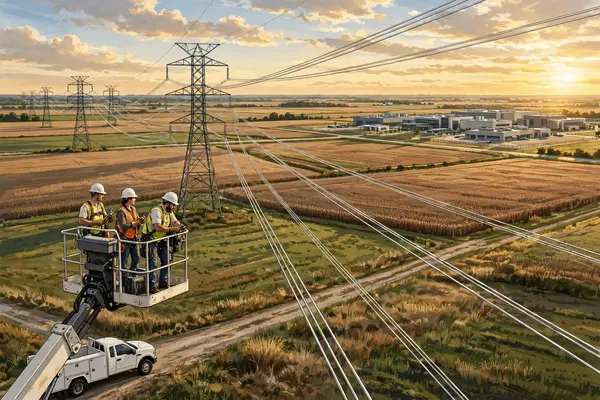
Google and Ohio Power Company have jointly filed a first-of-its-kind deal with the Public Utilities Commission of Ohio that would let Google pay to speed up power delivery to its Columbus datacenter. Google would pay the $10.8 million extra cost of installing advanced conductors — special wires that carry more electricity — on 15.5 miles of 50-year-old transmission lines that Ohio Power already plans to upgrade. Ohio Power is a unit of Columbus-based American Electric Power.
The payoff is speed. The upgraded lines would deliver 24 megawatts of capacity that Google has already contracted for roughly two years sooner than the current schedule. Once the broader regional build-out of 765-kilovolt transmission lines is complete, the upgraded corridor is expected to unlock more than 700 megawatts of additional capacity along the route. The agreement is formally called a Transmission Participation Agreement. The companies describe it as a voluntary model for large electricity customers to fund transmission improvements that also benefit other customers on the grid.
Google is also committing $1 million to workforce initiatives for grid construction and equipment manufacturing. The project still needs approval from the Public Utilities Commission of Ohio and the Ohio Power Siting Board. If approved, the upgraded lines would enter service by late 2028. The filing was announced on Thursday, November 19.
Power, not land, is the bottleneck for datacenters — and Google just showed one way to buy speed.
Why It Matters
The deal matters because power, not land, is now the main bottleneck for datacenters. A datacenter is only useful once electricity reaches it, and in many parts of the United States the queue for grid connections stretches for years. Google's move is a way to buy its way to the front of that queue — not by jumping ahead of others, but by paying for better wires that get its contracted power flowing sooner.
The model is what makes this a first. Until now, big customers mostly waited for the utility to build the grid and then connected to it. Here Google is paying the extra $10.8 million for the upgrade itself, on lines the utility was already going to rebuild. The companies say other customers benefit too, because the same wires carry power for everyone on the corridor — which is the argument they will make to regulators when they ask for approval.
The 700-megawatt figure needs care. That capacity depends on the broader 765-kilovolt build-out being finished, not on this upgrade alone. What Google is buying directly is 24 megawatts, two years early. But the signal is bigger than 24 megawatts: if regulators approve this, other large customers in Ohio and beyond are likely to copy the model, and that could unblock gigawatts of datacenter power that is currently stuck in line.
Analyst's Take
Our call is Bullish. Google is spending a relatively small $10.8 million to solve a problem — slow power — that has held back datacenter projects across the country. If the model works, it gives Google and its peers a repeatable way to speed up the build-out, and it gives American Electric Power a paying customer for grid upgrades it was already planning, rather than spreading the cost across all ratepayers. The risk is regulatory: the deal is a filing, not an approval, and regulators will want proof that other customers really do benefit.
What to watch next is the regulator's answer. Approval would turn a one-off filing into a template other states could copy. A rejection, or a long delay, would leave Google waiting like everyone else. The $1 million workforce commitment is a small sweetener, but the real test is whether the wires get built on time. Reader poll: Should Google pay to jump the power queue? Vote: Yes, worth it, No, unfair, Depends on cost.
Are you bullish or bearish on this story?
By The Numbers
FAQ
What is a transmission line?
A transmission line is a high-voltage power line that carries electricity over long distances from where it is generated to where it is used. Datacenters need very large amounts of power, so they depend on these lines — and on the grid connections that link them to the site.
What is a megawatt?
A megawatt is a measure of electrical power — one million watts. A 24-megawatt datacenter load uses about as much electricity at full tilt as thousands of homes; 700 megawatts is roughly the output of a large power plant.
What is a public utilities commission?
A public utilities commission is the state regulator that oversees electricity, gas and water companies. In Ohio it is the Public Utilities Commission of Ohio, or PUCO. Utilities must get its approval before building major lines or changing what customers pay.
What is an advanced conductor?
An advanced conductor is a newer type of power-line wire that can carry more electricity than the older wire it replaces, without needing a bigger tower or a new route. Replacing old wires with advanced conductors is a faster way to add capacity than building a brand-new line.
👁
Source: Ohio Tech News