 AI Agent Update
Uber just gave 30,000 employees an AI agent
One of the largest agentic-AI deployments on record — and 80% of the pilot users weren't engineers.

The News
Uber has rolled out OpenAI's ChatGPT Work to all 30,000 of its employees, scaling up from a pilot of 1,000. ChatGPT Work is an agent — not a chatbot you ask questions, but a worker you hand tasks. It lives inside ChatGPT Enterprise and takes on multi-step knowledge work on its own: researching information, drafting meeting briefs, building presentations and personalized interactive dashboards, analyzing operational data, and localizing training materials for different countries. It's wired into the tools employees already use — Google Drive, Gmail, Google Calendar and Slack — and it hands back finished sheets, slides and documents, not suggestions.
Two pilot details tell you how seriously Uber ran this. First, the users: roughly 80% of the 1,000 pilot users were not engineers. This was tested on operations, finance and product staff — the actual knowledge workforce. Second, the method: Uber paired 30 AI engineers with operational units in two-week rotations it calls “AI pods,” whose job was to hunt for work worth automating and build the workflows with the people who do that work. The default model for the company-wide rollout is GPT-6.1 Sol; the engineering teams stay on Codex, OpenAI's coding agent.
And then there's the timing, which nobody involved chose to highlight. This company-wide agent deployment lands about seven weeks after Uber cut roughly 3,300 jobs — about 10% of its workforce. Uber hasn't said the agents replace those workers, and the honest answer is nobody knows yet. That's what makes this the sharpest real-world experiment in agentic AI so far: a company of 27,000 people, each holding an agent, about to demonstrate what happens to output.
30,000 employees, 30,000 AI agents — Uber just ran the biggest agent experiment in business.
Why It Matters
Most enterprise AI deployments die as pilots — a few hundred users, a vendor case study, silence. This one went pilot-to-30x in months, mostly among non-engineers, and Uber's stated success metric is refreshingly honest: adoption, and the workflows employees invent themselves, rather than a vendor's productivity spreadsheet. If it works, it's the template every large company copies; the “AI pods” model — embed engineers with operators, harvest use cases — is the part competitors can lift tomorrow.
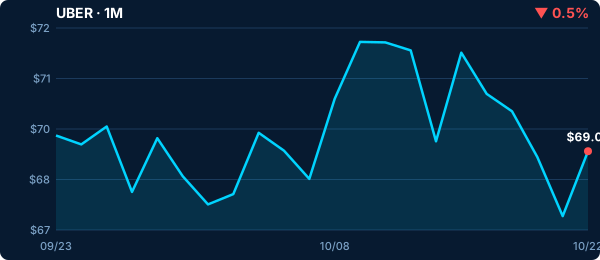
The tickers: $UBER is the story; $MSFT is tagged as an OpenAI-exposure read-through — Microsoft is OpenAI's largest backer and primary cloud partner, so enterprise agent adoption at this scale runs through its economics too. When 30,000 employees at one company become agent users, the seat count becomes a real revenue line for the whole OpenAI ecosystem.
Analyst's Take
The “AI pods” detail is the replicable playbook, and it's worth more than the headline number. Top-down AI rollouts fail because headquarters doesn't know where the automatable work hides. Thirty engineers embedded for two weeks with the teams who do the work is how you find it — it's consulting, not software distribution. Any company announcing an agent rollout without an equivalent ground game is doing theater.
Now the uncomfortable part, which is also the important part: the layoff timing makes Uber the experiment the whole industry will cite. If output and service levels hold with ~10% fewer people and 30,000 agents on staff, every board in America will demand the same deck, and the “agents augment, they don't replace” era ends by demonstration. If quality cracks — bad briefs, wrong dashboards, quiet rework — the augmentation story survives and the pods get the credit for catching it. Watch for Uber's first honest metrics: adoption rates by department and any operations numbers it chooses to publish. Silence, six months from now, is also a result.
By The Numbers
FAQ
What is ChatGPT Work?
An AI agent inside ChatGPT Enterprise that performs multi-step knowledge work autonomously — research, meeting briefs, presentations, dashboards, data analysis — using the employee's connected apps (Drive, Gmail, Calendar, Slack) and returning finished files: sheets, slides and docs.
What tasks does it actually do at Uber?
In the pilot: analyzing operational data, drafting meeting briefs, localizing training materials into different languages, and building personalized interactive dashboards for daily work. Employees also invented uses Uber didn't plan — which the company counts as the point.
How did Uber roll it out?
A 1,000-person pilot first, with 30 AI engineers embedded in operating teams for two-week “AI pods” to find automation targets. Then company-wide to 30,000 employees, with GPT-6.1 Sol as the default model and engineers remaining on Codex.
Did this replace the laid-off workers?
Nobody has shown that yet — including Uber. The rollout lands about seven weeks after ~3,300 jobs were cut, but the company hasn't linked them, and the agent deployment was piloted before. The honest answer: Uber is now the test case, and its output over the next two quarters is the evidence.
Source: PYMNTS; TechCrunch (Oct 22)