 AI Agent Update
OpenAI's $30B raise just took a $150B haircut — and it's still the biggest private valuation in history
Investors balked at $1.4T. The cut tells you where the market's real ceiling is.

The News
Start with the cut, because the cut is the news. OpenAI told investors on Thursday that it aims to secure signatures by the end of next week on what it calls an “opportunistic” bridge round — a shorter, faster fundraising meant to carry the company to its next big step — of up to $30 billion. The price: a $1.25 trillion valuation before the new money goes in. The round is led by Coatue and investors from the United Arab Emirates, and a parallel deal locks in extra computing capacity for OpenAI in the UAE.
The Financial Times reported the part OpenAI did not lead with: that $1.25 trillion is a cut. Earlier in October, OpenAI pitched investors at $1.4 trillion, and investors pushed back. The result is a markdown of roughly $150 billion between the pitch deck and the term sheet. In plain terms: the seller asked for a price, the buyers said no, and the price came down — the first time that has visibly happened to a frontier AI lab at this scale.
Context matters, though. Even at the reduced price, $1.25 trillion-plus would make OpenAI the most valuable private company in history. The round sits ahead of a likely 2027 IPO — an initial public offering, the first time a company sells shares to the general public on a stock exchange. OpenAI is raising privately now, at a negotiated price, because the public market window — see Thursday's chip rout — is currently charging a lot more for AI risk than it was a month ago.
A $150B haircut on the pitch deck — and $30B still clears.
Why It Matters
This is the first hard price signal on frontier-lab equity in the funding-scare era. Until now, private AI valuations only moved in one direction, set in rooms where saying yes was the default. A 10%-plus markdown negotiated in the open tells every investor in every AI deal where the market's real ceiling currently sits — and it gives Anthropic, SpaceX's xAI and every other private lab a fresh comparison point for their own raises.
It also frames the 2027 IPO question. A public offering needs public investors to pay at least the last private price. If the private price is already being negotiated down in a risk-off tape, the IPO bar gets higher, not lower — which is exactly why OpenAI would rather sign this bridge now, at a known price, than test the public market in this weather.
Analyst's Take
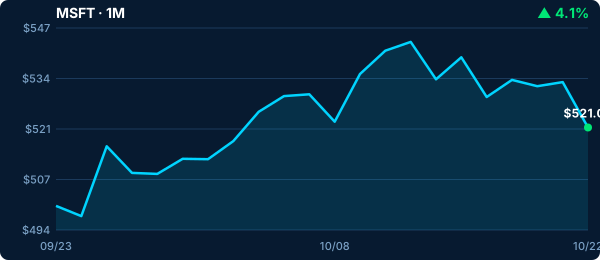
A quick note on the tickers: OpenAI is a private company — you cannot buy its stock. $MSFT, $NVDA and $ORCL are read-throughs: Microsoft as OpenAI's largest backer and primary cloud partner, Nvidia as the chip supplier its spending flows to, and Oracle as a compute partner. They move on OpenAI news because OpenAI's fortunes run through their income statements, not because they are OpenAI.
Now the take: the cut is the healthy part. Price discovery — buyers and sellers actually arguing about what something is worth — is what functioning markets do, and its absence is what bubbles look like. The same week public AI names were sold indiscriminately, $30 billion of private money still cleared at $1.25 trillion. Capital formation is intact; the price of capital is what changed. Watch whether the 2027 IPO talk survives if Thursday's tape becomes a trend — a bridge round buys time, and time is only valuable if the window reopens.
By The Numbers
FAQ
What is a bridge round?
A shorter fundraising a company does to carry itself to a bigger event — here, a likely 2027 IPO. Instead of a full priced round with a long process, OpenAI is raising up to $30B quickly, at a negotiated valuation, to fund operations and compute until the public listing.
Why did investors push back on $1.4 trillion?
The market's mood changed. With public AI stocks selling off over funding concerns, investors demanded a discount for the risk that a 2027 IPO might price below the private mark. The $1.25T result is the compromise: still a record, but with the froth negotiated out.
Who is leading the round?
Coatue, the technology investment firm, and investors from the United Arab Emirates. A parallel agreement also secures additional UAE computing capacity for OpenAI, tying the money to the buildout it funds.
What does this mean for a 2027 IPO?
It sets the bar. Public investors will be asked to pay at least $1.25 trillion. If AI markets recover, that's achievable for the largest private company in history. If the funding scare deepens, the IPO may slip — which is precisely the risk the bridge round is designed to wait out.
Source: TechCrunch (Oct 22); FT reporting