 AI Agent Update
SK hynix killed its $15B Solidigm IPO — and Seoul cheered
Regulators said no, shareholders said no, and the stock jumped 4.4%.

The News
SK hynix filed before the market opened on Friday, October 23, and the filing was a full stop: the company is halting both the pre-IPO funding round and the planned Nasdaq listing of Solidigm. An IPO — initial public offering — is when a company sells shares to the public for the first time. Solidigm is SK hynix's US memory subsidiary, which makes NAND flash and SSD storage drives; it is the business SK hynix bought from Intel for roughly $9 billion. The listing, led by Goldman Sachs and Morgan Stanley, was expected to raise about $3.8 billion before the IPO and up to roughly $15 billion in total.
Two forces killed it. First, Korea's Financial Supervisory Service said the dual listing — the same business effectively trading in two places, inside SK hynix in Seoul and separately on Nasdaq — conflicted with Korea's duplicate-listing rules, which exist to protect shareholders of the parent company. Second, those shareholders made their own feelings clear: they objected that a separate Solidigm listing would dilute their claim on the business and price it at a discount to what it's worth inside SK hynix. When both the regulator and the owners say no, the deal is over.
And then the punchline: SK hynix stock closed up 4.4% at ₩1,277,000, leading the KOSPI's recovery on the day. Investors were not mourning the lost funding. They were celebrating the dilution that will now not happen. Context for next week: SK hynix reports third-quarter results on October 28, with its HBM4 shipments — the newest high-bandwidth memory for AI chips — reportedly running short of expectations.
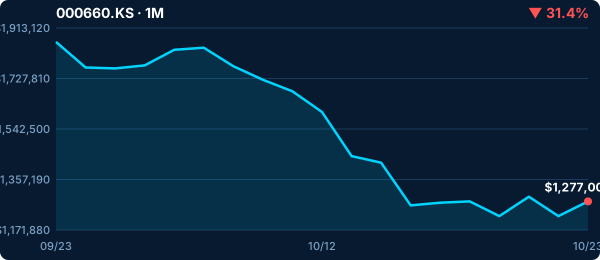
SK hynix canceled a $15B IPO and the stock went up — dilution avoided beats cash raised.
Why It Matters
The strategic cost is real, even if the stock disagrees. Solidigm's IPO was the easiest external funding lever SK hynix had for the NAND and HBM spending race — money raised from new investors rather than from its own cash. That lever is now closed. The factories still need building, so the spending now comes off SK hynix's own balance sheet, competing directly with dividends, buybacks and the HBM expansion for the same cash.
The precedent may matter beyond one company. Korea's regulators have now effectively said that spinning a major subsidiary into a second listing will face a shareholder-protection fight. Every Korean tech group with a valuable subsidiary and a US listing in mind just watched its roadmap get more complicated.
Analyst's Take
A note on the ticker: SK hynix trades in Seoul; $SKHY is the line tracked here for US readers. The market's read of this news is clear and, in the short term, probably right: dilution avoided beats cash raised. Shareholders kept 100% of Solidigm's upside instead of selling a slice of it cheaply in a hostile market — listing a NAND business into a memory selloff would have priced it at the bottom of the cycle.
But separate the two clocks. On the funding clock, this is a loss: the capex race just got more expensive to run, and it now runs through SK hynix's own cash generation. On the precedent clock, it's bigger than SK hynix — Korean spin-listings just got harder for everyone. The Oct 28 print is now an execution test, not just a demand story: with no IPO cushion, HBM4 execution is the whole argument. Watch whether management addresses how the buildout gets funded now.
By The Numbers
FAQ
What is Solidigm?
SK hynix's US subsidiary making NAND flash memory and SSD storage drives. SK hynix created it after acquiring Intel's NAND business for about $9 billion. It was to be listed separately on Nasdaq before SK hynix halted the plan on Oct 23.
Why did regulators block it?
Korea's Financial Supervisory Service said the dual listing conflicted with Korea's duplicate-listing shareholder-protection rules. Shareholders also objected: a separate listing could dilute their stake and value Solidigm at a discount to its worth inside SK hynix.
What does this mean for SK hynix's spending plans?
The factories still get built, but the money now comes from SK hynix's own balance sheet instead of new public investors. That makes cash generation — starting with the Oct 28 earnings — carry more weight.
Is the NAND business still growing?
Solidigm's business wasn't the problem — AI datacenters keep buying storage, and SK hynix stressed the halt was about market conditions and shareholder interests, not Solidigm's prospects. The question is funding the expansion, not finding demand.
Source: Korea JoongAng Daily; AJU Press (Oct 23)