
TSMC reportedly wants cash up front from some AI chip clients
TSMC is reportedly setting credit limits for AI chip customers based on balance sheets and payment history, with orders above the limit payable in cash, amid concerns about circular financing in AI.
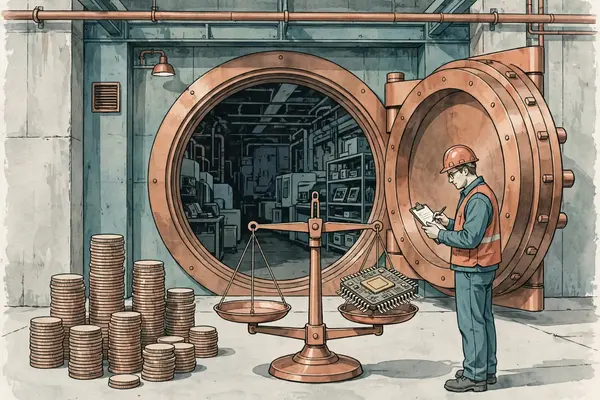
The News
TSMC is reportedly setting credit limits for AI chip customers based on their balance sheets, payment history and default risk, with orders above the limit payable in cash and some customers required to prepay to secure capacity. TSMC has not announced the policy, and the originating outlet, Kuai Keji, said it could not confirm it independently — this story reports it as reported throughout.
The change mainly affects custom AI chip makers, several of which are raising debt and equity at the same time to fund wafer working capital — the cash needed to pay for chips while they are being made — a sign that cash, not demand, is the constraint. Alchip raised $510 million in June via global depositary shares listed in Luxembourg, with the proceeds earmarked for growth and advanced-technology development — an example of the funding pressure on custom-chip makers, not a response to this reported policy. The reports link the shift to concerns about circular financing in AI: companies investing in each other and then buying from each other.
Directionally, the reports match what chair C.C. Wei said on TSMC's October 15 earnings call: capacity planning now factors in customers' financing, power supply and component readiness, with TSMC teams sent to verify US data-center build-outs. TSMC's board also approved $40.93 billion of capital appropriations on November 10 — a board authorisation for capacity, packaging, fabs and 2027 R&D, not 2026 capital spending. Customer advance payments already stood at around NT$234 billion at the end of June 2026.
The world's biggest chipmaker is reportedly checking its customers' wallets before it checks their orders.
Why It Matters
A credit limit is simple: it is the most a supplier will let you owe. TSMC builds chips first and gets paid later, so every order is a loan until the customer pays. If a customer is well funded, the limit is generous; if it is stretched, the limit is small and the rest must be paid in cash. Prepayment to secure capacity is the same idea — pay first, then the factory runs.
Circular financing is the worry behind the reports. Imagine company A invests in company B, and B uses the money to buy chips from a company A also owns — the same cash is counted as investment, revenue and demand at different stops. It looks like growth, but no new customer is actually buying anything. Suppliers that spot the pattern start asking for cash, because cash cannot be circled.
For TSMC, this is risk management, not a slowdown signal. Customer advances of NT$234.23 billion already show that big customers prepay routinely. TSMC's teams are now sent to verify US data-center build-outs in person — a supplier checking that its customers' projects are real before it commits factory time. The question is which smaller, custom-chip customers can keep up — and whether the ones raising debt and equity to pay for wafers are funding real demand or a circle.
Analyst's Take
Our call is Mixed. Tighter credit is good discipline and bad news at the same time. If TSMC is rationing capacity toward the best-funded customers, the strongest chipmakers get their wafers and the weakest get squeezed — which is healthy for the industry and painful for the companies on the wrong side of the line.
The circular-financing worry is the real story here. If some AI demand is companies buying from each other with money they raised from each other, then the order book looks bigger than the real end demand. If the reports are right, the weakest-funded custom chipmakers face a choice: raise cash, or lose capacity to better-funded rivals. A supplier that checks balance sheets before taking orders is protecting itself against the day the circle breaks.
The caveat is that the policy is unconfirmed — TSMC has not announced it, and the originating outlets could not verify it independently. What is confirmed is the direction: Wei said on October 15 that financing is now part of capacity planning, and NT$234.23 billion in customer advances shows prepayment is already normal at TSMC. Reader poll: Bullish or bearish on $TSM? Vote: Bullish, Bearish, Mixed.
Are you bullish or bearish on this story?
By The Numbers
FAQ
What is a credit limit?
A credit limit is the most a supplier will let a customer owe before demanding payment — like the limit on a credit card. TSMC reportedly sets each AI chip customer's limit from its balance sheet, payment history and risk of default, and orders above it must be paid in cash.
What is circular financing?
Circular financing is when companies invest in each other and then buy from each other, so the same money goes around in a circle and looks like new business at every stop. It worries suppliers because the demand can vanish if any one company in the circle runs out of cash.
What is a GDR?
A GDR, or Global Depositary Receipt, is a way for a company to raise money from international investors by selling shares listed abroad. Alchip raised $510 million in June 2026 through global depositary shares (GDS) listed in Luxembourg, with the proceeds earmarked for growth and advanced-technology development.
👁
Source: InvestingLive