
Chip stocks split Tuesday, then rallied after hours on Nvidia's beat
Arm rose 4.76% and Broadcom 2.46% in Tuesday's session while TSMC's ADR fell 3.68%, then the whole group jumped after hours — AMD up 3.5% and Intel up 2.2% — after Nvidia's results.
The News
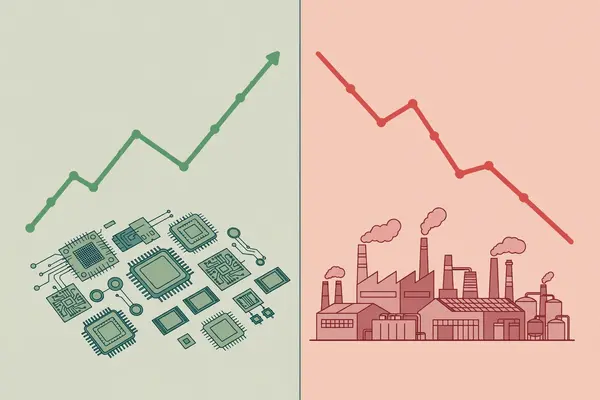
Tuesday's regular session split the chip sector. Designers rose — Arm surged 4.76% to $183.39 and Broadcom gained 2.46% to $341.60 — while manufacturers fell: TSMC's ADR dropped 3.68% to $359.69, Micron fell 0.92% to $712.42 and Intel slipped 0.54% to $55.17. AMD — a fabless designer, not a manufacturer — edged down 0.17% to $503.41, with the PHLX Semiconductor Index up 0.34% to 9,642.88.
After Nvidia's beat, the whole group rallied in after-hours trade: Nvidia up as much as 5%, AMD up 3.5%, Intel up 2.2%, Arm up 5.5%, Broadcom up 2.8%, Super Micro up 5.2%, and neoclouds CoreWeave up 7% and Nebius up 9%. SanDisk and Micron also rose in after-hours trade. The same stocks that fell or lagged in the session jumped together once the results landed.
In Wednesday Asia trade the lift faded unevenly: Taiwan-listed TSMC gave back its early gain to close 0.23% higher, and Kioxia faded from 6.1% higher at the open to close just 0.74% higher at ¥8,025, even as Seoul rallied. Seoul's rally showed the same news can lift one market while leaving another flat. After-hours moves are thin-volume first reactions, not a verdict — and Wednesday's Asian session showed how quickly the first reaction can cool.
Tuesday's session split the chip sector in two. After hours, Nvidia's beat glued it back together — for one night.
Why It Matters
The split happened because chip companies do different jobs. Arm and Broadcom design chips and license their designs — they earn money from ideas, with high margins and no factories to run. TSMC manufactures chips for others, so it carries the cost of building and running fabs. When investors worry about spending, they punish the factory first and reward the designer.
After-hours trading is a different market from the daytime one. Far fewer shares change hands, so a burst of buying moves prices more than the same orders would at noon. Neoclouds like CoreWeave and Nebius — companies that rent out AI computing power — moved the most after hours, up 7% and 9%, because their business depends directly on Nvidia's chips staying in demand. That is why a 5% after-hours jump is a signal, not a settlement — it shows the direction of the first reaction, but the regular session, with full volume, decides whether it sticks.
The Asian fade is the cautionary half of the story. Seoul rallied hard on the same news, but Taiwan's TSMC slipped and Kioxia gave back nearly all of its opening gain. The region that makes the chips was less convinced than the region that buys the memory — a split worth watching when the US market reopens.
Analyst's Take
Our call is Mixed. The session told one story and the evening told another, and both were real. Designers like Arm and Broadcom rose on their own strength while manufacturers like TSMC fell on margin and demand worries — then Nvidia's numbers lifted everyone at once. A sector that moves together on one earnings report is a sector priced on one theme: AI spending.
The after-hours rally deserves a discount. After-hours trading runs on thin volume, so small orders move prices further than they would in the regular session, and the first reaction is often the most enthusiastic one. Wednesday's Asian fade — TSMC closing just 0.23% higher in Taiwan, Kioxia giving back almost all of its open — is the market's second thought.
What matters now is whether the regular session confirms the after-hours move. If Arm, AMD and Intel hold their gains into Wednesday's US close, the rally is real. If they drift back, Tuesday's split was the truer read. The PHLX index's 0.34% Tuesday rise is the session's scoreboard — a flat day despite the split underneath; Wednesday's US close will say whether the after-hours rally rewrote it. Reader poll: Bullish or bearish on AMD? Vote: Bullish, Bearish, Mixed.
Are you bullish or bearish on this story?
By The Numbers
FAQ
What is after-hours trading?
After-hours trading is buying and selling that happens once the main stock market has closed, usually in smaller volumes. Prices can move sharply because fewer traders are active — a big after-hours jump is a first reaction, not a settled verdict.
What is the PHLX Semiconductor Index?
The PHLX Semiconductor Index, often called the SOX, tracks the biggest US-listed chip companies in one number. When it rises just 0.34%, as it did on Tuesday, the chip sector as a whole had a flat day, even if a few individual stocks rose sharply.
What is an ADR?
An ADR, or American Depositary Receipt, is a way for a foreign company's shares to trade on a US exchange. TSMC's ADR is the US-traded version of the Taiwanese chipmaker's shares, priced in dollars.
👁
Source: Finwire