 AI Agent Update
Tenstorrent raises $1.5B at $6.2B to take the RISC-V fight to Nvidia
Jim Keller's Tenstorrent just raised $1.5 billion at a $6.2 billion valuation — more than double its December 2024 mark — with a cap table full of public-market crossover money. After reported Qualcomm takeover talks at $8–10B produced no deal, this raise is the independence play.
The News
Tenstorrent raised $1.5 billion in a Series E round at a $6.2 billion post-money valuation, according to Reuters — more than doubling the roughly $2.6 billion valuation of its December 2024 round, which raised over $693 million led by Samsung Securities and AFW Partners.
The round was led by Trace Capital and Innovation X, with participation from ARK Invest, Fidelity Management & Research, Morgan Stanley, T. Rowe Price, SanDisk, Tether Investments, Cadence Ventures and Protagonist. That is a cap table that reads like a who's-who of crossover investors who usually arrive just before an IPO.
Led by Jim Keller — the chip architect behind landmark designs at Apple, AMD and Tesla — Tenstorrent builds AI chips and software on RISC-V, the open-source instruction set that carries no licensing toll to Arm or x86 incumbents. The new funds will scale production of its Galaxy servers, each packing 32 Blackhole processors.
The context that makes this raise interesting: in June, The Information reported Qualcomm was in talks to acquire Tenstorrent for $8–10 billion. No deal was ever announced. Raising $1.5 billion at $6.2 billion — below the reported Qualcomm range — is the company choosing the harder road: independence over exit.
Tenstorrent just turned down the Qualcomm ending and chose the harder one: building the open alternative to Nvidia in public.
Why It Matters
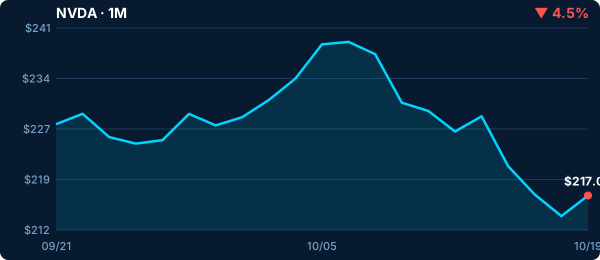
Every credible Nvidia challenger that reaches production scale tightens the long-term pricing umbrella over $NVDA's accelerators and gives hyperscalers a second source to negotiate with. Tenstorrent's bet is structural: RISC-V's open foundation means no architecture licensing tax and a software stack it controls end to end — the anti-CUDA play, funded like it means it.
For $AMD, a stronger independent Tenstorrent cuts both ways: it validates the market for non-Nvidia accelerators that AMD also sells into, but it also adds a well-funded rival for the same second-source slot in hyperscaler racks.
Analyst's Take
The tell in this round is the investor list. ARK, Fidelity, Morgan Stanley and T. Rowe Price do not write $1.5 billion checks into science projects — they write them into pre-IPO positions. Tenstorrent turned down the Qualcomm ending (reportedly at a higher number) because its backers think the public market will pay more for the only scaled, independent, open-architecture AI chip company than a strategic acquirer will.
The risk is execution, not demand: Galaxy systems have to ship in volume and the software stack has to be good enough that leaving CUDA doesn't hurt. Watch for a named hyperscaler deployment — that is the milestone that converts this valuation from story to franchise.
By The Numbers
FAQ
What is Tenstorrent?
An AI chip company led by legendary chip architect Jim Keller. It designs AI processors and servers — its Galaxy systems each pack 32 Blackhole processors — and builds its software stack on RISC-V, the open-source chip architecture.
What is RISC-V and why does it matter?
RISC-V is an open-source instruction-set architecture: anyone can build chips on it without paying licensing fees to Arm or Intel. For Tenstorrent, it means full control of its hardware-software stack and no architecture tax — a structural cost advantage in its fight with Nvidia.
Did Qualcomm try to buy Tenstorrent?
The Information reported in June that Qualcomm was in talks to acquire Tenstorrent for $8–10 billion. No deal was announced, and this $1.5B raise at a $6.2B valuation signals the company chose independence over a sale.
Who invested in Tenstorrent's Series E?
Trace Capital and Innovation X led the $1.5B round, joined by ARK Invest, Fidelity Management & Research, Morgan Stanley, T. Rowe Price, SanDisk, Tether Investments, Cadence Ventures and Protagonist.
Source: Reuters via TechStartups