 AI Agent Update
Supermicro's new rack packs 256 Nvidia Vera CPUs for the agent era
22,500 concurrent agent sandboxes in one liquid-cooled rack.

The News
Supermicro announced on Thursday, October 22, a new rack-scale system — an entire cabinet of computing, sold as one unit — built around 256 of Nvidia's Vera CPUs, and cooled entirely by liquid rather than air. The spec sheet reads like a category being invented in real time: 22,528 processor cores, 45,056 threads, up to 400 terabytes of memory, and the claim that matters — up to 22,500 concurrent agent sandboxes running in a single rack. It includes Nvidia's BlueField-4 chips for networking and security, and Nvidia's Open Agent Safety Platform.
A sandbox, in plain terms, is a sealed playpen for an AI agent: an isolated mini-computer where the agent can run code, use tools and make mistakes without touching anything real. Agents need sandboxes the way websites need servers — thousands of them, all at once, whenever users show up. GPUs do the thinking for agents, but the sandboxes themselves mostly run on regular CPUs. Until now, that CPU capacity was an afterthought bolted onto GPU orders. Supermicro just made it the product.
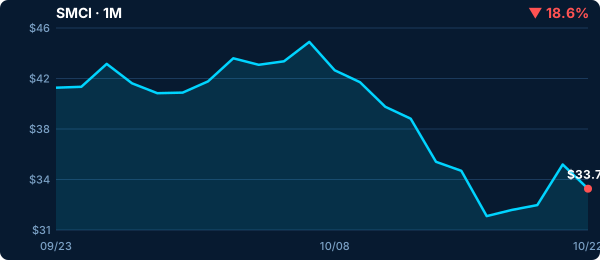
And the product announcement isn't even the week's biggest Supermicro news. Earlier in the week the company raised its preliminary fiscal-Q1 revenue guidance to $18.5–19.5 billion, from $14.5–15.5 billion — a roughly $4 billion upward revision before the quarter is even reported. Companies raise guidance like that when orders are arriving faster than the old forecast assumed.
One rack, 22,500 AI agents. The agent era needs new plumbing.
Why It Matters
The agent era changes what datacenters buy. Training a model is a GPU problem. Running millions of agents — each executing code, calling tools, checking its own work in a sandbox — is a CPU-throughput problem at a scale nobody budgeted for two years ago. A rack that hosts 22,500 sandboxes turns that problem into a line item with a price, which is how new product categories start.
For $NVDA, every Vera CPU rack is also a Vera Rubin ecosystem sale — CPUs, BlueField networking and safety software from the same vendor, sold as a unit. For $SMCI, the rack plus the guidance raise says agentic infrastructure isn't a roadmap slide; it's converting into purchase orders now.
Analyst's Take
The guidance raise is doing more work than the spec sheet, and investors should weight it that way. Specs are marketing until someone pays; an $18.5–19.5B guide — raised by roughly $4 billion in one step — is customers paying. Supermicro is telling you, in the only language that settles arguments, that agentic-AI infrastructure demand is ahead of its own plan. In a week when the market sold everything AI on financing fear, a four-billion-dollar guide raise is a demand datapoint with a dollar sign on it.
The real question is supply, not demand: can the Vera CPU supply chain actually feed this box at volume? Nvidia's newest CPU platform, liquid-cooling components, and 400TB of memory per rack are all choke-point ingredients in a week when a competitor (Lam Research) just showed what supply constraints do to a stock. Watch Supermicro's actual reported quarter for conversion — if the Vera rack ships on schedule alongside that raised guide, the “agent infrastructure” category has its first proven revenue line.
By The Numbers
FAQ
What is the Nvidia Vera CPU?
Nvidia's data-center CPU — the general-purpose processor in its Vera Rubin platform, designed to work alongside its GPUs. Where GPUs do the heavy AI math, Vera CPUs run everything around it: coordinating work, running tools, and hosting the sandboxes agents live in.
What is an agent sandbox?
An isolated, disposable mini-computer where an AI agent can safely execute code and use tools. If the agent breaks something, only the sandbox dies. Running agents for real users means running thousands of sandboxes at once — which is the market this rack is built for.
Why liquid cooling?
Dense racks generate more heat than fans can remove. Liquid cooling carries heat away far more efficiently, letting 256 CPUs live in one cabinet. At this density, it's not an upgrade — it's the only way the box works.
What did Supermicro guide?
Earlier in the week it raised preliminary fiscal-Q1 revenue guidance to $18.5–19.5 billion, up from $14.5–15.5 billion. A raise that size, before results are even reported, signals orders running well ahead of the company's earlier plan.
Source: Supermicro company release via PR Newswire (Oct 22)