
Samsung to reportedly build SpaceX Starlink satellite chips at its Austin, Texas fab in a $1.9B expansion
Samsung will reportedly make the chip that lets Starlink satellites talk to each other with lasers, building it in Texas instead of France — a $1.9B bet on American chipmaking.
📊 Scorecard: our Bullish call on $005930.KS is scored from ₩196,800, the last close before it ran. Its first result comes after the next close.
The News
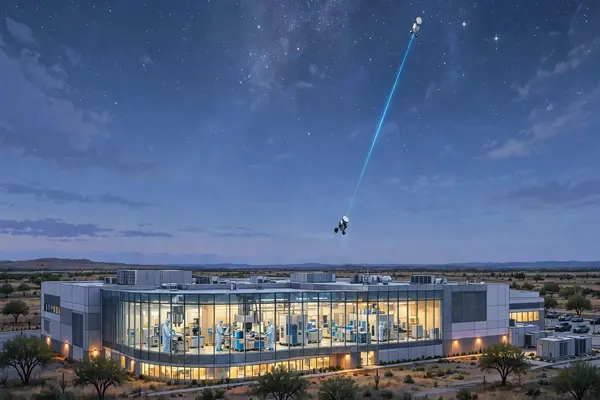
Samsung will make a key chip for SpaceX's Starlink satellites at its factory in Austin, Texas. The chip, called the STM32V8, is a small controller — think of it as the traffic cop inside the satellite — that runs the laser links Starlink satellites use to talk to each other in space. Samsung built the chip together with STMicroelectronics, using an 18-nanometer manufacturing process known as FD-SOI. Some of that production will move from STMicroelectronics' plant in Crolles, France, to Samsung's Austin site.
The move comes with a $1.9 billion investment — about 2.7 trillion won — to expand the Austin plant. That spending sits inside Samsung's much larger Texas commitment of roughly $37 billion, which is backed by up to $4.745 billion in subsidies from the CHIPS Act, the U.S. law that pays chipmakers to build factories on American soil. Samsung is targeting 2030 for the expanded plant's operational capacity, so this is a long-term build, not a quick win.
One important caveat: Samsung declined to officially confirm contracts with individual customers, so the SpaceX link is reported rather than confirmed by Samsung itself. Investors did not cheer the news on the day. Samsung shares closed Monday at 196,800 won, down 4.47%, while STMicroelectronics shares closed Friday at $46.73, up 0.58%. The wider market was weak, and a single contract report was not enough to lift Samsung's stock.
Samsung declined to officially confirm contracts with individual customers.
Why It Matters
Laser links matter because they let Starlink satellites pass data to each other directly in orbit, instead of bouncing every signal down to a ground station and back up again. That makes the network faster and harder to interrupt, which matters for a service that now carries internet traffic for millions of people and for customers such as airlines and ships far from land. The chip at the centre of that system is small, but it is the part that keeps the lasers lined up and the data flowing.
The manufacturing detail matters too. FD-SOI is a chipmaking method that uses very little power, and power is precious on a satellite, where every watt comes from solar panels and batteries. Building this chip on an 18-nanometer FD-SOI process is a sign that Samsung's foundry — its business of making chips designed by other companies — can handle specialised, high-reliability work, not just the memory chips Samsung is famous for.
For the market, the story is also about where chips get made. The CHIPS Act is Washington's bet that the United States should build more of its most important chips at home, and Samsung's $37 billion Texas commitment is one of the biggest pieces of that bet. A SpaceX order, even an unconfirmed one, would put a high-profile American customer on Samsung's Texas production line and help justify the billions being spent there.
Analyst's Take
Our call is Bullish. A Starlink chip order would be exactly the kind of marquee customer Samsung's foundry business needs to prove it can compete with TSMC for advanced work, and the Texas expansion gives it the capacity to deliver. The $1.9 billion investment is real money going into real buildings, and the CHIPS Act subsidies lower the risk of that spending. If the Austin line wins more orders like this one, Samsung's foundry story changes from promise to pipeline.
The risks are honest ones. Samsung has not confirmed the contract, so investors are working from a report, not a company announcement. The 2030 target for operational capacity is years away, and chip demand can swing sharply in that time. Samsung's own shares fell 4.47% on Monday, a reminder that one good headline does not move a stock when the broader market is selling.
Still, the direction of travel is right: American chipmaking is getting funded, Samsung is building where the customers are, and a laser-link chip for the world's biggest satellite network is a serious vote of confidence in its factories. We would rather own the foundry story early than chase it after the contracts are confirmed. Reader poll: Will Samsung's Texas fabs win more big US customers? Vote: Yes, more coming / No, TSMC keeps lead / Too early to tell.
Are you bullish or bearish on this story?
By The Numbers
FAQ
What is the STM32V8 chip?
It is a microcontroller — a small controller chip — that runs the laser links Starlink satellites use to communicate with each other in space. Samsung co-developed it with STMicroelectronics on an 18nm FD-SOI process.
Why is Samsung building it in Texas?
Samsung is investing $1.9B to expand its Austin fab, part of a roughly $37B Texas commitment backed by up to $4.745B in CHIPS Act subsidies. Building in the US puts production close to American customers.
Has Samsung confirmed the SpaceX contract?
No. Samsung declined to officially confirm contracts with individual customers, so the SpaceX link is reported rather than confirmed by Samsung itself.
👁
Source: Seoul Economic Daily