
DRAM spot prices slide for a fourth straight week as tracker calls a market correction
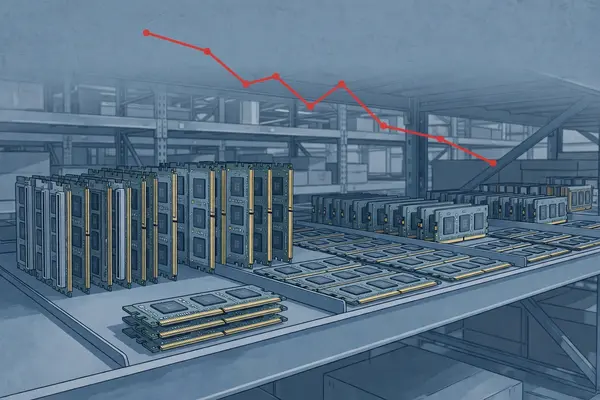
DDR4 spot prices fell 2.7% for a fourth straight week and DDR5 slipped 1.4%, as the DDRWatcher tracker shifted its market reading to Correction — while PC DRAM contract prices chipmakers actually charge big customers are still rising 13–18% this quarter.
The News
Memory chip prices on the open market — the 'spot' market, where buyers and sellers trade chips for immediate delivery — fell again last week. DDRWatcher, a tracker that follows DRAM prices, says DDR4 chips averaged $46.51, down 2.7% from the week before, the fourth weekly drop in a row. DDR5 chips averaged $60.21, down 1.4%, while GDDR6, the memory used in graphics cards, was broadly flat at $12.51, up 0.3% on the week. The tracker has shifted its reading of the market from 'Transition' to 'Correction' — its word for a market that is cooling rather than just pausing — though it flags low confidence in that call, because prices for finished memory modules are still firm and no new contract reset has appeared.
The contrast is the story. While spot prices slide, the prices chipmakers actually charge big customers under longer-term contracts are still rising. TrendForce's November 11 update still has fourth-quarter PC DRAM contract prices up 13–18%, and its November 12 spot analysis also showed chip prices extending their declines as buyers wait for lower prices. (Source: TrendForce, November 11–12, 2026.) Spot weakness is now a four-week trend, but it is not yet a contract reversal: DDR5 chip spot prices are still up 13.0% over the past 12 weeks and sit just 2.0% below their recent high, and DDR5 memory modules averaged $243.22, up 0.6% on the week.
Memory stocks fell with the news on Friday. Micron closed at $778.31, down 2.52%; SanDisk closed at $885.01, down 5.59% — that price is before its 8-for-1 stock split, with split-adjusted trading starting November 20, so the share price will look about eight times lower after that date even though the company's value does not change. SK hynix closed in Seoul at ₩1,216,000, down 3.03%, and Samsung at ₩206,000, down 0.96%. Western Digital, which also sells memory-related storage, closed at $295.65, down 5.00%.
Spot prices are cooling while contract prices still rise — the memory market is sending two different signals at once.
Why It Matters
Spot prices are the memory market's early warning system. Contract prices are set in negotiations that run for months, so they move slowly; spot prices move every day, and they show what buyers are willing to pay right now. Four straight weekly declines say buyers think chips will get cheaper, so they are waiting — and that waiting itself pushes prices down further. The shift to a 'Correction' reading is the tracker's way of saying the slide is now a trend, not a blip.
But a spot correction is not the same as a contract reversal, and that gap is what investors are weighing. Contract prices are still rising 13–18% this quarter, which means chipmakers are still collecting more money per chip from their biggest customers. DDR5 spot is still up 13% over 12 weeks, and finished modules are still getting more expensive. If buyers come back, spot prices can turn quickly. If the wait-and-see drags on, contract negotiations for next quarter will feel the pressure.
The stocks already reflect the worry. Micron, SanDisk, SK hynix and Samsung all fell Friday, and the memory names are also carrying a second overhang: Bloomberg reports the US Commerce Department is preparing export-permit rules for Southeast Asia that could crimp the Nvidia chip demand that drives high-bandwidth memory orders (see our Megaspeed story today). The next real test comes Monday, when Seoul reopens, and on Tuesday, when Nvidia reports — its outlook will say a lot about how much memory the AI buildout still needs.
Analyst's Take
Our call is Mixed. The spot market is clearly cooling — four weeks of declines and a regime change to Correction is a real signal, not noise. But the contract market, which is where the money is actually made, is still rising, and DDR5 is still up sharply over 12 weeks. That split is exactly why the verdict is mixed: the direction of spot prices is bad for the memory makers, and the direction of contract prices is good, and neither has won yet.
What to watch: whether spot declines slow or deepen this week, whether module prices stay firm, and what Nvidia says about demand on Tuesday. If spot stabilises, the correction may stay a footnote. If buyers keep waiting, the next contract round is where the pain would show up.
Reader poll: are you bullish or bearish on memory stocks? Vote: Bullish, Bearish, or Mixed.
Are you bullish or bearish on this story?
By The Numbers
FAQ
What is the difference between spot and contract prices?
Spot prices are what buyers pay for chips delivered right away, and they move daily. Contract prices are set in longer-term deals with big customers and change only when contracts are renegotiated, usually each quarter. Spot prices often move first, so traders watch them as an early signal.
What does a 'Correction' regime mean?
It is DDRWatcher's label for a market that is cooling — prices falling for several weeks — rather than just pausing between rises. The tracker flags low confidence in the call because finished memory modules are still getting more expensive and no fresh contract reset has appeared.
Why is SanDisk's share price about to change?
SanDisk is doing an 8-for-1 stock split. Shareholders of record on November 9 get seven extra shares for each one they own after the close on November 19, and split-adjusted trading starts November 20. The price per share will fall to roughly one-eighth of its current level, but each shareholder owns eight times as many shares, so the total value does not change.
👁
Source: DDRWatcher