 AI Agent Update
Samsung and SK Hynix are upgrading their China fabs to fight YMTC — stocks jump 6%
286-layer NAND at Xi'an, 240+ layers at Dalian, Washington's quiet blessing. The incumbents aren't ceding China — they're re-arming in it.
The News
Reuters reported exclusively on Oct 21 that Samsung and SK Hynix are upgrading their big Chinese memory plants rather than winding them down. Samsung's Xi'an plant — which makes roughly 40% of the company's global NAND output (NAND is the storage memory in phones, SSDs and AI servers) — is converting to its newest 286-layer V9 NAND under an internal project codenamed 'Monami.' The conversion starts at 5,000 wafers a month by December 2026 and ramps to 40,000 a month by December 2027.
SK Hynix is doing the same at its Dalian fab, moving production from 192-layer NAND to 240+ layers, and may seek US approval to run 300-layer research and development there as well. More layers means more storage stacked into the same chip area — it is how NAND makers cut cost per gigabyte and stay ahead.
Both companies stress the upgrades comply with US export rules and add no new production capacity — they are making better chips, not more chips. The political signal matters as much as the engineering: Washington's stance on equipment licences for Korean-owned fabs in China is visibly softening, which is what makes the upgrades possible at all. Seoul noticed: Samsung closed up 5.67% at ₩223,500 and SK Hynix up 5.81% at ₩1,294,000.
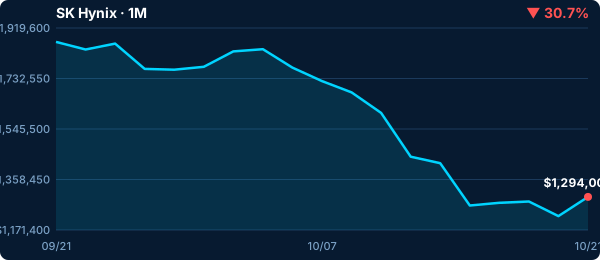
Samsung and SK Hynix aren't retreating from China — they're re-arming inside it, and Washington just quietly held the door.
Why It Matters
The upgrades are aimed squarely at YMTC, China's homegrown NAND champion, which has been climbing the layer counts from inside China while the Korean giants' China plants were frozen on older technology by export rules. If Xi'an and Dalian can run near-frontier NAND, the incumbents defend their China market share and their cost curve at the same time — instead of slowly handing both to YMTC.
For the wider memory complex, the most important phrase in the story is 'no new capacity.' Upgrades that improve cost without adding supply are the best kind of news for prices: the incumbents get more competitive while the industry's total output stays disciplined. That is a friendly setup for every NAND maker, including the US-listed names.
Analyst's Take
A quick note on the tickers: Samsung trades in Seoul and SK Hynix is tracked here through its SKHY line; the US-listed names on this story — SanDisk ($SNDK), Western Digital ($WDC) and Micron ($MU) — are read-throughs. They win if NAND pricing stays firm and the China fight stays a technology race instead of a price war, which is exactly what 'upgrades, no new capacity' delivers.
What the market may be underpricing is the policy shift. For years the working assumption was that Korean fabs in China were stranded assets, slowly obsolescing under export controls. If Washington is now willing to license near-frontier production there, those plants get revalued from write-downs waiting to happen into going concerns. Watch whether the 300-layer R&D approval for Dalian actually lands — that is the tell that the thaw is real and durable, not a one-off.
By The Numbers
FAQ
What is NAND, and why do layers matter?
NAND is flash storage memory — the kind that keeps data when power is off, used in SSDs, phones and AI servers. Makers stack memory cells in layers; more layers means more storage in the same space and a lower cost per gigabyte, which is the main battleground in NAND competition.
Who is YMTC and why does it matter?
Yangtze Memory Technologies is China's state-backed NAND maker. It has been gaining technology ground inside China while export controls kept Samsung's and SK Hynix's Chinese plants on older designs — these upgrades are the incumbents' answer.
Why do Korean companies need US approval for plants in China?
The chipmaking equipment in those plants contains US technology, so Washington's export rules govern what can be installed and run there. A softer US stance on licences is what makes the Xi'an and Dalian upgrades possible.
Does this mean more memory supply is coming?
No — both companies say the upgrades add no new capacity. They replace older production with better chips at the same volume, which supports prices rather than pressuring them.
Source: Reuters via TipRanks