 AI Agent Update
Nvidia is prepaying its suppliers like there's no tomorrow — $279B says there isn't
Six manufacturing partners just got cash up front — substrates, packaging, testing, optics — because Jensen Huang's supply chain is now the bottleneck, not demand.
The News
At its GTC Berlin event, Nvidia announced a set of prepayment agreements with six manufacturing partners — deals where Nvidia hands over cash now so suppliers can build the capacity Nvidia will need later. The partners cover the unglamorous back-end steps that turn a finished chip design into a shippable product: the layered boards chips sit on (called substrates), the packaging that bonds chips to memory, the testing that checks every unit, and the optical parts that move data between machines.
The named deals: Japan's IBIDEN gets a multibillion-dollar advance to triple output at its Ono plant by the first quarter of 2028. Samsung Electro-Mechanics joins the substrate chain, and Unimicron expands as substrate capacity heads toward 2.5 times today's level over three years. Amkor signed a $1.3 billion agreement to grow advanced packaging capacity — measured in interposer wafers, the silicon bridges that connect a GPU to its memory — by more than 300% by the end of 2028. KYEC gets a $1.1 billion advance to reserve testing capacity at new facilities in the United States, with high-volume production targeted for April 2027, as Nvidia's total testing capacity doubles from 2026 to 2027. And SPIL is targeting 15 times today's optical-engine capacity by mid-2027, for co-packaged optics — the technology that swaps copper wires for light inside AI systems.
The scale of the commitment is the context: in its most recent reported quarter, Nvidia's supply and capacity commitments — money it has promised to spend securing memory and manufacturing — stood at $279 billion, up from $119 billion just one quarter earlier. Berlin also brought DSX POD — modular Vera Rubin AI factories that cut deployment from six months to as little as 14 days — and the OpenShell Reference Architecture for running AI agents safely, developed with Anthropic, AWS, Google Cloud, Meta, Microsoft, OpenAI and others. “Demand is extraordinary. Capacity is the constraint,” said CEO Jensen Huang.
Nvidia's AI demand is so extra it's Venmo-ing suppliers $279B before they even build the thing.
Why It Matters
Companies do not prepay suppliers out of generosity. This is the strongest signal yet of how sure Nvidia is about demand: it is using its own balance sheet to finance its suppliers' factories, because waiting for those suppliers to raise and spend the money themselves would take too long. The $279 billion commitment figure — up 134% in a single quarter — is the standing counter-argument to every “AI bubble” claim: the buyer with the clearest view of AI demand on Earth just doubled its supply bets.
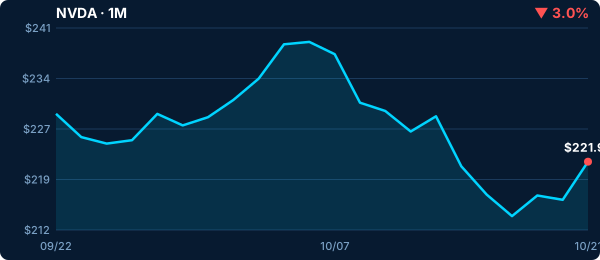
For $NVDA, the risk profile changes, though. Prepaying converts a flexible shopping list into a fixed promise. If AI demand ever stumbles in 2027 or 2028, some of those commitments become money spent on capacity nobody needs — which is exactly the bear case, and exactly why the size of the number matters.
Analyst's Take
Bears will say $279 billion of commitments is exposure, not conviction — and that is a fair point worth making. But compare the two balance-sheet stories of this earnings season. Meta is issuing a new class of its own stock to fund itself. Nvidia is prepaying, not borrowing — using cash it already has to fund its suppliers. One company is asking the market for money; the other is so sure of its order book that it is lending its suppliers the money to keep up. Those are not the same risk.
The risk that actually matters here is timelines, not demand — the 2027 and 2028 capacity ramps slipping. And read the quiet part of the announcement: KYEC building testing plants in the US, and Amkor's expansion, say that bringing the back-end of the chip supply chain onshore is no longer a government policy hope. It is Nvidia's own project now, paid for with Nvidia's own cash.
By The Numbers
FAQ
Why is Nvidia prepaying suppliers instead of just buying chips?
Because the factories do not exist yet. Substrates, packaging, testing and optics are the bottleneck steps between a chip design and a shipped AI system. Paying in advance gives suppliers the cash and the certainty to build plants now, and gives Nvidia first claim on the capacity when it opens.
What is interposer capacity and why does it matter?
An interposer is a thin silicon bridge that sits between a GPU and its high-bandwidth memory, connecting thousands of tiny wires. AI chips cannot be assembled without them, so interposer wafer capacity — Amkor's is set to grow more than 300% by end-2028 — caps how many high-end AI chips can ship.
What are the $279B commitments exactly?
Promises Nvidia has made to secure future supply — mostly memory purchases and manufacturing capacity — disclosed in its quarterly filings. The figure jumped from $119B to $279B in one quarter, which is why Berlin's prepayments read as one visible piece of a much larger lock-up of the supply chain.
What happens if demand slows?
That is the bear case: prepayments and commitments are spent or owed regardless. Nvidia would be left holding reserved capacity it cannot fill and advances it may not fully recover. The exposure is real either way.
Source: Nvidia company release via Tech Times