
Seven Nova Scotia rallies demand a moratorium on EverWind's Anthropic data centre
On Saturday, November 7, rallies in seven Nova Scotia communities demanded a moratorium on large-scale AI data-centre proposals, targeting EverWind Fuels' Point Tupper campus — a $10 billion project where Anthropic has signed a 20-year lease. The province says the project proceeds only if it meets guidelines on water, environment, power rates and capacity.
The News
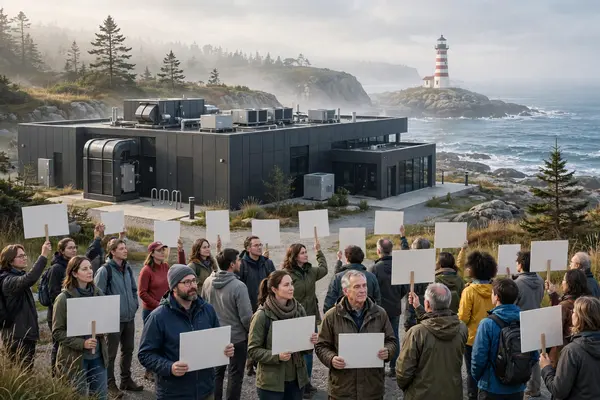
On Saturday, November 7, rallies in seven Nova Scotia communities — Halifax, Kentville, Port Hawkesbury, Truro, Bridgewater, Westville and Sydney — demanded a moratorium on large-scale AI data-centre proposals. The target was EverWind Fuels' Point Tupper campus: a $10 billion project whose first phase is 95 megawatts, coming online in 2027, with a 325-megawatt expansion planned for mid-2028. Anthropic, the AI company behind Claude, has signed a 20-year lease for the 18,600-square-metre facility. Halifax drew the largest crowd, described as hundreds to nearly 1,000 people; there is no official count, and no total across the seven rallies has been confirmed.
The protesters cite water and power — the two resources a datacenter consumes at industrial scale — and the same concerns that drove the US midterm results, where voters backed datacenter limits in 40 of 41 ballot measures. EverWind says the campus will draw from the provincial grid until its approved onshore wind farms are built, but construction on those wind farms has not started. Premier Tim Houston's office said the project proceeds only if it meets provincial and federal guidelines on water, the environment, power rates and capacity — a conditional green light, not an unconditional one.
The Nova Scotia rallies are part of a wider pattern this week. On Friday, November 6, protesters broke into Microsoft's Amsterdam datacenter construction site and 150–200 people were detained. Core Scientific's quarterly filing, made on November 5, added a new risk factor on datacenter moratoriums and organised opposition. The backlash is no longer a local planning dispute: it is a disclosed business risk, a ballot-box result and a street protest in the same week, and it is now aimed squarely at the biggest names in AI.
Our government has been clear that a data centre can only proceed if they can meet and exceed provincial and federal guidelines, which include protecting water, the environment, and power rates and capacity.
Why It Matters
A protest in seven towns is not a planning decision, but it is a signal about where the politics of AI infrastructure is going. The datacenter backlash has moved in a week from ballot measures in the US to a broken-into construction site in Amsterdam to rallies across Nova Scotia — and the projects it targets are no longer speculative. Anthropic's 20-year lease is a signed commitment from a company whose prospective buyers are discussing a $1.2–1.3tn IPO valuation, above its last confirmed $965bn private valuation, and it is being contested by people who live next to the site. Halifax drew the largest crowd, described as hundreds to nearly 1,000 people, and the rallies spanned seven communities — a coordinated action, not a single-town protest.
That is why the verdict is Mixed. Nothing has been stopped, and the province has not said no — it has said "only if." But the "only if" is doing real work now: water, environment, power rates and capacity are all conditions that can delay or reshape a project. The read-through for Google and Amazon, Anthropic's big investors, is that the infrastructure their AI bets depend on is getting harder to build, in more places, all at once.
Analyst's Take
Our call is Mixed. The rallies are real and the numbers are big — seven towns, a $10 billion project, a 20-year lease from one of the world's most valuable AI companies — but nothing has been stopped. The province has set conditions, not a ban, and EverWind still has its approvals. The story is the direction of travel: the backlash that started as local planning disputes is now a coordinated, cross-border movement, and it is aimed at the flagship projects.
What to watch: whether the province's conditions harden into delays, whether the wind farms EverWind is counting on break ground, and whether the Nova Scotia rallies spread to other Canadian datacenter proposals. The US ballot results showed what happens when the question goes to voters; Nova Scotia is the first test of what happens when it goes to the streets.
Are you bullish or bearish on this story?
By The Numbers
FAQ
What exactly are people protesting?
EverWind Fuels' Point Tupper campus, a $10 billion datacenter project where Anthropic — the AI company behind Claude — has signed a 20-year lease for an 18,600-square-metre facility. The first phase is 95 megawatts, coming online in 2027, with a 325-megawatt expansion planned for mid-2028. Protesters cite water and power use, and want a moratorium — a pause — on large-scale AI datacenter proposals.
Where did the rallies happen?
In seven Nova Scotia communities on Saturday, November 7: Halifax, Kentville, Port Hawkesbury, Truro, Bridgewater, Westville and Sydney. Halifax drew the largest crowd, described as hundreds to nearly 1,000 people; there is no official count, and no total across the seven rallies has been confirmed.
What is a megawatt, in plain terms?
A megawatt is a million watts — a measure of electrical power. A typical home uses a few thousand watts at peak, so 95 megawatts is roughly the power draw of a small town. Datacenters need that much power running constantly, which is why local power grids and water supplies are at the centre of the debate.
What has the province said?
Premier Tim Houston's office said the project proceeds only if it meets provincial and federal guidelines on water, the environment, power rates and capacity. EverWind says it will draw power from the provincial grid until its approved onshore wind farms are built — construction on those has not started.
Is this the same backlash as the US ballot measures?
It is the same movement in a different country. In the US midterm elections, voters backed datacenter limits in 40 of 41 ballot measures. In Nova Scotia, the same concerns — water, power, and who benefits — are now being raised about a project anchored by one of the world's biggest AI companies.
👁
Source: CBC News / The Canadian Press