 AI Agent Update
Neoclouds are getting repriced like credit, not tech
CoreWeave's bonds yield 15%. Its stock just hit a 2026 low. Same company, two verdicts.

The News
Neoclouds are the new companies that rent out AI computing power — giant warehouses of Nvidia GPUs that AI labs and tech giants hire by the hour instead of building their own. On Thursday, the market re-priced them as if they were junk borrowers rather than tech growth stories. CoreWeave fell 10.1% to a 2026 low and IREN fell 8.4%, as Meta's accelerating AI spending sparked a sector-wide selloff. Short interest in CoreWeave — the share of its stock borrowed by traders betting it falls — is 23.7% of the float, and across the five neoclouds short sellers hold roughly $17 billion of bets, up about $6 billion in mark-to-market profits in October alone.
The credit numbers are harsher than the stock chart. CoreWeave's bonds yield about 15% — meaning lenders demand a 15% annual return to hold its debt, a level normally attached to companies in real trouble. Its CDS (credit default swaps, essentially insurance against the company failing to pay its debts) trades above 1,000 basis points, or 10 percentage points — distressed territory. The market is looking at companies that borrow billions to buy GPUs that age fast, and charging them accordingly.
And yet. In the same 24 hours, Nebius — another neocloud — closed a $3.5 billion, 364-day senior secured credit facility with Citi, priced at SOFR plus 2.75% (capped at 3.50%), to fund datacenter development and GPU purchases. Citi underwrote it against more than $40 billion of long-term contracts Nebius holds with investment-grade customers including Microsoft and Meta. A major bank looked at the same sector, read the contracts, and wrote the check. Nebius shares still fell 7.3% to $158.89 — the equity market sold the company on the day its lender validated it.
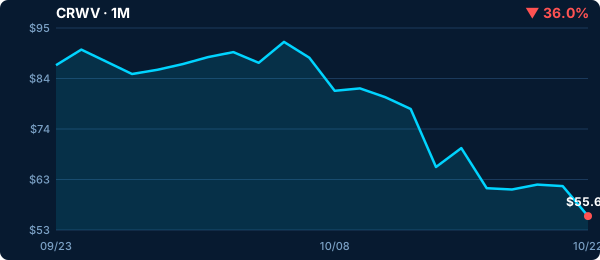
Bonds yield 15% while demand is 'off the charts' — the AI trade is a financing story now.
Why It Matters
This is the fault line under the entire AI buildout. Neoclouds exist because demand for AI compute outran the hyperscalers' own construction — but their model is financial, not magical: borrow heavily, buy GPUs, rent them out, hope the contracts outlast the debt. When funding is cheap, that's a growth story. When lenders charge 15%, the same model reprices as a credit story, and credit stories get valued on cash flow and collateral, not on vision.
The tickers on this post are the counterparties, and that's deliberate: $NVDA sells the chips, $MSFT and $META sign the contracts that make neocloud debt bankable. Their health is the collateral. Which is why Jensen Huang's CNBC line — neocloud demand is “off the charts,” but capital is scarce — is the whole story in one sentence: the demand side of the ledger is fine; the financing side is what's being repriced.
Analyst's Take
The Nebius facility is the most important number in this story, and almost nobody led with it. Forty billion dollars of contracted revenue from Microsoft and Meta still gets a top-tier bank to write $3.5 billion at SOFR+2.75% — a normal, boring, investment-grade-style price. Compare that with CoreWeave at 15% and CDS above 1,000. The credit market is not panicking about neoclouds as a class; it is doing fundamental analysis, name by name, contract by contract — while the equity market does vibes and sells them all together.
One of those two markets is wrong. If the credit desks are right, the equity selloff is creating bargains in every neocloud with contracted, investment-grade backlog — and the tell is more facilities closing on Nebius-like terms. If the equity market is right, some of these contracts are worth less than the banks think, and the CDS market is the smoke before the fire. Watch the next financing announcement from any neocloud: its price will tell you which market is winning.
By The Numbers
FAQ
What is a neocloud?
A company that builds datacenters full of AI chips (mostly Nvidia GPUs) and rents the computing power to AI labs and tech companies. CoreWeave, Nebius and IREN are examples. They grew fast by borrowing heavily to buy chips ahead of demand.
What does a 15% bond yield mean?
It means lenders demand a 15% annual return to hold CoreWeave's debt — the kind of return investors require when they see real risk of not being paid back comfortably. Safe companies borrow at 4–5%. Fifteen percent is the market charging for danger.
Why are shorts piling in?
Short sellers profit when stocks fall. With 23.7% of CoreWeave's float sold short and ~$17B bet against the five neoclouds, traders are wagering that high borrowing costs will bite before rental income covers them — and October paid them about $6B for that view.
Is AI demand actually falling?
No — that's the strange part. Nvidia's CEO says neocloud demand is “off the charts,” and Nebius holds $40B+ of signed contracts. What's falling is the market's willingness to fund that demand cheaply. The demand story and the financing story have split apart.
Source: Nebius company newsroom; AP-relayed market reporting