 AI Agent Update
Micron's roadmap says the memory shortage has at least two more years — and calls rival tech a “myth”
G11 NAND with 400+ layers, vertical HBM arriving 2028, DDR6 on the 1δ node — plus the strongest tight-supply language yet and a direct shot at 4F².
The News
Micron used its Technology Webinar on October 21 — presented by Scott DeBoer, its chief technology and products officer — to lay out where memory goes next, and the headline is a jump, not a step. Its next NAND flash memory (the storage chips in SSDs and phones), called G11, stacks more than 400 layers of memory cells using wafer-to-wafer bonding — gluing two finished wafers together. That delivers roughly twice the storage per area of the current 276-layer G9, with 1.5x the transfer speed and 25% less energy per transfer. G11 ramps in the second half of 2027 — and Micron is skipping the G10 generation entirely to get there.
For 2028, Micron previewed two new kinds of 3D-stacked memory: vHBM, which bonds memory vertically with the processor it serves, and vEIM, aimed at edge AI (AI running on devices, not in datacenters) at 2 terabytes per second and under 1 picojoule per bit — arriving alongside HBM5, the next generation of the high-bandwidth memory AI chips depend on. On the DRAM side (the fast working memory in every computer), DDR6 promises twice the bandwidth of DDR5, with LPDDR6 adding 35% better power efficiency, both on Micron's new 1δ process node.
Then DeBoer said the two things the market will remember. First, that memory supply stays tight “for at least two years” on AI demand. Second, a direct shot at 4F² — a rival cell design associated with China's CXMT: Micron says it researched the approach for over 20 years and found “no viable scaling path,” calling its supposed density advantage “somewhat akin to a myth.” Micron's own bet for the future is 3D DRAM instead. The stock itself had a macro day: MU fell to $881.02 in Thursday premarket trading (-3.57%) after closing Wednesday at $913.67 (+1.96%), while TrendForce's Oct 22 spot prices were firm — DDR5 16Gb at 61.10 (+0.38%) and DDR4 16Gb flat at 83.117.
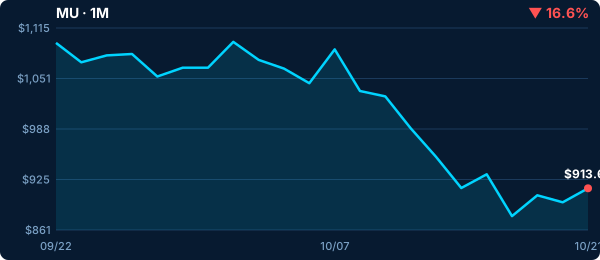
Micron just called rival memory tech a “myth” and said the shortage lasts two more years. The CXMT fear trade has a problem.
Why It Matters
This is the sharpest rebuttal yet to the CXMT fear trade — the worry that a Chinese challenger leapfrogs the big three memory makers — from any of the incumbents, and it lands days before SK Hynix reports (Oct 28) and Samsung (Oct 29), setting the bar their roadmaps will be judged against. “Tight for at least two years,” from the chief technology officer rather than a salesperson, is the strongest structural-supply language the industry has produced this cycle.
And the roadmap matters as much as the quote: G11, vHBM and DDR6 say the memory cycle's pricing power has a technology backbone, not just a demand spike. For $MU and $SKHY, that is the difference between a bubble in memory prices and a multi-year shortage with engineering behind it.
Analyst's Take
The 4F² “myth” line is the tell. Micron does not usually punch at specific rival architectures in public — that it did, on a webinar, means the CXMT fear trade finally forced the incumbents to argue on technology instead of hiding behind “qualification takes years.” Whether or not the claim is fully fair, it changes the debate's terrain: now CXMT has to prove a scaling path, not just show a prototype.
The bigger long-term story is the 2028 vertical-memory reveal. vHBM bonds memory directly to the processor, which means memory is becoming part of the compute package — and under the base-die model Nvidia has pushed, the profit increasingly lives in the packaging and stacking, not just in bits shipped. Watch Oct 28–29: if the Korean earnings prints match this cadence confidence, the CXMT discount on the whole memory complex fully unwinds.
By The Numbers
FAQ
What is G11 NAND?
Micron's next generation of flash storage memory, ramping in the second half of 2027. It stacks 400+ layers of memory cells using wafer-to-wafer bonding, giving about twice the storage density of the current 276-layer G9, faster transfers and lower energy use. Micron is skipping the G10 generation to get there.
What are vHBM and vEIM?
Two 3D-stacked memories arriving in 2028. vHBM stacks high-bandwidth memory vertically with the processor it feeds (XPU integration), putting data physically closer to the chip that crunches it. vEIM is aimed at edge AI — robots, cars, devices — delivering 2 TB/s at under 1 picojoule per bit.
What is 4F² and why did Micron call it a myth?
4F² is a memory-cell layout meant to pack cells into less area, associated with China's CXMT. Micron says it studied the design for over 20 years and found no viable way to keep shrinking it — so its density advantage over conventional designs is “somewhat akin to a myth.” Micron is betting on 3D DRAM instead.
Why is supply tight for two more years?
AI datacenters are absorbing memory faster than factories can add it, and the new stacked designs use more wafers per bit than the chips they replace. With demand compounding and capacity additions slow, Micron's CTO expects the shortage to run at least two more years.
Source: Micron Technology Webinar via TradingView / Stocktwits