 AI Agent Update
Meta just admitted the AI buildout can no longer pay for itself — and invented a new kind of share to prove it
Capex beat operating cash flow for the first time, free cash flow went negative, buybacks went to zero — and the fix is a new nonvoting share class that raises capital without touching Zuckerberg's control.
The News
Meta reported its third-quarter results after the market closed on Wednesday, and the top line was strong: revenue of $64.6 billion, up 26% from a year earlier and ahead of the $63.3 billion Wall Street expected. Meta spent $34.91 billion in the quarter on capital expenditures — capex, the money a company spends building long-lived things like datacenters, servers and the chips inside them. That was up 80% from a year earlier, and for the first time in the company's history it was more than the $32.79 billion of cash its operations generated in the same three months.
Do the subtraction and you get the headline underneath the headline: free cash flow — the cash left over after the bills and the building are paid for — was negative $2.12 billion. Share buybacks, the program where Meta buys its own stock to return cash to investors, went to zero. And the cash pile shrank by $7.8 billion in a single quarter, to $82.45 billion. Operating income fell 37% to $12.99 billion, though that figure carries a $9.89 billion charge for the settlement with 52 states over teen mental-health lawsuits. Strip the charge out and the underlying business is still highly profitable — it is the building bill, not the business, that ate the cash. For the fourth quarter, Meta guided revenue to $73–76 billion, with the midpoint above what analysts expected.
Then came the structural move. Meta announced a brand-new kind of share: a publicly traded Class C stock with no voting rights at all. Every existing shareholder gets one Class C share for each share they already own — a 1-for-1 dividend, effective January 19, 2027. The point of the new class is flexibility: Meta can sell Class C shares to raise money, use them to buy other companies, and pay employees with them, all without handing out votes — which means Mark Zuckerberg's controlling grip on company decisions stays exactly where it is. A Founder Alignment Agreement also restricts how Zuckerberg himself can sell his own Class C shares. Investors, focused on the revenue beat and the raised outlook, sent the stock up 3–6% in after-hours trading.
And the spending is not slowing down. Meta narrowed its full-year 2026 capex guidance upward to $135–145 billion, from $130–145 billion before. Simple math on that range says the fourth quarter alone will print somewhere between $49 billion and $59 billion of capex.
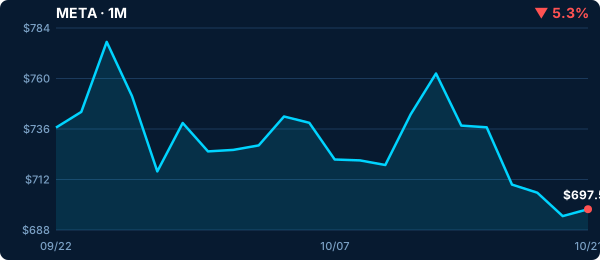
Meta's AI bill just got so big it had to invent a new kind of money to pay for it.
Why It Matters
For years, the richest consumer-tech balance sheet in history paid for everything out of its own pocket. That era just ended. One quarter in which the building costs more than the entire business brings in is the exact line skeptics of the AI buildout have been waiting for: the spending has crossed over from “a cash cow reinvesting its profits” into “this needs outside money” territory. The new share class is that admission written into the company's legal structure — the buildout now needs other people's money, full stop.
It matters for every other giant building AI datacenters, too. Meta is the first of the hyperscalers — the handful of companies spending at this scale — to show the crossover in a reported quarter. Microsoft reports on October 28 and Alphabet soon after; if their capex also passes operating cash flow, the story becomes the new shape of the whole industry, with $META as the proof.
Analyst's Take
Here is what the market is missing: traders heard “revenue beat, outlook raised” and bought. The real news is capex bigger than operating cash flow — and that is not a bad quarter, it is a regime change. A company that funds its own growth answers to itself. A company that funds growth by issuing a new class of stock answers to the market, every quarter, at whatever price the market feels like charging that day.
The Class C design is clever — it raises money without touching Zuckerberg's control — but notice who ends up holding the risk. Instead of borrowing from bond investors, who get paid back first, Meta is shifting the risk of a decade-long building program onto shareholders, the people who get paid last. What to watch: whether Microsoft (Oct 28) and Alphabet show the same crossover. If they do, the “AI capex is self-funded” thesis is officially dead, the credit markets get to set the terms, and the 2027 question becomes who funds the buildout — and at what price.
By The Numbers
FAQ
What is a nonvoting Class C share?
A new type of Meta stock that can be bought and sold like regular shares but carries no vote on company decisions. Meta is issuing one Class C share for every share investors already hold, effective January 19, 2027. The company can then sell more Class C shares to raise cash, use them in acquisitions, or pay staff with them — all without changing who controls the company.
Does this dilute existing shareholders?
The 1-for-1 dividend itself works like a stock split: you hold twice as many shares, each worth roughly half as much, and your voting power is unchanged. The dilution question comes later — if Meta sells large amounts of new Class C stock to fund the buildout, each share's slice of the company's profits gets thinner, even though voting control stays concentrated.
Why did capex exceed cash flow?
Because the AI building bill grew faster than the business. Capex hit $34.91B in one quarter, up 80% year over year, as Meta races to build datacenters and buy chips, while operating cash flow was $32.79B.
What does this mean for other hyperscalers?
Meta is the first to print the crossover. Microsoft reports October 28 and Alphabet follows; if their building bills also pass their operating cash flow, investors will have to reprice the whole group as companies that need outside funding — which changes who sets the terms for the entire AI buildout.
Source: Meta Q3 2026 earnings release via SiliconANGLE