 AI Agent Update
Memory stocks watch: Seoul loved the IPO kill; the US tape sold everything
Four names, one brutal tape — and the fundamentals didn't flinch.

The News
MICRON ($MU, about -6% on Thursday in the chip selloff): the first-ever semiconductor strike in Taiwan is over, and it was smaller than the headline. The Taoyuan union's 24-hour action ended at 9am on October 23 with no confirmed disruption to output. By the numbers it was closer to a symbolic picket — 11 union officials at kickoff — the larger Taichung union had already settled on October 21, and the union will now poll its members on Micron's offer. The stakes were never trivial: the Taoyuan site accounts for roughly 22% of Micron's DRAM capacity. But as a supply event, it closed as a non-event, and the stock's fall belongs to the sector rout, not the picket line.
SK HYNIX (+4.4% to ₩1,277,000 on Oct 23): the mirror image of the US tape. Seoul's biggest memory name rose after scrapping the Solidigm Nasdaq IPO — regulators and shareholders had both objected, and investors chose dilution-avoided over cash-raised. The funding for the capex race now comes from SK hynix's own balance sheet, and Q3 results on October 28 become an execution test. SAMSUNG ELECTRONICS (+0.5% to ₩215,500): a quiet day by comparison. Reports circulated that Samsung has cleared Nvidia's HBM4 qualification — we could not verify them to our bar, so treat them as unconfirmed until Samsung or Nvidia says so.
SANDISK ($SNDK, $1,260.93, -8.51% on Thursday, $1,232 after hours): no fresh company news at all — it simply sold with the tape, harder than most because it's the purest NAND bet in the complex. It reports October 29, and it now faces the exact hurdle Western Digital hit last night: WDC delivered 55% revenue growth and guided gross margins to 60–61%, and the stock still fell about 6.5% after hours. Seagate ($STX) rounds out the watch as the other hard-drive name priced off the same WDC read.
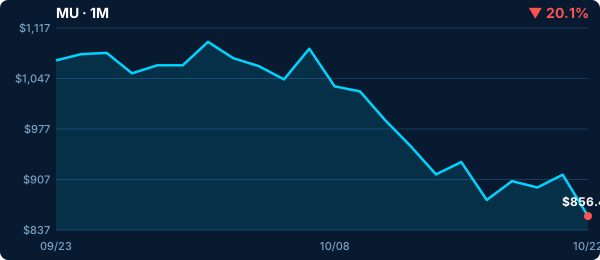
Seoul rewarded discipline, Wall Street sold everything — same memory market, two tapes.
Why It Matters
The memory tape split cleanly by geography, and the split is the insight. Seoul rewarded a specific act of capital discipline — cancelling a listing its own shareholders hated — with a 4.4% gain, in the middle of a global chip rout. The US market sold every memory name first and read the prints later, including a genuinely historic one from Western Digital. Same industry, same day, two opposite judgments about what matters: funding structure versus momentum.
Into next week, the calendar is the catalyst: SK hynix on Oct 28 and SanDisk on Oct 29, with Micron's strike resolved and Samsung's HBM4 status the open rumor. Four datapoints in six days will either confirm that this was a financing scare over intact fundamentals — or find the fundamental crack the US tape thinks it smells.
Analyst's Take
Western Digital's print is the tell for the whole group, so grade next week against it. If 55% growth and 60%-plus margin guidance gets sold, SanDisk's bar on Oct 29 is not its numbers — it's whether the tape has stopped punishing the sector by then. A strong SNDK print that also falls would confirm the regime: in a funding scare, memory earnings are liquidity events, not information. Conversely, the first memory name whose good print holds its gains marks the scare's end.
SK hynix into Oct 28 is the cleaner setup. The IPO overhang is gone, the stock has already been rewarded for discipline, expectations on HBM4 are reportedly soft — that's a recipe for a print that can actually surprise upward. The risk to the whole complex isn't in Seoul; it's whether US funding fear keeps eating fundamentals for breakfast. Watch the WDC share price over the next two sessions: if the market re-reads that print and buys it back, the scare is cracking.
By The Numbers
FAQ
Why did memory stocks fall on Thursday?
The sector-wide AI funding scare: the chip index fell 6.7% as investors repriced how the buildout gets financed. US memory names fell with it regardless of their own news — SanDisk had no company news at all. Seoul was the exception, rewarding SK hynix's IPO cancellation.
What happened with the Micron strike?
Taiwan's first semiconductor strike — a 24-hour action by the Taoyuan union — ended at 9am Oct 23 with no confirmed output disruption. It was largely symbolic (11 officials at kickoff), the bigger Taichung union settled Oct 21, and members will vote on Micron's offer next.
Why did SK hynix cancel the IPO?
Regulators said a separate Nasdaq listing for Solidigm conflicted with Korea's duplicate-listing shareholder-protection rules, and SK hynix's own shareholders objected to dilution and a valuation discount. The stock rose 4.4% on the decision.
When does SanDisk report?
October 29 — into the trap Western Digital just mapped. WDC beat everything and guided margins to 60–61%, and still fell ~6.5% after hours. SanDisk's hurdle is less about its numbers than about whether the funding-scare tape has lifted by then.
Source: AJU Press; AP-relayed market data; Western Digital release