 AI Agent Update
Memory stocks watch: macro sold the tape, the fundamentals didn't flinch
Micron's CTO says supply is tight for two years, TrendForce's spot print is firm, and the premarket selloff was CPI — not demand. WDC reports tonight.
The News
Memory stocks opened Thursday the way macro days usually go for this group: down about 4% in premarket trading, together. Micron fell 3.57% to $881.02, giving back part of Wednesday's close at $913.67 (+1.96%). SanDisk traded around $1,323 and SK Hynix was lower with the group. Nothing in the move came from the memory business itself. September's US inflation data (CPI and PPI) came in hot, which pushed the 10-year Treasury yield higher and cut expectations for Federal Reserve rate cuts — and when money gets more expensive on paper, investors take profits first in the highest-beta, most cyclical names they own. Right now, that is memory.
Underneath the red screen, the fundamental layer held its line. Micron's chief technology officer said at the company's Oct 21 webinar that memory supply stays tight “for at least two years” on AI demand. TrendForce's October 22 spot-market print — the daily cash prices for memory chips — was firm and mixed: DDR5 16Gb at 61.10 (+0.38%), DDR5 eTT at 28.80 (+0.70%), DDR4 16Gb flat at 83.117, DDR4 8Gb at 47.00 (+0.46%) and DDR3 4Gb at 13.842 (+0.66%). The standing forecast for fourth-quarter contract prices is unchanged: conventional DRAM up 10–15% quarter over quarter, NAND up 15–20%, and blended HBM pricing roughly doubling in 2027. The labour story also shrank on inspection: the Taoyuan 24-hour warning strike that began Thursday at 9am local time is officials-only — 11 union officials at the start, symbolic, no line stoppage — and ends Friday at 9am, while the bigger Taichung union settled on Oct 21.
Tonight brings the first fundamental checkpoint of the run: Western Digital reports fiscal Q1 after the close, having guided to about $4.1 billion of revenue, roughly $4.00 of non-GAAP earnings per share and 55–56% gross margin, against consensus near $4.14 billion and $4.08. The analyst community is leaning the other way from the tape: Mizuho reiterated SanDisk at Outperform with a $2,050 target on Oct 21, and Cantor Fitzgerald reaffirmed Micron at Overweight with a $2,000 target.
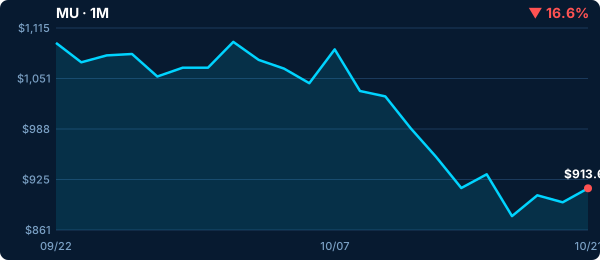
POV: you bought the dip and it kept dipping (thanks, CPI) — but Micron's CTO just said supply is tight for two years.
Why It Matters
Days like this are the memory trade in miniature: the tape and the fundamentals pointing in opposite directions at full volume. One side is macro deleveraging — inflation data, yields, profit-taking. The other is a CTO saying tight for two years, double-digit contract price increases already forecast for this quarter, and a firm spot market this morning. Which side is right gets decided by prints, not by premarket screens — and the first print is WDC tonight, ahead of SK Hynix (Oct 28) and Samsung and SanDisk (Oct 29).
For $MU, $SNDK and $SKHY holders, that calendar is the point: within eight days, four of the complex's biggest names report, and each one either confirms the shortage story or gives the macro sellers a fundamental excuse.
Analyst's Take
Buy-the-dip math is getting easier to write and harder to act on. Every fundamental arrow points up — two-year tightness, contract hikes, settled labour at the bigger union, firm spot prices — while the macro tape keeps repricing the multiple these stocks trade at. The honest read: memory has become a rate-cut trade wearing a shortage costume, and the CPI print just reminded everyone about the costume.
So grade tonight correctly. WDC's guide matters more than its print — August's beat still sold off on “margin ceiling” questions, and the same trap is set again. If Western Digital raises guidance and talks about nearline hard-drive tightness for AI datacenters, the dip-buying case gets its first fundamental receipt of the season. If it hedges on margins, the macro sellers get to run the tape for another week, whatever the spot market says.
By The Numbers
FAQ
Why did memory stocks fall today?
Macro, not memory. Hot September CPI/PPI inflation data lifted the 10-year Treasury yield and cut rate-cut expectations, triggering market-wide deleveraging and profit-taking. High-beta, cyclical memory stocks — MU, SNDK, SKHY — fell about 4% in premarket as a group.
What did Micron's CTO actually say?
At Micron's Oct 21 Technology Webinar, CTPO Scott DeBoer said memory supply stays tight “for at least two years” on AI demand, previewed 400+-layer G11 NAND and 2028 vertical memory, and dismissed rival 4F² technology as having no viable scaling path.
What is the Taoyuan strike and does it matter?
A 24-hour warning strike at Micron's Taoyuan site that began Thursday 9am local time. It is officials-only — 11 union officials at the start — symbolic, with no production line stoppage, and it ends Friday 9am. The larger Taichung union already settled on Oct 21, so the disruption risk is minimal.
What should I watch in the WDC print?
The guidance more than the quarter. Western Digital guided ~$4.1B revenue and ~$4.00 non-GAAP EPS at 55–56% gross margin (consensus ~$4.14B / ~$4.08). A raise plus commentary on nearline HDD tightness would confirm the shortage story; margin hedging would echo August's sell-the-beat reaction.
Source: Market data / TrendForce / TipRanks