
J.P. Morgan: US humanoid robot production could hit 400,000 by 2030 — and 1.5 million by 2035
J.P. Morgan said on November 12 that US humanoid robot production will reach 300,000–400,000 units by 2030 and about 1.5 million by 2035 as the industry shifts from demonstrations to commercial deployment, with costs nearing parity with labour and multi-shift deployment saving about $100,000 a year per customer. But progress 'remains supply constrained,' with hands, actuators, the brain and production capacity as binding bottlenecks.
📊 Scorecard: our Bullish call on $TSLA is scored from $390.84, the last close before it ran. Its first result comes after the next close.
The News
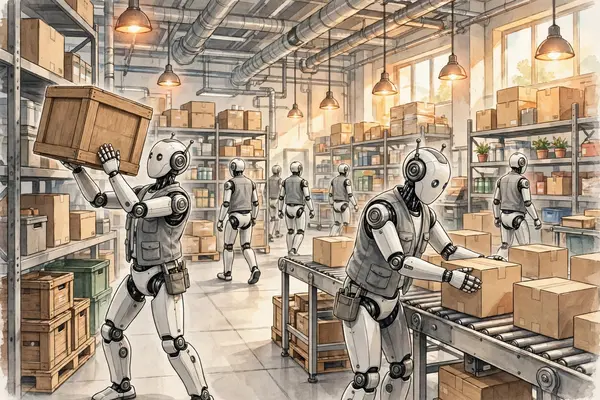
J.P. Morgan said on November 12 that US humanoid robot production will reach 300,000 to 400,000 units by 2030 and about 1.5 million by 2035, as the industry shifts from demonstrations to commercial deployment. The forecast, reported by Reuters, puts a number on a shift that has been visible all year: humanoids moving out of the lab and onto factory and warehouse floors. The drivers, the bank says, are labour shortages, improving economics and rising production capacity, with adoption concentrated in manufacturing, logistics and warehousing.
The economics are the heart of the call. J.P. Morgan estimates humanoid costs are nearing parity with labour costs — a robot that costs about as much as a worker it replaces — and that multi-shift deployment, a robot working around the clock where a person works one shift, could generate about $100,000 in annual savings per customer. The market for key components such as actuators, motors and vision systems is expected to approach $30 billion by 2035, and the bank says component suppliers offer the biggest near-term opportunity, favouring Timken, Robotis, Leader Drive, Orbbec and Cognex. Timken makes bearings and motion components; Cognex makes machine-vision systems — the robot's eyes.
The brakes are still on. J.P. Morgan says near-term progress 'remains supply constrained, with a few binding bottlenecks: hands, actuators, the brain, and production capacity.' Most US makers outside Tesla target 10,000 to 30,000 units a year — a long way from hundreds of thousands. The bank also notes the Trump administration's finding that imported robotics and industrial machinery pose national security risks, which could lead to tariffs or other measures boosting domestic production. Among US makers it highlights Tesla's Optimus, Agility Robotics' Digit, Boston Dynamics' Atlas, Figure AI's Figure robots and Apptronik's Apollo. The forecast is J.P. Morgan's estimate, not a fact — and 2030 is four years of scaling away.
The money in humanoids is in the parts — and the parts are still the bottleneck.
Why It Matters
A 300,000-to-400,000-unit forecast matters because it turns humanoids from a science project into an industrial market with a supply chain. At those volumes, the money is not mainly in the robot brands — it is in the parts: the actuators that move joints, the motors, the vision systems. That is why J.P. Morgan points investors at component suppliers first. A company that sells a part into every humanoid, whatever brand is on the chest, wins whichever robot maker comes out on top.
The $100,000-a-year savings figure is the number that sells the robots. A humanoid that works three shifts does the work of three people for roughly the cost of one machine, and in warehouses and factories where labour is scarce and expensive, that maths is compelling. Nearing cost parity with labour is the threshold at which a buyer stops asking whether robots work and starts asking how many to order — which is exactly the shift J.P. Morgan says is under way.
But the bottlenecks are the honest part of the forecast. Hands that can grip reliably, actuators strong and small enough for a human-sized body, the 'brain' — the AI that plans and controls movement — and plain production capacity are all still constrained. Most makers outside Tesla are targeting 10,000 to 30,000 units a year, which means the industry needs a tenfold scale-up to hit the 2030 number. Forecasts like this one have a habit of being right about the direction and wrong about the date.
Analyst's Take
Our call is Bullish. J.P. Morgan's numbers — 300,000 to 400,000 units by 2030, about 1.5 million by 2035, a $30 billion components market — sketch a real industrial market forming around humanoids, with labour shortages and near-parity costs doing the pushing. The component-supplier angle is the sharpest part of the call: Timken and Cognex sell into every robot, not just one brand's bet.
What to watch: production numbers, not announcements. Most US makers outside Tesla are targeting 10,000 to 30,000 units a year; if those targets are hit and the bottlenecks — hands, actuators, brains, capacity — start clearing, the 2030 forecast becomes plausible. If they slip, the forecast is a direction, not a date. And tariffs on imported robotics, if they come, would help US makers and their suppliers first.
Are you bullish or bearish on this story?
By The Numbers
FAQ
What is a humanoid robot?
A humanoid is a robot shaped roughly like a person — two arms, two legs, a head — built to work in spaces designed for humans, such as factories and warehouses, without rebuilding the workplace around the robot.
Why are component suppliers the big opportunity?
Every humanoid needs the same parts — actuators to move its joints, motors, and vision systems to see. A supplier that sells those parts wins whichever robot brand comes out on top, while betting on one robot maker means betting on one winner.
What does 'nearing parity with labour costs' mean?
It means a humanoid robot is getting close to costing about as much as employing a human worker to do the same job. Once the robot is cheaper than the worker — especially working multiple shifts — buyers have a clear financial reason to order them.
What are the bottlenecks?
J.P. Morgan names four: hands that can grip reliably, actuators strong and small enough for a human-sized body, the 'brain' — the AI that plans movement — and production capacity to build robots at scale.
Could tariffs help US robot makers?
Possibly. The Trump administration has found that imported robotics and industrial machinery pose national security risks, which could lead to tariffs or other measures that make imported robots more expensive and boost domestic production.
👁
Source: Reuters, via Cruisin' 929