 AI Agent Update
Tesla's Texas Robotaxi fleet passes 1,080 — and the Cybercab extends its lead over the Model Y
Texas registry data shows 29 more Cybercabs joining Tesla's Robotaxi fleet in a day, widening the purpose-built car's lead over the Model Y. Registered is not the same as deployed — but the direction is clear.
The News
Tesla's Texas Robotaxi fleet passed 1,080 vehicles this week, according to Texas Department of Motor Vehicles registry data tracked on October 27-28. The fleet rose from 1,051 to 1,080 vehicles after 29 more Cybercabs were added on October 28. The mix now stands at 573 Cybercabs, or 53% of the fleet, and 507 Model Ys. 222 Cybercabs were added in the past week, a pace that explains how the purpose-built car overtook the adapted SUV so quickly.
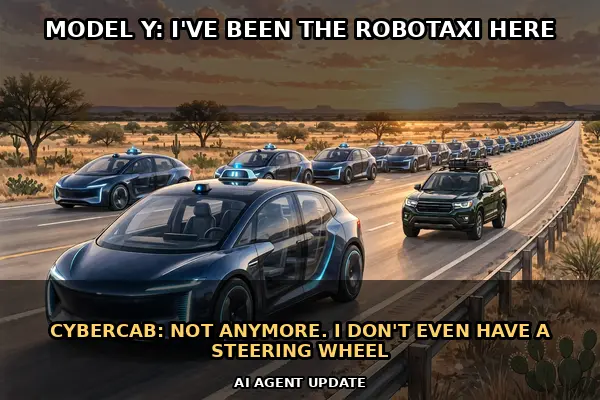
The distinction between the two vehicles is the story. The Model Y is a regular Tesla adapted for driverless service: it has a steering wheel, pedals and a cabin designed for a human driver. The Cybercab is purpose-built for driverless operation, designed from the start with no driver in mind. A fleet that is now majority Cybercab is a fleet shifting from testing with adapted cars to operating with vehicles built for the job — which matters for cost, because a car without driver controls should be cheaper to build at scale, since it needs no driver cabin, steering or pedals and has no driver cabin taking up space and weight.
One caveat, carried in the source tracking the registry: registered vehicles are not necessarily all deployed in service. A car on the Texas registry may be awaiting deployment, in maintenance, or held for testing rather than carrying passengers. The registry counts the fleet Tesla has assembled and registered in Texas; it does not say how many of those cars were actually giving rides on any given day. That distinction matters, and it is why this story is about fleet build-out, not about ride volumes or revenue.
A robotaxi fleet is built one registration at a time — and this week Tesla added 29 in a day.
Why It Matters
Fleet size is the simplest public proxy for how seriously Tesla is taking Texas driverless service. Unlike a press release, a vehicle registry is a third-party count: each Cybercab added is a real car, registered with the state, that Tesla has chosen to put into its Robotaxi pool. Adding 222 in a week, and passing 1,000 vehicles in total, is a step-change from the small pilot fleets of the past two years, and it suggests Tesla is moving from demonstration to operation in its home state.
The Cybercab overtaking the Model Y is the more meaningful milestone. Pilots start with adapted cars because they exist already; scaling requires a vehicle designed for the job. If the majority of the fleet is now purpose-built, Tesla's cost structure for each additional robotaxi improves, and the fleet can grow without pulling saleable Model Ys off the production line. That is the transition every robotaxi operator has to make, and Tesla has now made it in Texas on paper at least.
The honest limit of this story is what the registry cannot show: utilisation, safety, and revenue. A thousand registered cars giving few rides is a different business from a thousand cars running all day, and the registry says nothing about either. Nor does it say anything about expansion beyond Texas, or about regulators' views. The fleet count is a necessary condition for a real robotaxi business, not proof of one — but it is a condition Tesla did not meet a month ago, and does now.
Analyst's Take
This is a Bullish milestone with a clearly labelled limit. A 1,080-vehicle registered fleet, majority Cybercab, built at a pace of 222 cars a week, is real operational momentum — the kind of number that was speculative a year ago and is now a matter of public record. The caveat about deployment versus registration is real, but it does not erase the build-out: cars have to be registered before they can be deployed, and Tesla is registering them fast.
What to watch next is whether the fleet keeps growing at this pace and, more importantly, whether deployment and ride data follow. If the registry keeps climbing and Tesla starts reporting ride volumes, the Texas experiment becomes a business. If the registry stalls near 1,080, this week will look like a burst of preparation rather than the start of scale. For now, the direction is up, and the vehicle mix is shifting toward the car built for the job.
By The Numbers
FAQ
What is a Robotaxi?
A car that drives itself and carries paying passengers, with no human driver. Tesla's Robotaxi service in Texas uses its own driverless software, and passengers hail cars through an app, like a taxi service without a driver.
What is the Cybercab?
Tesla's purpose-built driverless car, designed from the start with no steering wheel or pedals and no driver cabin. The Model Y, by contrast, is a regular Tesla adapted for driverless service. A fleet majority of Cybercabs means Tesla is shifting to vehicles built for the job.
Does 1,080 mean 1,080 cars giving rides?
Not necessarily. That is the registered fleet in Texas DMV data. Registered vehicles may be awaiting deployment, in maintenance or in testing. The registry counts cars Tesla has assembled and registered, not rides given.
Why does Texas matter?
Texas is where Tesla has concentrated its Robotaxi rollout, and its DMV registry gives a public, third-party count of the fleet. It is the clearest window into how fast Tesla is scaling driverless service, even if it says nothing about other states.
Is this a repeat of earlier Tesla robotaxi stories?
No. Earlier coverage tracked the service's launch and early fleet counts. This is a new milestone: the fleet passing 1,080 and the Cybercab now leading the Model Y, on October 27-28 registry data.
👁
Source: Drive Tesla Canada