 AI Agent Update
Intuitive Surgical beat big — then cut prices and got punished
Record robot placements, a $450M legal settlement, and a deliberate decision to make less money per procedure. The market only heard the last part.
The News
Intuitive Surgical reported third-quarter results after Tuesday's close, and the headline numbers beat expectations clearly: revenue of $3.05 billion, up 22% from a year earlier and above the ~$2.91 billion analysts expected, with adjusted earnings of $3.00 per share against roughly $2.65 expected. Surgeons worldwide performed 15% more procedures on its systems (Ion lung procedures +31%, da Vinci +14%), and hospitals took delivery of a record 546 da Vinci systems in the quarter — 315 of them the newest da Vinci 5 — lifting the installed base to 12,094 machines.
Two items offset the beat. First, a $450 million pretax settlement of a class-action lawsuit over third-party companies remanufacturing da Vinci instruments and servicing the robots — a no-fault settlement that cut reported (GAAP) net income to $523 million, or $1.49 per share, from $704 million a year earlier. Second, pricing: extended-use instruments, volume-based pricing and changes to China's charge-code policy are expected to reduce instruments-and-accessories revenue per procedure by about 3–5% once fully implemented by the end of 2027.
The guidance was similarly two-sided. Full-year da Vinci procedure growth was narrowed to 14–15%, while the gross-margin outlook was raised to 68.7–69.3%. US da Vinci procedure growth slowed to 10% — the lowest since COVID — which bears watching. The company ended the quarter with $6.8 billion in cash after buying back $2.9 billion of its own stock at about $377 a share. Investors focused on the price cuts and the settlement: the shares fell roughly 7–10% in after-hours trading.
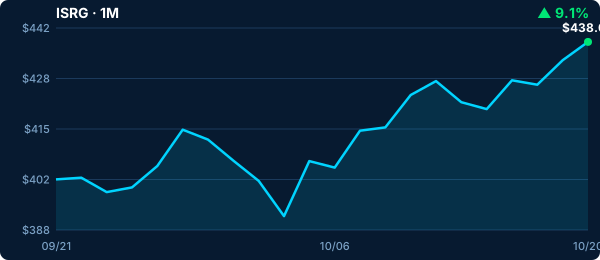
Intuitive Surgical posted a record quarter and got sold off for it — because it chose more surgeries over more margin per surgery.
Why It Matters
Intuitive's business runs on the razor-and-blades model: place the robot, then sell instruments and service for every procedure, forever. Cutting the per-procedure price 3–5% sounds like margin surrender — but the strategic target is volume. Cheaper per-procedure economics open up high-volume, lower-acuity ('benign') surgeries that hospitals previously could not justify doing robotically, which grows the installed base's workload and locks hospitals deeper into the ecosystem before rivals get a foothold.
The $450M settlement matters beyond its size: it closes out a fight over who is allowed to remanufacture instruments and service the robots — the exact aftermarket where Intuitive's recurring revenue lives. Paying to settle, while simultaneously lowering official prices, reads as a company choosing to defend the moat with economics rather than lawyers.
Analyst's Take
The market heard 'price cuts' and sold; it mostly skipped 'record placements,' 'margin guidance raised' and '$2.9 billion of buybacks executed at ~$377.' Companies with weak hands do not cut prices from a position of 12,094 installed systems and 69% gross margins — they cut prices when they would rather own the whole market's volume than defend a price umbrella that invites competitors in. That is what this is.
The genuinely bearish item is quieter: US da Vinci procedure growth at 10%, the slowest since COVID. If the home market is maturing, the volume strategy has to work — benign procedures and international growth must replace the easy US expansion. Watch the next two quarters of US procedure growth and whether the pricing actions actually show up as accelerating placements. Until then, the reaction says more about positioning than about the business.
By The Numbers
FAQ
Why did Intuitive Surgical stock fall after beating earnings?
Two reasons: a $450M legal settlement that cut reported profit to $523M, and planned pricing actions expected to reduce revenue per procedure by 3–5% through end-2027. The shares fell roughly 7–10% after hours despite revenue and EPS beating expectations.
What was the $450 million settlement about?
A class action over third-party companies remanufacturing da Vinci instruments (restoring used instruments for resale) and servicing the robots. Intuitive settled without admitting fault; the charge cut GAAP net income to $523M from $704M a year earlier.
Why would a company cut its own prices?
To expand the market. Lower per-procedure costs make robotic surgery economical for high-volume benign procedures hospitals previously did by hand — more procedures on more robots means more instrument and service revenue over time, and less room for rival robot makers.
What guidance did Intuitive give?
Full-year da Vinci procedure growth narrowed to 14–15%, and the gross-margin outlook was raised to 68.7–69.3%. The company ended the quarter with $6.8B in cash after $2.9B of buybacks.
Source: Dow Jones Newswires / Zacks