
Baykar delivers first three Kizilelma unmanned fighter jets to Turkish forces
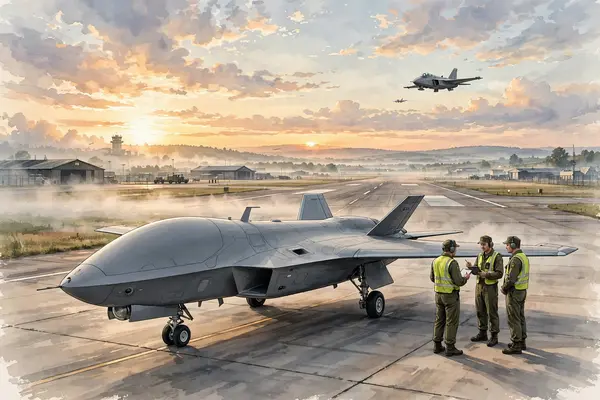
Turkish defence company Baykar delivered the first three Kizilelma unmanned fighter jets to Türkiye's security forces on Thursday, after 600 test and training sorties — and Baykar says it is the first unmanned fighter jet ever to enter military service.
📊 Scorecard: our Bullish call on $KTOS is scored from $29.65, the last close before it ran. Its first result comes after the next close.
The News
Turkish defence company Baykar delivered the first three Bayraktar Kizilelma unmanned combat aircraft to Türkiye's security forces on Thursday, November 19, after completing acceptance tests, and the aircraft have entered active service. Baykar calls it the first time an unmanned fighter jet has entered military service anywhere in the world — that framing is Baykar's own claim, and no independent authority has certified the comparison. Baykar did not name which unit received the aircraft, referring only to "security forces."
The Kizilelma is a single-engine, jet-powered, stealthy unmanned fighter designed for air-to-air and air-to-ground missions. It first flew on December 14, 2022. Baykar says the programme has accumulated 600 test and training sorties, and it self-financed the development — the company paid for it itself rather than with government development money.
In 2026 the platform demonstrated manned-unmanned teaming — piloted and pilotless aircraft working together — through an autonomous formation flight with Italian M-346 aircraft in May 2026, and tests included the supersonic Jet-230 missile. In May 2026 Baykar announced a framework agreement with Indonesia for a 12-aircraft fleet, with deliveries targeted from 2028 and an option for 48 more (60 in total).
Three jets in service is a small delivery with a large claim — Baykar says no unmanned fighter has ever entered service before.
Why It Matters
This matters because fighter jets have always had pilots, and a jet designed from the start to fly without one changes what an air force can do. A pilotless fighter can fly missions too dangerous or too long for a human, and it costs less to lose than a piloted jet and its pilot. Three aircraft in service is the first proof that a country is willing to trust that idea in real operations, not just in tests.
The testing record matters because it answers the obvious question: is this real? Six hundred sorties, autonomous formation flights with piloted Italian M-346 aircraft, and a live firing of a supersonic missile in 2026 are the kind of milestones a programme passes on the way to service, not the kind it claims after the fact. Self-financing matters too — Baykar paid for development itself, which means it believed in the jet enough to risk its own money.
The read-through for Kratos matters because Baykar is private, so investors cannot buy its shares. Kratos is the listed US company building the same kind of aircraft, and a rival proving the concept in service is good news for the whole category: it tells buyers and investors that unmanned fighters are a real market, not a science project. The watch item is scale — three jets is a start, and the Indonesia order from 2028 is the test of whether anyone else buys in.
Analyst's Take
Our call is Bullish. A first delivery is the moment a weapons programme stops being a prototype and starts being a capability. Three aircraft is a small number, but entry into active service after completed acceptance tests — plus 600 sorties, formation flying with piloted jets and a live missile firing this year — is a record of testing that goes well beyond a single demonstration flight. For Kratos, the listed US peer in unmanned combat aircraft, the read-through is that the market for pilotless fighters is now real, with a customer operating them.
The export angle is where this gets bigger. A framework agreement with Indonesia for 12 aircraft from 2028, with an option for 48 more, shows Baykar is already selling the jet abroad before it has proved itself in Turkish service for long. If Indonesia follows through, the Kizilelma goes from a national programme to an export product — and that is the point at which other countries, and other makers, have to respond.
The honest caveat is the claim itself. "World's first unmanned fighter in service" is Baykar's own description, and no independent authority has certified it — other countries have flown unmanned combat aircraft in tests, and what counts as "in service" can be argued. Treat the delivery as a fact and the superlative as the maker's claim. What to watch next is which unit operates the jets, whether more deliveries follow, and whether Indonesia's 2028 order holds. Reader poll: Is the unmanned fighter jet the future of air combat? Vote: Game changer, Too early to tell, Wait for exports.
Are you bullish or bearish on this story?
By The Numbers
FAQ
What is an unmanned fighter jet?
An unmanned fighter jet is a jet-powered combat aircraft with no pilot on board. It is flown by software and remote operators, and it is designed to fight other aircraft and attack ground targets, the same jobs a piloted fighter does.
What does stealthy mean?
Stealthy means the aircraft is shaped and built to be hard for radar to spot. It does not make the jet invisible, but it makes it much harder for enemy defences to detect and track.
What is a sortie?
A sortie is one flight by one aircraft on a mission, whether a test, a training flight or a combat mission. Baykar says the Kizilelma programme has flown 600 test and training sorties.
What is manned-unmanned teaming?
Manned-unmanned teaming is when piloted aircraft and pilotless aircraft fly and fight together, sharing information and tasks. In 2026 the Kizilelma demonstrated this by flying in formation with Italian M-346 aircraft, which do have pilots.
👁
Source: The Defense News