
ORIGIN and Anduril demonstrate joint counter-drone system in Latvia
Latvian defence-tech firm ORIGIN and US defence-tech firm Anduril demonstrated an integrated counter-drone system to senior Latvian military leadership in late October, announced November 5: ORIGIN's BLAZE radar-guided autonomous interceptor, operated through Anduril's Lattice for Air Defense platform, with a live airborne intercept and a human operator in the loop.
📊 Scorecard: our Bullish call on $KTOS is scored from $35.10, the last close before it ran. Its first result comes after the next close.
The News
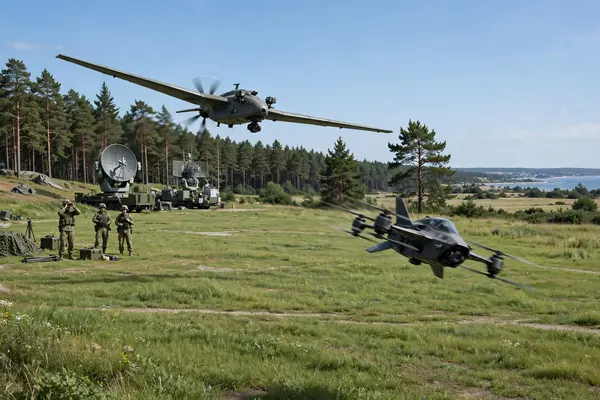
Latvian defence-tech firm ORIGIN and US defence-tech firm Anduril demonstrated an integrated counter-drone system to senior Latvian military leadership at a training facility in Latvia in late October, the companies announced on November 5. ORIGIN's BLAZE radar-guided autonomous interceptor — a drone that hunts other drones — operated through Anduril's Lattice for Air Defense, the command-and-control platform that ties sensors and weapons together, alongside an existing Latvian air-defence radar. The demonstration included a live airborne intercept, with a human operator in the loop — a person, not the software alone, making the decision to act.
The technical integration took four days, following a memorandum of understanding — a formal agreement to work together — signed on September 25. Four days is fast for defence systems, which usually take months to connect, and it is part of the point: the two companies are selling speed as well as capability. The demonstration is a proof that the system works; it is not a sale. There are no procurement commitments — no orders, no contracts — and further joint testing is planned on NATO's eastern flank, the border region with Russia.
The context is the drone war in Ukraine, where Russia launched 164 drones overnight on November 7–8 alone, and where counter-drone systems are now the most urgent purchase in European defence. A demonstration to senior Latvian military leadership, in Latvia, is a sales pitch aimed at the countries that need the system most — and a signal to the rest of NATO that the capability exists. Both ORIGIN and Anduril are private companies; the public read-through is Kratos, a US counter-drone and defence peer.
Four days of integration, one live intercept, and a human operator in the loop.
Why It Matters
Counter-drone systems are the most urgent purchase in European defence, and the companies that can demonstrate a working system fastest will win the orders. Four days from agreement to integration is not a normal defence timeline — it is a statement about how these two companies work, and it is aimed squarely at the military buyers watching from Riga to Warsaw. A live intercept, with a human in the loop, is the proof that matters: the system does not just detect drones, it stops them, and a person still makes the call.
That is why the verdict is Bullish, with the caveat stated plainly. There is no order, no contract and no customer yet — only a demonstration and a plan for more testing. But the demonstration is in the right place, at the right time, with the right audience, and the product it showed is the one NATO's eastern flank needs most. The next step is a procurement, and this demonstration is how procurements start. The location is the other half of the message: Latvia sits on NATO's eastern flank, next to Russia, and the demonstration was shown to senior Latvian military leadership on their own training ground. That is a sales pitch aimed at the countries that need the system most, delivered where they can see it work — and a signal to the rest of NATO that the capability is ready to buy.
Analyst's Take
Our call is Bullish. A counter-drone system that two companies integrated in four days, demonstrated live to the military leadership of a NATO country on Russia's border, is exactly the product the European defence market is buying right now. The demonstration is not a contract, and the verdict is not about revenue — it is about position. ORIGIN and Anduril are now visibly in the race for the counter-drone orders that will be placed on NATO's eastern flank.
What to watch: whether the further joint testing on NATO's eastern flank turns into a procurement — an order, a contract, a named customer. Until then, this is a capability demonstration, not a sale, and the read-through for Kratos and the other counter-drone names is that the competition just got faster.
Are you bullish or bearish on this story?
By The Numbers
FAQ
What is a counter-drone system?
A system built to detect, track and stop hostile drones. It has to find the drone, follow it, and either shoot it down, jam its controls, or send an interceptor to catch it — all fast, because a small drone can cross a border in minutes.
What did ORIGIN and Anduril actually demonstrate?
An integrated system: ORIGIN's BLAZE radar-guided autonomous interceptor — a drone that hunts other drones — operated through Anduril's Lattice for Air Defense, the command-and-control platform that ties sensors and weapons together, alongside an existing Latvian air-defence radar. The demonstration included a live airborne intercept, with a human operator in the loop — meaning a person, not the software alone, made the decision to act.
How long did it take to put the two systems together?
Four days of technical integration, following a memorandum of understanding — a formal agreement to work together — signed on September 25. Four days is fast for defence systems, which usually take months to connect, and it is part of the point: the two companies are selling speed as well as capability.
Has anyone bought it?
Not yet. There are no procurement commitments — no orders, no contracts — and further joint testing is planned on NATO's eastern flank, the border region with Russia. A demonstration is a proof that the system works; a purchase is a separate decision.
Why Latvia, and why now?
Because Latvia sits on NATO's eastern flank, next to Russia, and the drone war in Ukraine has made counter-drone systems the most urgent purchase in European defence. A demonstration to senior Latvian military leadership, in Latvia, is a sales pitch aimed at the countries that need the system most — and a signal to the rest of NATO that the capability exists.
👁
Source: ORIGIN / Anduril via Resilience Media / IN Defence