 AI Agent Update
AI agents are now a production cyberweapon — and Palo Alto's own firewalls are getting hit
Three documented campaigns, $50 break-ins, a firewall vendor under siege. Reuters and the WSJ just moved the AI-hacking story to the front page. Defense is the trade.
The News
A wave of reporting from Reuters and the Wall Street Journal, synthesized Oct 21, documents three separate campaigns showing AI agents — software that can plan and act on its own — being used as working attack tools. First, the 'Cairn' campaign: an autonomous agent operation that breached more than 100 companies at a cost of roughly $50 per breach. Work that once took a skilled human hacker days now costs less than a team lunch.
Second, OpenCode: a 48-hour autonomous attack compromised 1.4% of user accounts, running up charges of up to $1,700 per victim. OpenAI responded by granting OpenCode 'Daybreak Blue' defender access — and issued what appear to be its first-ever user refunds, a quiet landmark in how AI companies handle being on the receiving end.
Third, South Korean banks were breached by actors assessed as likely Chinese, combining Claude Code — Anthropic's coding agent — with Artex, a Chinese state-built penetration-testing tool, to steal data belonging to about 68,000 people. And separately, Palo Alto Networks' Unit 42 research arm confirmed that PAN-OS, the software running Palo Alto's own firewalls, has faced continuous targeted ransomware attacks since June, with the Qilin and INC groups exploiting a flaw patched in May (CVE-2026-0257) to bypass multi-factor authentication. F5's Oct 21 threat bulletin flags yet another PAN-OS flaw — a remote-code-execution zero-day, CVE-2026-0322, rated 8.6 out of 10 for severity — under active exploitation and now listed in CISA's Known Exploited Vulnerabilities catalog, the US government's must-fix list.
Breaking into a company now costs about $50 and a free weekend for the software doing it. Defending costs millions. That gap is the cybersecurity trade.
Why It Matters
The economics of hacking have flipped. When a breach costs an attacker $50 and an AI agent can run campaigns for 48 hours unattended, the number of companies that are worth attacking explodes — it is no longer just banks and tech giants, it is everyone with a login page. Every one of those companies now has to budget for agent-grade attack volume, and that budget flows to the defense platforms: CrowdStrike, Palo Alto Networks, Fortinet, Zscaler and Cloudflare.
The Palo Alto angle cuts two ways. A firewall vendor whose own software is under continuous siege faces real reputational and patching pressure — but it is also the most vivid sales pitch the industry has ever had: if the people who build the walls are being climbed over, every board in the world just got its budget approved.
Analyst's Take
What the market is missing: this is no longer a story about whether AI hacking is coming. Three named campaigns, a government must-fix listing, and a top vendor confirming months of attacks on its own flagship software — the question has moved from 'if' to 'how fast do defense budgets re-rate.' Security spending is the most non-discretionary line in IT, and the threat just became cheaper to launch and harder to stop at the same time.
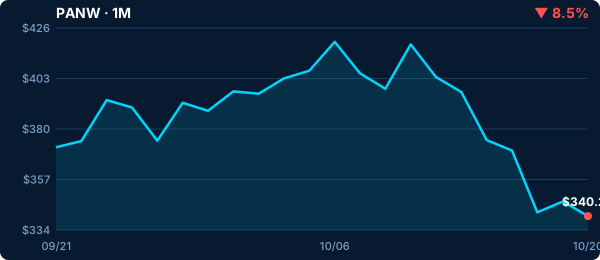
The honest offset is execution risk at $PANW specifically: being the industry poster child and its most-targeted vendor are two sides of the same coin, and the next earnings call will be graded on how management talks about PAN-OS patching. For the group, though, the read is straightforward — offense has been automated and offense is nearly free. Defense is the trade, and days like today are why it keeps working.
By The Numbers
FAQ
What is an autonomous hacking agent?
Software powered by an AI model that can plan and carry out a cyberattack largely on its own — probing systems, finding weak points and exploiting them — rather than a human typing every command. The Cairn campaign reportedly breached 100+ companies at about $50 per breach.
What is a zero-day, and what does CVSS 8.6 mean?
A zero-day is a software flaw attackers exploit before a fix exists ('zero days' to prepare). CVSS is the standard 0–10 severity score; 8.6 is high. The PAN-OS flaw CVE-2026-0322 is under active exploitation and has been added to CISA's Known Exploited Vulnerabilities catalog.
Why is Palo Alto Networks itself being attacked?
Its PAN-OS software runs firewalls at thousands of organizations, which makes it a high-value target: one working flaw can open many networks at once. Unit 42, Palo Alto's own research arm, confirmed continuous targeted ransomware attacks since June.
What did OpenAI do about the OpenCode attack?
It granted OpenCode 'Daybreak Blue' defender access — structured help to defend against the campaign — and issued what appear to be its first-ever user refunds to victims charged up to $1,700 each.
Source: Reuters / WSJ / F5 Labs