
Zipline seeks approval for 130,000 drone deliveries a day across Phoenix and Tucson
Zipline is seeking FAA approval for commercial drone delivery that could support up to 130,000 package deliveries a day across Phoenix and Tucson, operating 24 hours a day, seven days a week including holidays. The plans sit in an FAA draft environmental assessment published in November, with public comments open through December 7 — and the figures are maximum capacity, not an approval and not expected daily volumes.
📊 Scorecard: our Bullish call on $WMT is scored from $126.19, the last close before it ran. Its first result comes after the next close.
The News
Zipline is seeking FAA approval for commercial drone delivery operations that could support up to 130,000 package deliveries per day across the Phoenix and Tucson metropolitan areas, operating 24 hours a day, seven days a week including holidays. The plans appear in a draft environmental assessment published by the FAA in November 2026, and public comments are open through December 7, 2026. This is a proposal under environmental review, not an approval — no permission to fly the Arizona operations has been granted yet.
The scale in the proposal is striking. It would establish 65 charging locations and 1,300 dropboxes in each city, with up to 390,000 flight segments a day at maximum capacity. A flight segment is one leg of a drone's trip, so a single delivery can involve more than one segment. The figures are maximum operating capacity, not expected daily volumes: actual activity would depend on demand, weather and operations, and the network would start far below its ceiling.
Zipline would use its Platform 2 aircraft, with about 63 lb maximum takeoff weight and up to 8 lb of payload — the package weight it can carry on a trip. Zipline already holds an FAA Part 135 air carrier certificate, the licence that lets a company fly commercially, and a beyond-visual-line-of-sight exemption, which lets its drones fly beyond where a pilot on the ground can see them. It still needs amendments to its operating specifications — the detailed rules the FAA writes into a carrier's licence — before launching the Arizona operations.
130,000 deliveries a day is the ceiling, not the starting line — but the ceiling itself is the news.
Why It Matters
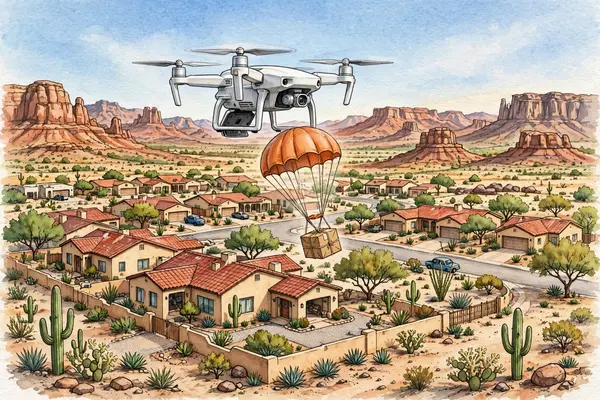
Drone delivery has spent years as a demonstration: a few neighbourhoods, a few hundred parcels, a press photo of a box descending on a rope. What makes the Zipline proposal different is that it is written for a whole metro area, not a trial zone. Sixty-five charging locations and 1,300 dropboxes in each city is the shape of a delivery network, the way a courier company thinks about depots and lockers — except the vehicles fly themselves and never hit traffic.
The numbers need careful reading, and the proposal itself says so. Up to 130,000 deliveries a day and 390,000 flight segments a day are maximum capacity — the ceiling if every charging point and dropbox ran at full scale. Nobody expects that on day one, and the assessment says actual activity would depend on demand, weather and operations. But a ceiling matters: it tells you the system is designed for retail volumes, not for a handful of medical samples, and it tells regulators and rivals that Zipline is planning for scale.
The regulatory position is the other half of the story. A Part 135 air carrier certificate is the licence that lets a company fly commercially, like a small airline, and a beyond-visual-line-of-sight exemption lets its drones fly beyond where a pilot can see them — both are permissions that take years to win. Zipline already holds them; what it still needs is an amendment to its operating specifications, the detailed rules the FAA writes into its licence. That is a narrower ask than starting from scratch, which is why the Arizona proposal reads as the next step in a long campaign rather than a first move.
For the public markets, the read-throughs are Walmart and Amazon. Walmart is a Zipline partner, so a Zipline network at this scale is a delivery option for its stores; Amazon's Prime Air is the direct competitor, so a rival building a two-city network at retail scale is a challenge to its own drone ambitions. Zipline itself is private, so neither ticker is a party to the proposal — they are the listed companies whose businesses the network would touch.
Analyst's Take
Our call is Bullish. A proposal for 130,000 deliveries a day across two metro areas is among the largest drone delivery plans put before the FAA — Zipline's own pending Texas proposal seeks 220,000 a day — and it comes from a company that already holds the two hardest permissions: a Part 135 air carrier certificate and a beyond-visual-line-of-sight exemption. The environmental assessment is a real step in a real process, not a press release, and the network it describes — 65 charging locations and 1,300 dropboxes in each city — is built for retail scale, which is why Walmart, a Zipline partner, and Amazon, whose Prime Air competes with it, are the read-throughs.
What to watch: the public comment period closes December 7, 2026, and the FAA's next move after that — plus whether the operating-specification amendments land. The 130,000-a-day figure is a ceiling, so the honest test is not whether Zipline hits it, but whether the review clears the way for the first commercial flights in Arizona at all. If it does, drone delivery stops being a pilot project and starts being infrastructure.
Are you bullish or bearish on this story?
By The Numbers
FAQ
Has the FAA approved this yet?
No. This is a proposal under environmental review. Zipline is seeking approval, and the FAA published a draft environmental assessment in November 2026, with public comments open through December 7, 2026 under the draft assessment — though the FAA's environmental review webpage lists December 9, so check the FAA page before submitting.
What does 130,000 deliveries a day actually mean?
It is the maximum operating capacity the proposal could support — the ceiling if everything ran at full scale. Actual daily activity would depend on demand, weather and operations, and would be far lower at the start.
What would the network look like?
The proposal would establish 65 charging locations and 1,300 dropboxes in each city, with up to 390,000 flight segments a day at maximum capacity. A flight segment is one leg of a drone's trip, so one delivery can involve more than one segment.
What drone would Zipline use?
Its Platform 2 aircraft, with about 63 lb maximum takeoff weight and up to 8 lb of payload — the weight of the package it can carry. That is roughly the size of a small suitcase of groceries or a few retail items, not furniture.
What approvals does Zipline already hold?
Zipline already holds an FAA Part 135 air carrier certificate — the licence that lets a company fly commercially, like a small airline — and a beyond-visual-line-of-sight exemption, which lets its drones fly beyond where a pilot can see them. It still needs amendments to its operating specifications before launching the Arizona operations.
👁
Source: DRONELIFE