 AI Agent Update
Walmart commits about $6 billion to expand Symbotic warehouse robotics across 25 distribution centers
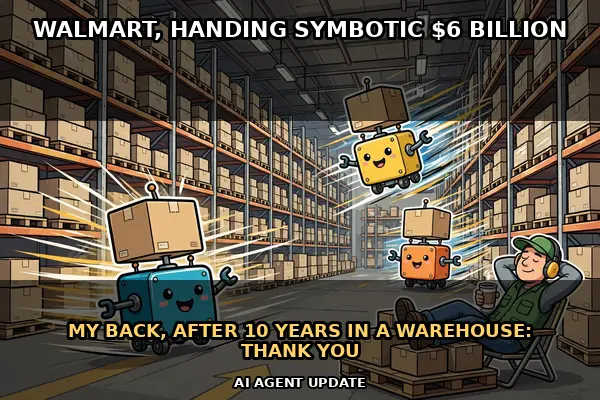
Walmart committed about $6 billion more to Symbotic warehouse robotics across 25 distribution centers — one of the largest robotics-spend commitments of the week, and a direct read on warehouse-automation demand.
The News
Walmart and Symbotic announced on October 29 an expanded commercial agreement with an initial commitment of approximately $6 billion in spend over several years, bringing further AI-enabled robotics capabilities to 25 US regional distribution centers and supporting opportunities across Walmart's global supply chain. The stated aims are e-commerce upstream inventory management — handling the stock that feeds online orders — more storage capacity, and better movement of goods through the supply chain, using Symbotic's BreakPack each-picking and SymMicro micro-fulfillment solutions (per Symbotic's announcement, as reported by Securities.io's Oct 29 Symbotic piece). Each-picking means picking individual items for individual orders, rather than moving whole pallets; micro-fulfillment means small, automated fulfillment operations close to customers.
Context keeps the headline honest. The two companies have worked together since 2017, and a 2022 agreement already targeted all 42 regional distribution centers over eight-plus years — so this is a deepening of automation at 25 centers, not a new network. No site-by-site timetable, job-impact figure, or audited savings number was disclosed, so none is claimed here. But the scale is still the story: $6 billion committed to warehouse robotics by the world's largest retailer, in a single agreement, is one of the largest robotics-spend commitments in this week's window and a direct read on warehouse-automation demand.
The deal also lands in a week when robotics headlines were dominated by humanoids and robotaxis. Walmart's bet is deliberately unglamorous: no humanoid demos, no geofence maps — just robots moving boxes faster in buildings that already exist. That is precisely why it matters. Warehouse automation is the part of robotics that already pays, at a scale no humanoid program has yet reached, and the world's biggest retailer just doubled down on it.
No humanoid demos, no geofence maps — just $6 billion of robots moving boxes faster. That is the part of robotics that already pays.
Why It Matters
Walmart's deal matters because warehouse automation is where robotics earns its keep today. Humanoid robots dominate headlines, but the economics of moving boxes are already proven: e-commerce orders require picking individual items at speed, and that work is expensive, hard to staff, and easy to measure. A $6 billion commitment says the world's most cost-obsessed retailer has done the math and the robots win. For Symbotic, this is a multi-year revenue anchor; for the robotics sector, it is proof that the biggest buyer in retail is still buying.
The deal's structure is also informative. This is an expansion of a nine-year relationship, not a first date. Walmart already knew Symbotic's systems, had already targeted all 42 centers in 2022, and chose to spend $6 billion more on deeper capabilities at 25 of them. That pattern — a customer expanding after years of use — is worth more than any new-logo announcement, because it reflects operating experience rather than a pitch deck. It also sets a bar for competitors: matching Walmart's automation level now requires a similar multi-billion commitment.
The honest limits are stated in the announcement itself. No timetable, no job figures, no savings numbers — so the deal's pace and payoff remain to be shown in Symbotic's results, not in a press release. And $6 billion 'over several years' is a commitment, not a single year's revenue. But even discounted for those caveats, this is the week's clearest demand signal in robotics, from the buyer least likely to spend $6 billion on a hunch.
Analyst's Take
The verdict is Bullish. A $6 billion commitment from the world's largest retailer, to a named vendor, for a named technology, across 25 named facilities, is about as concrete as a robotics demand signal gets. It is not a funding round, a demo, or a memorandum — it is a multi-year spend commitment, over several years, from a customer that has been buying from the same vendor since 2017. Repeat customers spending more is the oldest bullish signal in business.
What to watch next is execution: which centers get the new capabilities first, whether Symbotic's backlog and margins reflect a deal of this size, and whether other retailers follow. Walmart's automation lead is now a competitive weapon — rivals that still pick by hand are competing against robots on cost and speed. If Symbotic delivers on this expansion, expect its next customer announcements to get much bigger. If it stumbles, the whole warehouse-automation trade will feel it, because this is its flagship account.
By The Numbers
FAQ
What does Symbotic actually do?
Symbotic builds AI-enabled robotics systems for warehouses: machines that pick individual items (called 'each-picking'), sort them, and move goods through a distribution center. Its BreakPack system picks individual items for store orders, and SymMicro handles small-scale fulfillment for online orders.
What is a distribution center?
A giant warehouse where goods arrive in bulk from suppliers and are sorted and shipped to stores or customers. Walmart has 42 regional distribution centers in the US, and this deal deepens automation at 25 of them.
Is this 25 new warehouses?
No — and that distinction matters. Walmart and Symbotic have worked together since 2017, and a 2022 agreement already targeted all 42 regional distribution centers over eight-plus years. This is a deepening of automation capabilities at 25 centers, not a new network.
Why does Walmart spend this much on robots?
Moving goods through a warehouse is labor-intensive, and e-commerce orders — many small items, picked individually — are far harder to handle than bulk store deliveries. Automation raises storage capacity, speeds up order handling, and reduces dependence on a tight warehouse labor market.
Did the announcement include job cuts or savings figures?
No. No site-by-site timetable, job-impact figure, or audited savings number was disclosed, and none is claimed here.
👁
Source: Reuters