 AI Agent Update
WEC Energy beats, raises guidance, and unveils a $47.5B five-year plan built on large-customer demand
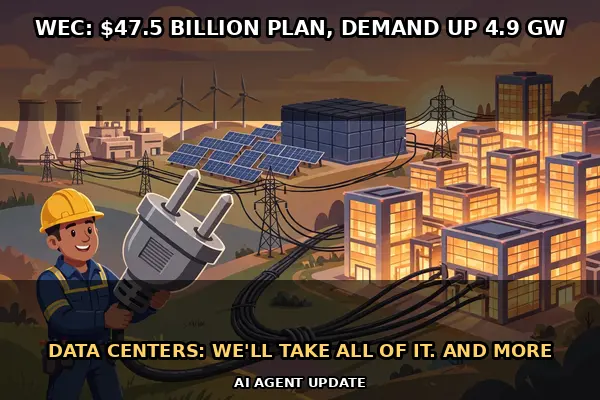
WEC Energy beat earnings by 20%, raised guidance, and unveiled a $47.5 billion five-year plan built on large-customer demand — the regulated-utility version of the AI power story, with gas and storage doing the heavy lifting.
The News
WEC Energy reported third-quarter 2026 net income attributable to common shareholders of $389.3 million, or $1.18 per diluted share, against $271.3 million, or $0.83, a year earlier, beating the $0.98 consensus by about 20%, on revenue of $2.29 billion, up 8.9% year on year. The company raised and narrowed its 2026 guidance to $5.60 to $5.64 per share, from $5.51 to $5.61. Earnings per share is profit divided by shares outstanding; guidance is the company's forecast. But the bigger story is the plan behind the quarter: a $47.5 billion capital plan for 2027 through 2031, targeting 7% to more than 9% annual earnings-per-share growth, built on 4.9 gigawatts of electric demand growth over 2026-2031 — one gigawatt more than previously planned — driven by very large customers, the data-center and large-industrial load class, whose share of WEC's asset base is projected to approach 30% by 2031. A gigawatt is a billion watts, roughly a large power station's output.
The plan's composition tells the story of what powering AI actually requires. It also extends the Point Beach nuclear power purchase arrangement with NextEra, pending approval. A power purchase agreement is a long-term contract to buy electricity from a specific plant; NextEra is named here as a read-through ticker because it owns the plant. This is the regulated-utility version of the AI power story: a Midwest utility re-rating its growth plan around large loads, with the same demand surge that is reshaping hyperscaler spending now reshaping a utility's investment program.
WEC is not an outlier — it is a template. Utilities across the US are discovering that data-center demand is not a rumor but a queue of interconnection requests, and their regulators are being asked to approve plans far larger than anything drawn up before the AI buildout. WEC's $47.5 billion is the number that makes that abstract shift concrete: a five-year program, funded by customers and capital markets, aimed squarely at serving loads that did not exist in utility planning a decade ago.
The AI power story has reached the regulated utility: $47.5 billion, and gas and batteries — not just renewables — doing the lifting.
Why It Matters
WEC matters because it translates the AI power story from headlines into a regulated balance sheet. Hyperscaler spending dominates the news, but someone has to generate the electricity, and that someone is usually a utility whose investments need regulatory approval years in advance. A $47.5 billion plan is a utility betting its next decade on large-load growth — and regulators approve such plans only when the demand is documented, not speculated. The 4.9 gigawatts of demand growth is therefore more than a forecast; it is a queue of customers whose projects are far enough along to enter a capital plan.
The plan's mix is the honest part. A plan that added only renewables would be a press release; a plan that adds gas and storage and extends a nuclear contract is an engineering answer to a real problem — large loads need power around the clock, in all weather, starting soon. That mix will disappoint purists, but it reflects the same reality driving the week's other energy stories: the grid's binding constraint is firm capacity, not total generation, and utilities that admit that will keep the lights on while others make promises.
The read-through extends beyond WEC. Every utility with a data-center queue is now re-rating its growth plan, and WEC's template — gas plus storage plus nuclear extension, aimed at very large customers — is likely to be copied across the Midwest and beyond. NextEra, as the Point Beach counterparty, shares directly in that template. The risk is concentration: if very large customers reach 30% of the asset base and their spending slows, WEC's growth story slows with them. But concentration cuts both ways — it also means WEC's fortunes are now tied to the most powerful demand trend in the energy economy, and this quarter, that trend is accelerating.
Analyst's Take
The verdict is Bullish. A 20% earnings beat, a raised guide, and a $47.5 billion plan targeting up to 9% annual earnings growth is a utility firing on all cylinders — and the demand behind it, 4.9 gigawatts of new load, is the most durable kind, because data centers do not unplug. Regulated utilities rarely offer growth stories; WEC just offered one, with the numbers to back it.
What to watch next is regulatory approval and execution. The Point Beach extension needs approval, the gas and storage investments need to be built on time, and the very-large-customer share approaching 30% concentrates WEC's fortunes on a customer class whose own spending is under market scrutiny this week. If the data-center queue keeps growing, WEC's plan looks conservative. If it stalls, the plan's later years will be revisited. For now, the queue is growing — and WEC is building for it.
By The Numbers
FAQ
What is a regulated utility?
A utility whose prices are set by government regulators in exchange for serving everyone in its territory. WEC serves customers in Wisconsin and the Upper Midwest; its allowed profits come from approved investments in power plants, wires and equipment.
What is a capital plan?
A multi-year program of investments — power plants, grid upgrades, storage — that a utility builds and then earns a regulated return on. WEC's $47.5 billion plan for 2027-2031 is the spending that drives its future earnings.
What are 'very large customers'?
The data-center and large-industrial load class: customers whose electricity demand is measured in hundreds of megawatts rather than kilowatts. WEC says their share of its asset base will approach 30% by 2031.
What is a PPA?
A power purchase agreement: a long-term contract to buy electricity from a specific plant. WEC extended its Point Beach nuclear PPA with NextEra, pending approval — NextEra is named here as a read-through ticker.
Why is gas growing in a clean-energy plan?
Because large new loads need power that is available around the clock, and batteries plus renewables alone cannot yet guarantee it.
👁
Source: Zacks