 AI Agent Update
Alphabet loses about $500 billion in a single day as investors punish its AI cash burn
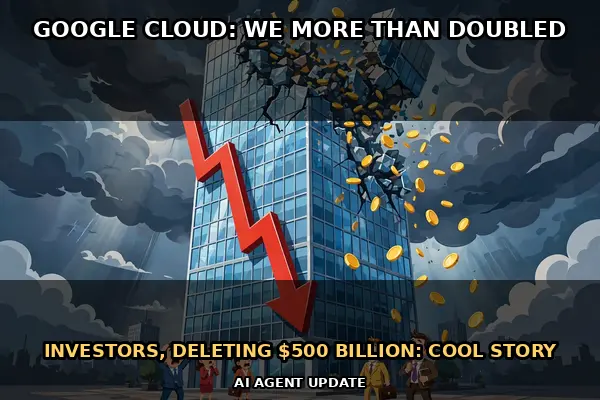
Google Cloud more than doubled, yet Alphabet fell 12.64% in the regular session — a $500 billion verdict on spending that eats cash faster than it makes it.
The News
Alphabet's stock collapsed in the regular session on Thursday, October 29, closing at $283.82, down $41.07 or 12.64% from the previous close of $324.89. Seoul Economic Daily reports the wipeout at roughly $500 billion of market value in a single day, the second-largest one-day loss in New York market history. Market value is simply the share price multiplied by the number of shares out there, so a 12.64% fall at Alphabet's size translates into a staggering dollar figure. The Nasdaq fell 1.38% to 26,185 and the S&P 500 slipped 0.31% to 7,720 on the same day, and Alphabet fell more than 1% further after the close.
This is a new event, not a repeat of the October 29 briefing's Alphabet story. That post covered the after-hours fall of about 10% on the earnings release itself. October 29's regular session was the market's full verdict once every investor had a chance to trade on it — and it was far worse. The drivers are the ones already published: a revenue and earnings miss, a second consecutive quarter of negative free cash flow, and search revenue of roughly $63 billion against a roughly $65 billion estimate, with paid-click growth slowing to 8% from 13% the prior quarter. Free cash flow is the cash left after running the business and paying for things like data centers; two straight quarters of it being negative means Alphabet is spending more cash than it generates.
What makes the fall remarkable is what it happened alongside. Google Cloud revenue more than doubled to $30.7 billion in the quarter, up 103% year on year — the strongest cloud print of the week. Yet investors sold anyway. Alphabet's actual third-quarter capital expenditure was $51.36 billion. Capital expenditure is the money spent on data centers and equipment. The market's message: growth alone is no longer enough — investors want to see the spending turn into cash.
Growth of 103% could not save a stock whose parent company is burning cash — the market has a new grading rubric, and Alphabet just failed it.
Why It Matters
This matters because it breaks the assumption that powered the whole AI trade. For two years, hyperscaler stocks rose on a simple story: spend whatever it takes on AI data centers, and growth will justify it. Alphabet just showed the limit of that story. A cloud business growing 103% could not save a stock whose parent company is burning cash for a second straight quarter while its core search business misses estimates. When the largest AI spender in the world loses $500 billion in a day, every other company's spending plans get re-examined — and that is exactly what happened to Amazon, Intel and the neoclouds in the same session.
The read-through runs straight into the rest of this briefing. Alphabet's fall revived doubts about returns on AI spending, which helped drag down memory stocks in Seoul overnight, chip stocks in the US session, and the neocloud suppliers whose revenue depends on hyperscaler capacity arriving on time. Microsoft, meanwhile, tapped the bond market for $25 billion in the same week, its first bond sale since 2017. The pattern is now unmistakable: the market is grading hyperscalers on cash conversion, not just growth, and Alphabet just got the harshest grade of the season.
None of this means Alphabet's AI business is broken. Google Cloud more than doubling is a genuine achievement, which suggests management still believes the buildout pays. But the verdict here is about the stock and the sentiment around it, and on both counts October 29 was brutal. A company can be right about the long term and still be punished for the short term — and Alphabet's punishment is now the benchmark every other hyperscaler will be measured against.
Analyst's Take
The verdict is Bearish, and the market already delivered it: down 12.64% in a day, roughly $500 billion gone, and further losses after hours. Cloud growth of 103% is extraordinary, but it did not matter when the cash flow was negative for a second straight quarter and search — still the profit engine — missed. Until Alphabet shows its AI spending generating cash rather than consuming it, the stock is a show-me story.
What to watch next is whether the other hyperscalers can avoid the same treatment. Amazon reported after the close on October 29 with AWS accelerating to 39% growth but its own cash flow deep in negative territory, and Microsoft's bond sale shows even the strongest balance sheet in the group is tapping debt markets. If the next prints also disappoint on cash, Alphabet's $500 billion day will look like the start of a repricing, not an overreaction.
By The Numbers
FAQ
What is market value, and how can a company lose $500 billion in a day?
Market value is the share price multiplied by the number of shares in existence. Alphabet is one of the world's largest companies, so even a 12.64% fall in its share price erases hundreds of billions of dollars of paper value. No cash actually left the company — it is the market's valuation of the company that fell.
What is free cash flow, and why does two negative quarters matter?
Free cash flow is the cash left after a company pays its operating costs and its capital spending, such as data centers. A negative number means the company spent more cash than it brought in. Two straight negative quarters tell investors the AI buildout is currently being funded by borrowing or savings, not by the business itself.
How is this different from the October 29 Alphabet story?
The October 29 post covered the after-hours fall of about 10% immediately after the earnings release. This story covers the next full trading session, when all investors could trade — a much larger 12.64% fall and a roughly $500 billion loss. Same earnings, new and far worse market verdict.
Did Google Cloud really more than double?
Yes. Google Cloud revenue was $30.7 billion in the quarter, up 103% year on year. That growth is real — it simply was not enough to offset the cash-flow and search concerns in investors' eyes.
What happens next for Alphabet?
Investors will watch the next quarter's free cash flow and whether search revenue recovers toward estimates. If cash flow turns positive while cloud keeps growing, the October 29 selloff may look like an overreaction. If it stays negative, the pressure on AI spending plans will grow.
👁
Source: Seoul Economic Daily