 AI Agent Update
Intel beats the quarter, then guides the fourth quarter far below the Street — shares fall about 21% after hours
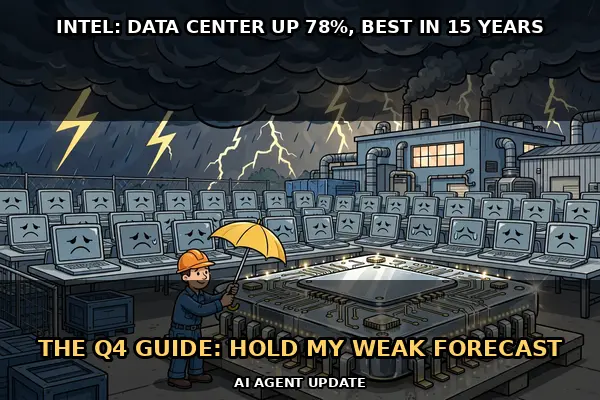
Intel's data-center business grew 78% — its best in 15 years — and then the company guided the fourth quarter far below Wall Street's expectations. The stock fell about 21% after hours and dragged the whole chip sector with it.
The News
Intel reported third-quarter 2026 results after the US close on October 29 with a genuine beat on the quarter just ended. Revenue was $16.51 billion, up 21% year on year. Adjusted earnings per share were $0.52 against $0.41 expected, and adjusted gross margin was 44.1% against 42.1% expected. Data Center and AI revenue was $7.3 billion, up 78% — its strongest data-center growth in 15 years — and foundry revenue, from making chips for other companies, rose 58% to $6.7 billion. Gross margin is the share of revenue left after the direct cost of making the product, and adjusted figures strip out one-off items to show the underlying business.
Then came the guide, and the stock fell off a cliff. Intel forecast fourth-quarter revenue of $15 to $16 billion against a roughly $17.07 billion consensus, adjusted EPS of $0.25 against $0.43, and gross margin of 38% against about 42.8% expected. Shares fell about 21% after hours on Reuters' read, with later wires putting the fall higher as the session developed. Three drivers, all new: Client Computing revenue — the PC business — fell 5% to about $8.1 billion, and Intel expects the PC slowdown to continue at least through the first half of 2027; a recent explosion at its Israel fab; and the investment bill keeps rising, with 2026 capital expenditure raised to $20 billion from $18 billion and a significant increase planned for 2027, with no positive free cash flow expected for 2026. Free cash flow is the cash left after running the business and paying for equipment.
The damage spread instantly. The chip sector had already had a bad day before Intel reported: the SOXX semiconductor ETF closed at $513.86, down 1.55%, with Nvidia down 0.80% to $213.66, AMD down 2.08% to $566.42, Broadcom down 1.94% to $345.00 and TSMC down 1.75% to $431.81, snapping a four-day winning streak as Alphabet's collapse revived doubts about AI spending.
A 78% data-center surge, erased by one guidance line — the market buys the future, and Intel just told it the future is smaller.
Why It Matters
Intel's guide matters because it is the first hard evidence that the PC slump is not over. Client Computing revenue fell 5% to about $8.1 billion, and Intel expects the PC slowdown to continue at least through the first half of 2027 — a roughly 12% slide in 2026 and about 10% more next year on one wire's read of the call. For PC makers like HP and Dell, named here as read-through tickers because they sank on the same guide, that is a demand warning, not an Intel-only problem. The consumer hardware cycle that was supposed to recover with AI PCs has not arrived.
The fab explosion adds an operational dimension that numbers alone do not capture. It is a reminder that the chip industry's capacity is physical, fragile, and concentrated — and that a single incident can move a quarterly guide by hundreds of millions. Investors who model chip supply as a smooth line just got a lesson in how lumpy it really is.
The sector-wide reaction is the most important part. Reuters notes the SOX index is still up more than 60% in 2026, but it is now 13% below its recent October high and 21% below its June all-time high. Intel's guide did not create the chip correction — Alphabet's collapse started it hours earlier — but it gave the correction its catalyst and its narrative: if even the company with 78% data-center growth cannot guide higher, the AI spending boom's next chapter is going to be bumpier than the last one.
Analyst's Take
The verdict is Bearish. The third-quarter beat was real but backward-looking, and everything forward-looking pointed the same way: a smaller PC market, a fab incident, margins compressing to 38%, and a rising investment bill with no positive free cash flow in sight. A turnaround story cannot survive a guide this far below consensus, and the roughly 21% after-hours fall says the market agrees.
What to watch next is whether the selloff stays an Intel story or becomes a chip story. Intel reports the problem first because its PC exposure is largest — but if the PC slump and delayed data-center deliveries hit the next reporters too, October 29 will be remembered as the day the chip trade broke.
By The Numbers
FAQ
What is guidance, and why did it matter more than the beat?
Guidance is a company's forecast for the next quarter. Investors trade on the future, not the past, so a forecast of $15 to $16 billion in revenue against a $17.07 billion consensus overwhelmed a strong quarter that had already happened.
What is gross margin?
Gross margin is the share of revenue left after the direct cost of making the product. Intel guided fourth-quarter gross margin to 38%, against about 42.8% expected — a sign that costs, including the fab incident, will eat into profits.
What happened at Intel's Israel fab?
A recent explosion at its Israel fab.
What is a foundry?
A foundry is a factory that makes chips for other companies, not just for itself. Intel's foundry revenue grew 58% to $6.7 billion — a sign its contract-manufacturing push is gaining traction even as its own PC business struggles.
Why did AMD and Broadcom fall too?
Because Intel's warning was read as a sector signal: if PC demand is weak and data-center spending is being delayed, every chip supplier faces the same headwinds.
👁
Source: BizTech Weekly