
Waymo pulls robotaxis off US freeways after California calls them an imminent hazard
California's DMV restricted Waymo's driverless cars from freeways indefinitely, calling them an imminent hazard after repeated construction-zone incursions — and Waymo pulled freeway rides everywhere else too. The restriction lifts only when Waymo demonstrates effective corrective actions.
📊 Scorecard: our Bearish call on $GOOGL is scored from $280.20, the last close before it ran. Its first result comes after the next close.
The News
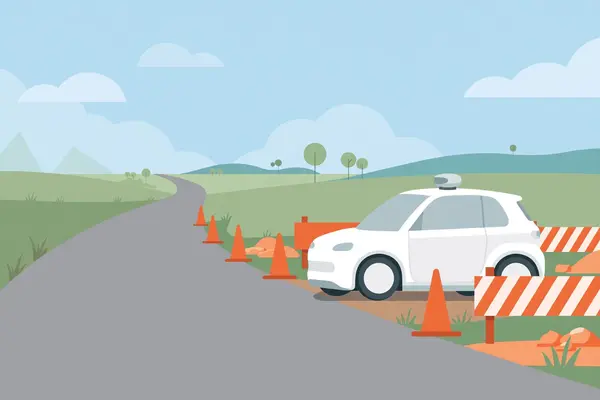
Waymo halted robotaxi rides on US freeways on Tuesday, November 17, after California's Department of Motor Vehicles barred its driverless vehicles from freeways in the state. The regulator said driverless freeway operations "pose an imminent hazard to public safety" after repeated incursions into active construction zones, despite a prior restriction and corrective actions Waymo took after similar incidents in May 2026.
The incidents behind the restriction were specific, according to the DMV's account reported by KBNW and others (the cited Reuters report gives no incident details). The DMV cited three Waymo vehicles entering a closure on US Route 101 near Burlingame, and a vehicle attempting to pass California Highway Patrol cars running a traffic break on Interstate 280. California's restriction took effect November 11 and stays in place until Waymo demonstrates "effective corrective actions." It is the second time in 2026 that Waymo has halted freeway rides — the first was its own voluntary pause in May, after similar construction-zone incidents; this time the halt follows a regulator's order.
Waymo went further than California required. It temporarily restricted freeway operations across all of its other operating markets while it evaluates performance. Freeway rides had been offered in San Francisco, Los Angeles, Phoenix, Miami and Austin — a small slice of its network. Street service continues in all 15 cities where Waymo operates. Waymo's last disclosed volume was more than 500,000 trips a week, reported in April 2026, and the company has not published a newer weekly figure.
Waymo's freeway problem is no longer a California problem — it pulled the rides everywhere, and now it has to prove the fix works.
Why It Matters
Freeways matter because they are the hardest test a robotaxi faces. City streets are slow, with traffic lights and low speed limits. Freeways mean high speeds, merging traffic and construction zones that change from one day to the next — exactly the situations where a mistake turns dangerous fast. A robotaxi that cannot be trusted on a freeway is a service with a ceiling on how useful it can be.
The construction-zone detail is what makes this ban serious. Waymo's cars did not just make a one-off error. They entered active closures more than once, after a prior restriction and after corrective actions that followed similar incidents in May 2026. Regulators can forgive a first mistake; a repeated mistake after a promised fix is what turns a warning into a ban.
The wider context is competition. Waymo has spent years building a lead in driverless cars, but Tesla and Amazon's Zoox are now pushing into the same business, and Zoox joined the Uber app in Las Vegas on November 16. Every month Waymo spends proving its freeway safety case is a month its rivals spend signing up riders. The ban does not kill the robotaxi business, but it slows the leader down at the moment the race is getting crowded.
Analyst's Take
Our call is Bearish. The core business still works — street service continues in all 15 cities and more than 500,000 trips a week is a real, operating service, not a demo. But freeways are where a robotaxi service proves it can handle the hardest, fastest driving, and Waymo has now failed that test twice in one year, in the state that matters most to it.
The timing makes it worse. Tesla and Amazon's Zoox are making robotaxi inroads of their own — Zoox joined the Uber app in Las Vegas on November 16 — so Waymo's freeway pause hands rivals a window to catch up in the exact market where Waymo was supposed to be years ahead. A safety regulator calling your cars an 'imminent hazard' is also the kind of headline that slows every future permit, in every city, not just California.
For readers, the practical question is how long the pause lasts and what 'effective corrective actions' actually means. Waymo chose to restrict freeway rides in its other markets voluntarily, which suggests it is not confident the problem is limited to California. Until it can show a fix that regulators accept, the freeway story is a drag on the robotaxi thesis. Reader poll: Will Waymo win freeway access back? Vote: Yes, soon; Not this year; Never on freeways.
Are you bullish or bearish on this story?
By The Numbers
FAQ
What is a robotaxi?
A robotaxi is a taxi with no human driver — cameras, radar and software drive the car instead. Waymo's robotaxis are owned and operated by Waymo, a subsidiary of Google's parent company Alphabet.
What does the DMV do?
The DMV, or Department of Motor Vehicles, is the California state agency that licenses drivers and vehicles. It can also suspend or restrict permits for driverless-car companies operating in the state.
What is an imminent hazard?
An imminent hazard is a danger the regulator believes could cause harm right now, not at some point in the future. It is the language the DMV used to justify restricting Waymo's freeway operations until the company demonstrates effective corrective actions — it did not revoke Waymo's permits, and street service continues.
👁
Source: 985 The River