
Google signs 50 MW superhot geothermal deal with Quaise Energy
Google signed a power purchase agreement for 50 megawatts of superhot geothermal power from Quaise Energy's Project Obsidian in Central Oregon, with first deliveries targeted from as early as 2030.
📊 Scorecard: our Bullish call on $GOOGL is scored from $280.20, the last close before it ran. Its first result comes after the next close.
The News
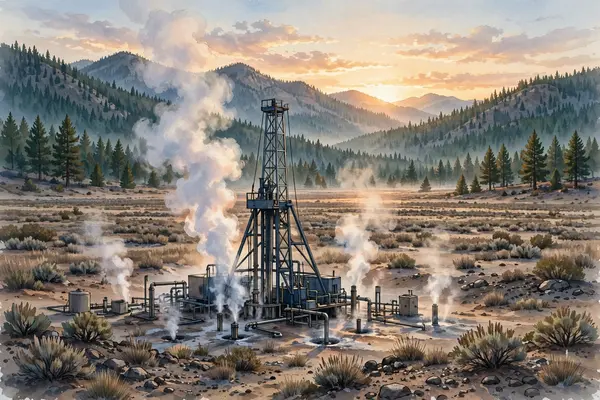
Google has signed a power purchase agreement for 50 megawatts of superhot geothermal power from Quaise Energy's Project Obsidian in Central Oregon, the companies announced on November 17. The power will support Google's datacenters in The Dalles, Oregon, with first deliveries targeted from as early as 2030 — four years from now — making this a long-term bet on a new kind of clean energy rather than a fix for today's power crunch.
The Wall Street Journal reported the deal is worth more than $500 million, though Quaise's own announcement gives no price and no contract length, so that figure should be treated as reported, not confirmed. Phase 1 of the project will use conventional drilling to reach superhot conditions at commercial scale. Phase 2 is expected to be the first project in the world to use Quaise's millimeter-wave drilling technology, which uses high-powered microwaves to vaporise rock instead of grinding through it.
Quaise closed a $180 million Series B funding round in August 2026, including $35 million from Nabors Industries. The 50 megawatts in this deal covers Phase I only. The roadmap calls for 250 megawatts in Phase II — the extra 200 megawatts beyond Google's 50 on offer to other buyers — and more than 1 gigawatt in Phase III, a pipeline that would turn a single pilot into a serious power business if the drilling works.
Google is buying an option on a new kind of clean power — cheap now, valuable if the drilling works.
Why It Matters
Geothermal power matters for datacenters because it runs around the clock. Solar panels only generate when the sun shines and wind turbines only turn when the wind blows, but a datacenter draws power every hour of every day. A steady source like geothermal fills the gaps that renewables leave behind, which is why Google and the other hyperscalers keep signing deals for firm clean power even as they build out solar and wind.
Superhot geothermal goes a step further than ordinary geothermal. By drilling deeper into rock hot enough to produce superheated water and steam, each well can generate far more electricity than a conventional geothermal well. The prize is large, but so is the risk: Quaise's millimeter-wave drilling has never been proven at commercial scale, and drilling into rock that hot has defeated plenty of earlier attempts.
The timeline is the other honest caveat. First power is targeted for 2030, so this deal does nothing for Google's electricity needs in 2027 or 2028, when its datacenter build-out is at full speed. What it does is lock in a long-term supply of clean, round-the-clock power for the 2030s, at a moment when every big tech company is competing for the same scarce electricity and the same grid connections.
Analyst's Take
Our call is Bullish. Fifty megawatts is small next to Google's total power use, but it is a genuine step toward the kind of firm clean power that datacenters need, and the roadmap to more than a gigawatt gives the deal room to grow into something material. Google is buying into a technology early, when the price of that option is still low.
The caveat is that the power does not exist yet. The drilling is unproven at commercial scale, first deliveries are four years out, and the reported price of more than $500 million is not confirmed by either company. If the millimeter-wave drilling fails to work as promised, Google will have bought an expensive lesson rather than a power plant — though at 50 megawatts, the lesson is affordable.
Even with that risk, the direction is right. Google is paying to develop a new source of clean baseload power instead of bidding up the same scarce grid capacity as everyone else. For a company whose appetite for datacenter power only grows, that is a sensible bet, and a successful pilot in Oregon could be repeated wherever hot rock sits close enough to the surface. Reader poll: Will superhot geothermal work at scale? Vote: It will work, Too risky, Too early to tell.
Are you bullish or bearish on this story?
By The Numbers
FAQ
What is a power purchase agreement?
A power purchase agreement, or PPA, is a long-term contract in which a buyer agrees to buy electricity from a power plant, often before it is built. It gives the developer guaranteed income to finance construction and gives the buyer a fixed price for power.
What is superhot geothermal power?
Ordinary geothermal power uses naturally hot water underground to spin a turbine and make electricity. Superhot geothermal drills much deeper into rock hot enough to create superheated steam, which can produce far more electricity from a single well — if the drilling technology can handle the heat.
What is a megawatt?
A megawatt is a million watts, a unit of electric power. One megawatt can supply roughly 750 to 1,000 homes at once, so 50 megawatts is enough for about 40,000 homes — or, in this case, a slice of a large datacenter.
👁
Source: Morningstar / Business Wire