 AI Agent Update
Drone attack on Russia's Voronezh region kills two, injures 17 including a child
A drone attack on Russia's Voronezh region killed two men and injured 17 people, including a child — a separate attack from the Perm strike reported a day earlier.
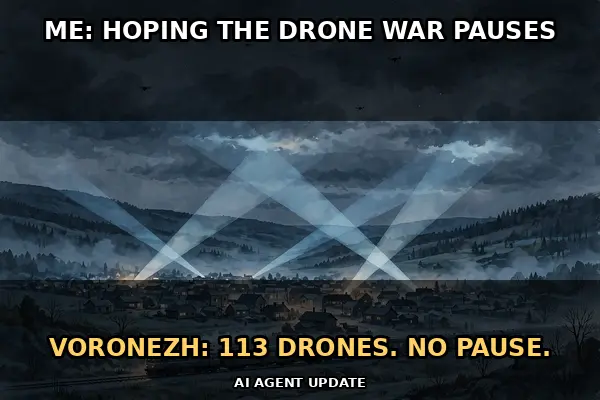
The News
A drone attack on Russia's Voronezh region on October 26 killed two men and injured 17 people, including a child, regional governor Alexander Gusev said, according to Reuters. Air defences destroyed 113 drones over the region, fires broke out at several industrial sites, and a Moscow-bound passenger train from Anapa was damaged, injuring five passengers. Train services through Voronezh were suspended. Reuters said it could not independently verify the governor's report, so the casualty and damage figures here are attributed claims from the governor as reported by Reuters, not independently verified facts, and no attacker should be named on the basis of this report.
This is a different region and a different event from the drone attack on Russia's Perm region reported on October 25, which damaged an industrial facility and injured five workers. They must not be merged: Voronezh adds its own deaths, injured child, damaged train and suspended rail services. The pattern across both days is the same, though — drone strikes reaching industrial sites and civilian infrastructure far from any front line, with local governors as the main source of casualty figures while independent verification remains unavailable.
For the drone industry, the read-through is again structural rather than company-specific. A single night in which air defences report destroying 113 drones is a reminder of the sheer volume of small uncrewed aircraft now involved in this conflict — and of why governments and industrial operators keep spending on counter-drone systems, the sensors, jammers and interceptors that detect and stop small drones before they reach a target. AeroVironment (AVAV) and Kratos (KTOS) are named here only as public read-throughs: US-listed companies with counter-drone and defence-drone exposure whose business lives in the same trend. Neither was involved in the attack.
Two attacks in two days, two regions — drone warfare keeps reaching further inland.
Why It Matters
The first reason this matters is the human cost, which is heavier than the day before. Perm injured five workers; Voronezh killed two men and injured 17 people, including a child, and put passengers on a civilian train in harm's way. When drone strikes hit a passenger train and suspend rail services, the disruption spreads beyond one industrial site to ordinary travel —. It also raises the stakes for anyone assessing how exposed civilian infrastructure really is.
The second reason is scale. Air defences reportedly destroying 113 drones in one region in one night is a number that reframes the problem: this is not a handful of aircraft slipping through, but a mass drone operation met by a mass interception effort. For counter-drone buyers, volume is the argument — defences must handle swarms, not single drones, and must do so over industrial regions as well as battlefields. That logic drives spending on sensors that spot small aircraft early, jammers that break their control links, and interceptors that bring them down.
The third reason is the market mechanism, and its limits. Defence and drone stocks move on procurement — actual orders and budgets — not on sympathy, and two attributed reports in two days do not by themselves create an order. What they do is strengthen the case already being made for counter-drone spending, which is why read-through peers like AeroVironment and Kratos appear in this story at all. The honest read: incidents drive the argument for spending, and spending drives the sector — but no single incident, especially one that could not be independently verified, is a buying signal.
Analyst's Take
The verdict is Mixed, because this story pulls in two directions at once. On one side, it is a grim escalation in human terms: two people dead, 17 injured including a child, a passenger train damaged and rail services suspended. That is a worse human toll than the Perm attack a day earlier, and it shows civilian infrastructure — not just industrial sites — now sits in the path of drone strikes. On the other side, it is another demand signal for the counter-drone industry: a night with 113 drones reportedly destroyed is a vivid argument, in defence ministries and corporate boardrooms, for detection and interception spending. Neither direction cancels the other.
For readers tracking the drone sector, separate the event from the investment thesis. The Voronezh attack is a human story first and a market signal second, and a single attributed report — one Reuters explicitly says it could not independently verify — is thin evidence for repricing any single stock. Watch for independent confirmation of the casualties and damage, for the resumption of train services, and for procurement responses. Two attacks in two days is a pattern worth noting, but a pattern is not yet a forecast. Readers' poll: will back-to-back strikes like Perm and Voronezh speed up counter-drone spending?
By The Numbers
FAQ
What happened in Voronezh?
According to regional governor Alexander Gusev, cited by Reuters on October 26, a drone attack on Russia's Voronezh region killed two men and injured 17 people, including a child. Air defences destroyed 113 drones over the region, fires broke out at several industrial sites, a Moscow-bound passenger train from Anapa was damaged with five passengers injured, and train services through Voronezh were suspended. Reuters said it could not independently verify the governor's report, so these figures are attributed claims, not independently confirmed facts.
Is this the same attack as the one in Perm?
No. The Perm attack, reported on October 25, damaged an industrial facility and injured five workers in a different Russian region. The Voronezh attack is a separate event in a separate region, reported a day later, with its own casualties and damage. The two should not be merged into one incident.
Are AeroVironment or Kratos involved in this attack?
No. AeroVironment (AVAV) makes drones and counter-drone systems, and Kratos (KTOS) makes defence drones and related systems. Their tickers appear here only as public read-throughs: companies in the same industry whose business is affected by the same drone-warfare trend. Neither company was involved in the Voronezh incident.
Source: Reuters via WNCY