 AI Agent Update
SpaceX's $40 billion GPU debt claim triggers a neocloud credit shakeout warning
Elon Musk says SpaceX has closed $40 billion of debt to buy AI chips — and warns that lenders have almost entirely shut off credit for smaller AI cloud firms without other big revenue.
The News
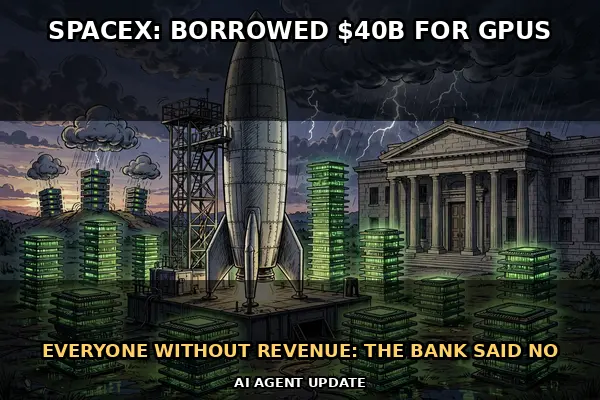
Elon Musk said on October 25 that SpaceX had closed $40 billion of debt to buy graphics processors, or GPUs — the specialised chips that power AI — for delivery in the first and second quarters of 2027. He posted the claim on X, his own social network. The debt's terms, its lenders and its interest rates have not been disclosed by SpaceX, so none of those details should be treated as confirmed. The story here is Musk's claim plus the warning that came with it, not a filed deal with known terms.
In the same post, Musk said debt markets had 'almost entirely shut off' for firms without substantial revenue outside AI data centers. That is a direct warning about neoclouds: newer companies such as CoreWeave, Nebius and IREN that rent out AI computing power but lack the broad, established businesses of the big hyperscalers. If lenders will no longer fund them cheaply, their growth plans — which depend on borrowed money to buy chips and build data centers — get much harder to finance. SiliconANGLE, reporting on the post, explicitly framed the consequence as favouring financially established hyperscalers such as Amazon Web Services, Microsoft and Google over smaller, debt-dependent operators.
The market reaction was swift. CoreWeave, Nebius and IREN fell about 2.5% in Sunday overnight trading and more than 4% in Monday premarket trading, according to CoinCentral citing CNBC figures. Premarket and overnight prices are snapshots taken before the regular trading session, not final closing prices. CoinCentral, citing CNBC, put the after-hours moves at CoreWeave down 2.96%, Nebius down 3.36% and IREN down 3.03%, with October falls of 33–39% for the group. Those October declines show this is not a one-day wobble: neocloud shares have been falling for weeks as investors question how much debt these companies can carry.
Debt markets have 'almost entirely shut off' for firms without revenue outside AI data centers.
Why It Matters
The first reason this matters is simple arithmetic. Building an AI data center is enormously expensive: the chips alone cost billions, and the buildings, power and cooling add billions more. Companies that cannot fund that spending from their own profits must borrow. When borrowing gets harder, the whole business model slows down. That is why a warning from Musk — himself one of the biggest buyers of AI chips — lands so hard: he is describing the funding conditions his competitors face, from inside the market.
The second reason is the divide it exposes between two kinds of AI builders. Hyperscalers such as Microsoft, Amazon and Google earn money from many businesses, so lenders see them as safe borrowers even if AI spending slows. Neoclouds earn most of their money from one thing — renting AI computing — so lenders see them as a bet on AI demand continuing at today's pace. When that bet looks shakier, lenders pull back first from the companies with the least to fall back on. That is the shakeout Musk is predicting: not necessarily that neoclouds disappear, but that the weakest-funded ones cannot keep growing at the old pace.
The third reason is what it means for Nvidia, the chip supplier at the centre of all of this. Nvidia sells the GPUs that both SpaceX and the neoclouds buy, so a neocloud slowdown could eventually mean fewer chip orders. For now, SpaceX's own $40 billion claim points the other way — demand for GPUs remains enormous. The tension between those two facts is the story to watch: chip demand is still huge, but companies buying chips on borrowed money are finding borrowing harder.
Analyst's Take
This is a Bearish story for neoclouds, and a relatively favourable one for the big hyperscalers — exactly the divide Musk's warning draws. CoreWeave, Nebius and IREN need outside money to grow, and if that money is now expensive or unavailable, they must grow more slowly, raise money by selling shares, or lean harder on customer payments in advance. None of those options is painless. The hyperscalers, by contrast, fund AI data centers largely from their own huge cash flows from cloud, advertising, software and shopping, so a lending freeze hurts them far less.
The counterpoint comes from Nebius itself. Chief executive Arkady Volozh admitted in a vodcast excerpt from Nvidia's GTC Berlin event last week, which circulated on X on Sunday, that some capital sources including asset-backed financing and debt markets had 'temporarily dried up'. But he said customer advances and other instruments should fund 'at least' its gigawatt of capacity and Nebius also has a $3.5 billion facility announced on Thursday and $40 billion in long-term customer contracts cited by its chief operating officer. But not every neocloud faces the same immediate squeeze. Readers' poll: will the neocloud shakeout hit all three names, or will customer advances keep Nebius building?
By The Numbers
FAQ
What is a neocloud?
A neocloud is a newer cloud company built almost entirely around renting out AI computing power. Unlike Microsoft, Amazon or Google, which earn money from many different businesses, a neocloud depends heavily on AI data centers. That makes it more exposed when lenders get nervous about AI spending.
What does it mean when debt markets 'shut off'?
Debt markets are where companies borrow money by selling bonds or taking loans. When they 'shut off' for a type of company, lenders are unwilling to lend at any reasonable price, or only at very high interest rates. For companies that need borrowed money to build data centers, that can slow or stop their expansion.
Why does SpaceX's deal matter if its terms are undisclosed?
SpaceX is a private company, so it does not have to file public deal documents the way listed companies do. The terms, lenders and interest rates for this $40 billion of debt have not been disclosed, so they should not be treated as confirmed. What is confirmed is Musk's own claim on October 25, plus his warning about credit for other firms — and the market reaction that followed.
Source: CoinDesk