
Trump, Xi and Putin's 'Peace Declaration': an oil pledge with no targets
The three leaders met for 90 minutes in Shenzhen and pledged to raise refined-oil supply — but the declaration says nothing about Ukraine or the Iran war, and sets no targets or timetable.
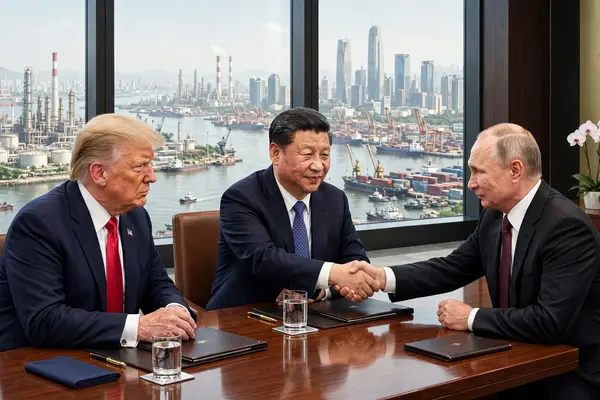
The News
Donald Trump, Xi Jinping and Vladimir Putin held the first-ever meeting of the three leaders together on Thursday, November 19, a 90-minute session at Kylin Villa in Shenzhen on the sidelines of the APEC summit. The three issued a four-point "Declaration Toward Peace" covering energy, reform of the United Nations, immunity for state officials from International Criminal Court jurisdiction, and a reaffirmation that "a nuclear war cannot be won and must never be fought", alongside a dialogue on reducing nuclear risks.
On energy, the declaration says "the three countries plan to increase the production and supply of refined petroleum products for the benefit of all nations" and reaffirmed "the importance of stable energy flows". Refined petroleum products are fuels made from crude oil, such as petrol, diesel and jet fuel. The language is aimed at the supply disruption caused by the war in Iran, which has put pressure on oil shipments through the Strait of Hormuz, the narrow waterway that carries a large share of the world's seaborne oil.
What the declaration does not do is just as important. It makes no mention of Russia's war in Ukraine or the US-led war in Iran, sets no production targets, arranges no commercial deals and gives no timetable for putting anything into practice. Putin acknowledged afterwards that it set no ambitious goals and that nobody would be forced to comply. Trump said he and Xi agreed Iran needed to fully reopen the Strait of Hormuz and could not obtain a nuclear weapon, but there were no signs he secured agreements from Xi or Putin to help resolve the Iran conflict. China's Foreign Minister Wang Yi said the countries would maintain coordination at working level after the summit — though Putin later said no regular meetings had been agreed.
Three leaders, one declaration, zero targets: the Shenzhen pledge is a signal about oil supply, not a supply deal.
Why It Matters
The meeting matters because it is the first time the leaders of the United States, China and Russia have sat down together as a trio. These are three of the world's biggest energy players: the US is the largest oil producer, China is the largest oil importer, and Russia is a major exporter. When they agree in public that energy flows should be stable, markets listen — even when the agreement is thin.
The pledge matters for Exxon and Chevron because their shares move on expectations about oil supply. More refined fuel on the market would normally mean lower fuel prices, which is bad for oil producers' profits but good for consumers. But a pledge with no numbers cannot be priced: traders cannot work out how many extra barrels might appear, or when, so the declaration gives them nothing concrete to trade on.
The gaps matter most of all. The two wars shaping oil prices right now — Russia's war in Ukraine and the US-led war in Iran — are not mentioned at all, and the leaders left Shenzhen disagreeing over something as basic as whether they had agreed to meet regularly. That tells you how far this was from a negotiated deal, and why the market reaction should be measured in sentiment, not barrels.
Analyst's Take
Our call is Mixed. A first-ever meeting of the three most powerful leaders on earth, agreeing in public that energy flows matter, is a real signal — but a signal is all it is. The declaration promises more refined-oil supply without saying how much, by when, or who does what, and Putin's own words after the meeting made clear nobody is bound by it. For Exxon and Chevron, that means no change to the supply picture today.
The two sides of the story roughly cancel out. On the one hand, the world's three biggest powers talking about stable energy flows, and Trump and Xi agreeing on Hormuz and on Iran not obtaining a nuclear weapon, lowers the temperature a little. On the other, the declaration says nothing about the two wars actually disrupting oil — Ukraine and Iran — and the leaders could not even agree afterwards on whether they had agreed to meet regularly.
What to watch next is whether anything concrete follows: a number, a date, or a deal between any of the three countries on fuel supply. Until then, the pledge is words on paper, and oil prices will keep moving on the war and the weekly supply data instead. Reader poll: Will this pledge change oil supply? Vote: Yes, supply rises, No, just words, Too soon to tell.
Are you bullish or bearish on this story?
By The Numbers
FAQ
What is a trilateral meeting?
A trilateral meeting is a meeting between three parties. This one brought together the leaders of the United States, China and Russia — Donald Trump, Xi Jinping and Vladimir Putin — for the first time ever as a group.
What are refined petroleum products?
Refined petroleum products are fuels made from crude oil in a refinery, such as petrol, diesel and jet fuel. The declaration pledges more production and supply of these finished fuels, not of raw crude oil itself.
What is the Strait of Hormuz?
The Strait of Hormuz is the narrow waterway between Iran and Oman that connects the Persian Gulf to the open sea. A large share of the world's seaborne oil passes through it, so any threat to shipping there can push oil prices up.
What does it mean for a declaration to be non-binding?
A non-binding declaration is a statement of intent, not a contract. Nobody is legally forced to do what it says, there are no penalties for ignoring it, and in this case Putin himself acknowledged that nobody would be forced to comply.
👁
Source: BusinessWorld