
Trump urges Nvidia to take Huang back — 'a second chance' — as the board says no
At a White House press conference on Friday, November 20, President Donald Trump said Nvidia should rehire Jensen Huang, while the board has said it does not intend to reinstate him and Treasury Secretary Scott Bessent said H200 chip policy toward China is unchanged.
The News
At a White House press conference on Friday, November 20, President Donald Trump said Nvidia should take Jensen Huang back as chief executive. 'I think the company, if they were smart, they [would] take that brilliant man, accept an apology and let him go back to work,' Trump said, adding: 'I would like to see Jensen get a second chance.' Trump said he had discussed Huang with Chinese President Xi Jinping in Shenzhen, who called Huang 'brilliant.' Trump had earlier named former Apple chief executive Tim Cook as his preferred successor, in a November 12 Truth Social post — but on Friday he put Huang ahead of Cook, saying he wanted the company to give Huang a second chance.
The board has shown no sign of moving. Chair Harvey Jones said on this week's earnings call that 'the Nvidia board unanimously accepted his resignation and does not intend to reinstate Jensen as CEO,' and CNBC reported the board is not considering his return. The two sides are now in open disagreement: the president wants the founder back, and the board that accepted his resignation says it has made its decision.
Friday's 14% fall in Nvidia shares followed a Reuters report that SEC enforcement staff are examining potential accounting issues at the company; the SEC declined to comment and no finding has been made. Huang resigned on November 12 after an affair with a woman suspected of being a Chinese spy, according to reporting cited by The Outpost — an allegation, not an established finding.
The two accounts of the talks with China also conflict. Treasury Secretary Scott Bessent told CNBC on Friday that Huang 'did not come up' in his own discussions with Chinese officials. Bessent also said US policy on H200 sales to China is unchanged — 'the H200 is the threshold level of chips that could be sold to the Chinese' and 'I wouldn't anticipate any change in policy' — and attributed Nvidia's halt in H200 shipments to a 'paucity of orders' from Chinese buyers rather than a policy shift, adding that China is 'many years behind' in developing its own semiconductor capabilities. Betting markets give Huang's return a 10% chance, up from 7%, with Haas leading the next-CEO race at 26% and Cook at 4%, according to Kalshi on November 20.
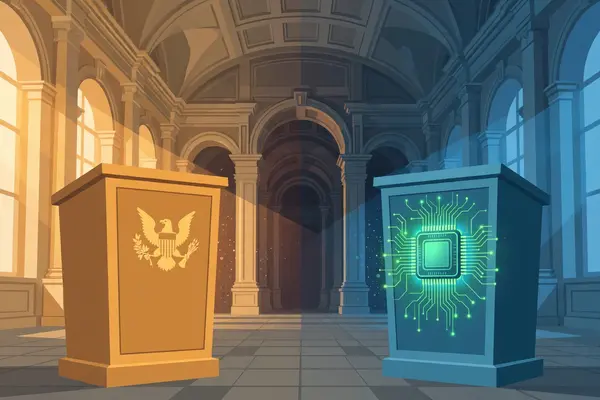
The president wants Huang back; the board has already voted no — and the betting market gives the return a 1-in-10 chance.
Why It Matters
Boards, not presidents, pick chief executives. That is the basic point here: Nvidia's board is elected by shareholders, and its chair has said unanimously that it does not intend to reinstate Huang. A president can praise a former chief executive, lean on a board in public, and shape the politics around a company — but he cannot appoint its boss. The unanimous language matters because it leaves no room for a split board to be lobbied one member at a time.
The conflicting accounts of the China talks are a reminder to file both versions and reconcile neither. Trump says he raised Huang with Xi; Bessent says Huang did not come up in his own talks; a senior official says they were separate conversations. All three statements can be true at once, and none of them changes the underlying facts: Huang is out, the board says he is staying out, and the H200 policy is, by Bessent's own account, unchanged.
The H200 point is the one with money attached. The H200 is the most powerful chip the US allows Nvidia to sell to China, and Bessent's statement that the threshold is unchanged — plus his claim that the shipping halt reflects a lack of Chinese orders rather than a policy change — takes a policy risk off the table for now. The betting markets agree with the board, not the president: a 10% chance of return is a long shot, and the next-CEO market has Haas, not Cook, in front.
Analyst's Take
Our call is Mixed. Trump's intervention guarantees the Huang story stays in the headlines, and a president's public preference is never nothing. But the board has spoken unanimously, the betting market prices a return at one in ten, and the H200 policy — the part that actually affects Nvidia's revenue — is unchanged. The noise is loud; the facts are settled for now.
What to watch next is the next-CEO search, where Haas leads the betting at 26%, and whether the board names a permanent chief executive before the December hearings put Huang back in the spotlight. Also watch H200 orders from Chinese buyers: if they return, Bessent's 'paucity of orders' explanation gets its test.
The president has made his preference clear; the board has made its decision clear. Reader poll: Should Nvidia rehire Jensen Huang — yes or no? Vote: Yes, bring him back, No, move on, Too soon to tell.
Are you bullish or bearish on this story?
By The Numbers
FAQ
What is the H200?
The H200 is Nvidia's most powerful AI chip that the US allows to be sold to China. Treasury Secretary Scott Bessent said the H200 is the threshold level of chips that could be sold to the Chinese, and that he would not anticipate any change in that policy.
What is Kalshi?
Kalshi is a regulated prediction market where people trade contracts on the outcome of events, so its prices work as a rough measure of what traders think will happen. It gives Huang's return as Nvidia CEO a 10% chance, up from 7%.
Who picks a CEO?
A company's board of directors picks its chief executive, not the president. Nvidia's board is elected by shareholders, and its chair, Harvey Jones, said on the earnings call that the board unanimously accepted Huang's resignation and does not intend to reinstate him.
What is a board chair?
The board chair leads the company's board of directors, the group that oversees management and hires or fires the chief executive. Harvey Jones became Nvidia's first board chair when Huang resigned on November 12.
👁
Source: The Outpost