
SoftBank swings to a ¥1.115 trillion quarterly loss on a $3.7B data-centre charge
SoftBank Group reported a net loss of ¥1.115 trillion (about $7.02 billion) for the quarter ended September — its first quarterly loss in nearly two years — including $3.7 billion of charges tied to power-generation equipment for US AI data-centre projects. Shares fell as much as 11% in Tokyo before recovering to close down 0.44%.
📊 Scorecard: our Bearish call on $9984.T is scored from ¥3,855, the last close before it ran. Its first result comes after the next close.
The News
SoftBank Group reported a net loss of ¥1.115 trillion — about $7.02 billion — for the quarter ended September, its first quarterly loss in nearly two years. A year earlier the company made a ¥2.502 trillion profit, so the swing from profit to loss is more than ¥3.6 trillion in a single year.
The loss included $3.7 billion of charges tied to changes in procurement plans for power-generation equipment for US AI data-centre projects, plus financing costs of ¥462 billion. In plain terms: SoftBank had planned to buy power equipment for the giant AI data centres it is helping to build in the United States, changed those plans, and took a large charge for doing so. Financing costs are the interest and fees paid on borrowed money, and at ¥462 billion they were large enough to matter on their own.
The shares had a wild day in Tokyo. They fell as much as 11% to an intraday low of ¥3,465 — the lowest price reached during the trading session — before recovering to close at ¥3,855, down just 0.44% on the day. The recovery saved the session, but it did not change the picture: the stock has more than halved from its June peak and was down 12% for the year through Tuesday.
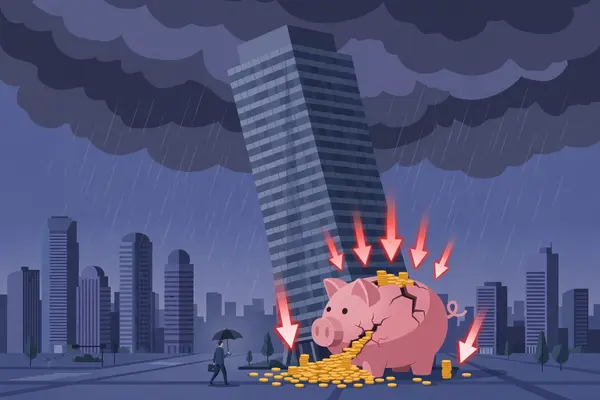
SoftBank lost $7 billion in a quarter — and the data-centre buildout did much of the damage.
Why It Matters
The loss matters because of who took it and why. SoftBank is not a bystander in the AI boom — it is the biggest financial backer of the buildout through its Stargate commitments, the programme to build giant AI data centres across the United States. When a loss is driven by the value of its investments falling, that is a market problem. When it is driven by the cost of building data centres, that is a buildout problem — and it is the kind of problem that spreads, because every other builder faces the same power and equipment costs.
The scale of the charges is the second reason it matters. $3.7 billion tied to changes in procurement plans for power-generation equipment is not a rounding error; it is a sign that the plans themselves are shifting under the builders' feet. Power is the binding constraint on AI data centres — there is not enough of it, in the right places, at the right price — and SoftBank's charge is the clearest evidence yet that the constraint is now showing up in earnings, not just in analyst notes.
The share price tells the third part of the story. A stock that falls 11% intraday and then recovers to close down 0.44% is a stock the market cannot decide about. The recovery says buyers believe the loss is survivable. The fact that the stock has more than halved from its June peak and is down 12% for the year says the market has been losing faith for months. The next quarter will settle which of those two readings is right.
Analyst's Take
Our call is Bearish. A $7 billion quarterly loss at the company funding the AI buildout is not a footnote — it is a warning about the cost of the buildout itself. The charges came from power-generation equipment for US data centres, the physical backbone of the AI boom, and they landed alongside ¥462 billion of financing costs. When the deepest-pocketed funder in AI takes a hit like this, the whole buildout gets more expensive.
What to watch: whether the recovery in the shares holds. The stock bounced from an 11% intraday fall to close down just 0.44%, which says buyers stepped in. But the stock has more than halved from its June peak, and the next quarter will show whether the data-centre charges were a one-off or the start of a pattern.
Are you bullish or bearish on this story?
By The Numbers
FAQ
How big was SoftBank's loss?
A net loss of ¥1.115 trillion, about $7.02 billion, for the quarter ended September. A year earlier the company made a ¥2.502 trillion profit, so the swing from profit to loss is more than ¥3.6 trillion.
What caused the loss?
The loss included $3.7 billion of charges tied to changes in procurement plans for power-generation equipment for US AI data-centre projects, plus financing costs of ¥462 billion. Procurement means buying the equipment; a charge here means the company wrote down the value of those plans.
What happened to the shares?
Shares fell as much as 11% in Tokyo on Wednesday to an intraday low of ¥3,465, then recovered to close at ¥3,855, down just 0.44% on the day. The stock has more than halved from its June peak and was down 12% for the year through Tuesday.
Why does SoftBank matter to AI?
SoftBank is the AI buildout's biggest financial backer through its Stargate commitments — the giant data-centre programme it is funding in the US. A loss driven by data-centre construction costs, rather than by the value of its investments falling, is a direct read on how expensive the buildout has become even for its deepest-pocketed funder.
What is Arm's role in this story?
Arm is the chip designer SoftBank owns, and its shares are a read-through for SoftBank's health: when SoftBank stumbles, Arm often moves with it. Arm closed at $181.49 on Tuesday, down 2.58%.
👁
Source: TradingView / Dow Jones