
SoftBank and ABB explore carving out China to salvage the $5.4B robotics deal
SoftBank and ABB are exploring a carve-out of the China business to salvage their $5.4 billion robotics deal after Beijing blocked it, Bloomberg reported on November 7 — with SoftBank said to be leading the effort, talks at an early stage, and any reworked deal worth materially less than the original price.
The News
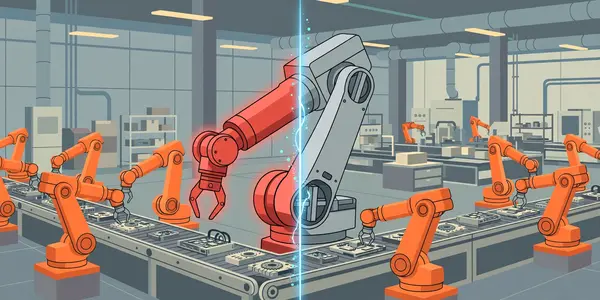
SoftBank and ABB are exploring a carve-out of the China element of their $5.4 billion robotics deal after Beijing blocked it, Bloomberg reported on Saturday, November 7, citing people familiar with the matter. The plan would set up the China business as a separate entity under different ownership so the rest of the division could still be sold to SoftBank, with SoftBank said to be leading the effort. Talks are at an early stage and may not lead to an agreement. Neither company has confirmed the talks: SoftBank did not respond to requests for comment and ABB declined to comment.
This is a genuinely new development on top of the block itself, which we reported yesterday. On November 5, ABB confirmed that China's foreign-investment security-review office had prohibited SoftBank from acquiring ABB's robotics business in China. The prohibition covers the business in China — the division's biggest market, about 30% of its robot-related business, according to Reuters — and the Financial Times' sources said the commission worried robotics data could be transferred overseas and used to train AI models, including OpenAI's, in which SoftBank is a major investor. That rationale rests on the FT's sources, not an official Chinese announcement.
ABB is also weighing alternatives. Bloomberg reports a sale to another buyer could value the business at $2–3 billion — far below the $5.375 billion SoftBank agreed to pay in October 2025 — or ABB could revive the spin-off it abandoned when SoftBank made its offer, though an IPO would be difficult with a signed sale agreement in place. The market reaction was sharp: SoftBank shares fell 11% in Tokyo trading on November 6 — but that fall came amid a broad technology sell-off after the U.S. midterm elections, with uncertainty over the deal adding to the pressure, rather than from the block alone — and ABB's weekly decline exceeded 5%. Citi analyst Martin Wilkie estimated the block would roughly halve ABB's acquisition capacity to about $5 billion.
The deal is not dead — but the $5.375 billion version of it is being taken apart and rebuilt in real time.
Why It Matters
This matters because it shows how a blocked deal gets rebuilt rather than buried. The block itself, reported yesterday, was a warning that robotics is now treated as a national-security asset: the reported concern was that data collected by robots could flow overseas and be used to train AI models. A carve-out is the industry's answer to that kind of block — split the business along the regulator's line and keep the rest of the deal alive. If it works here, it becomes a template for every cross-border robotics deal that touches China.
It matters for the money, too. The gap between $5.375 billion and $2–3 billion is the price of the block: that is what the division is worth to another buyer once the SoftBank premium and the China piece are both gone. Citi's estimate that the block roughly halves ABB's acquisition capacity to about $5 billion shows the block bites both ways — ABB loses a $5.4 billion cheque and much of its ability to go shopping for something else. And for SoftBank, the stakes are strategic: this division was the centrepiece of its push into physical AI, and losing it would leave that strategy without its main asset.
Analyst's Take
Our call is Mixed, because a path to salvage exists but it is early-stage, unconfirmed by either company, and any restructured deal is worth materially less than $5.375 billion. The carve-out is the best available answer to a block that targeted exactly the China piece: cut that piece out, put it under different ownership, and let the rest of the sale go ahead. It is clever, and it is the kind of restructuring dealmakers reach for when a regulator draws a line through one country. But clever is not the same as agreed, and the reported $2–3 billion alternative valuation tells you what the market thinks the division is worth without SoftBank's price.
What to watch is whether the early talks harden into something either side will put its name to. A carve-out needs a buyer for the China business, a price for the rest, and a regulator willing to accept the new structure — three separate negotiations, none of them started in public. If they come together, SoftBank keeps the centrepiece of its push into physical AI, the branch of artificial intelligence concerned with robots that can see, move and work in the real world. If they do not, ABB is left holding a division it was ready to sell, with a spin-off or a much cheaper sale as the fallback.
Are you bullish or bearish on this story?
By The Numbers
FAQ
What exactly is being carved out?
The China element of ABB Robotics. The plan, as reported by Bloomberg, would set up the China business as a separate entity under different ownership so the rest of the division could still be sold to SoftBank. China is the division's biggest market, about 30% of its robot-related business, according to Reuters.
Why was the deal blocked in the first place?
China's foreign-investment security-review office prohibited SoftBank from acquiring ABB's robotics business in China, ABB confirmed on November 5. The Financial Times' sources said the National Development and Reform Commission worried robotics data could be transferred overseas and used to train AI models, including OpenAI's, in which SoftBank is a major investor.
What are the alternatives if the carve-out fails?
ABB is also weighing a sale to another buyer — which Bloomberg reports could value the business at $2–3 billion — or reviving the spin-off it abandoned when SoftBank offered $5.375 billion in October 2025. An IPO would be difficult with a signed sale agreement in place.
How has the market reacted?
Sharply. SoftBank shares fell 11% in Tokyo trading on November 6 — part of a broad technology sell-off after the U.S. midterm elections, with uncertainty over the deal adding to the pressure — and ABB's weekly decline exceeded 5%. Citi analyst Martin Wilkie estimated the block would roughly halve ABB's acquisition capacity to about $5 billion.
Is the deal confirmed to be going ahead in a new form?
No. Talks are at an early stage and may not lead to an agreement. Neither company has confirmed the carve-out talks — SoftBank did not respond to requests for comment and ABB declined to comment.
👁
Source: Bloomberg via Reuters (SRN News)