
Pony.ai and Toyota launch fully driverless Gen-7 bZ4X robotaxi service in Guangzhou
The Gen-7 bZ4X Robotaxi is now carrying paying passengers with no driver at all in Guangzhou, 24 hours a day, as Pony.ai and Toyota target around 1,000 cars across China.
📊 Scorecard: our Bullish call on $PONY is scored from $4.46, the last close before it ran. Its first result comes after the next close.
The News
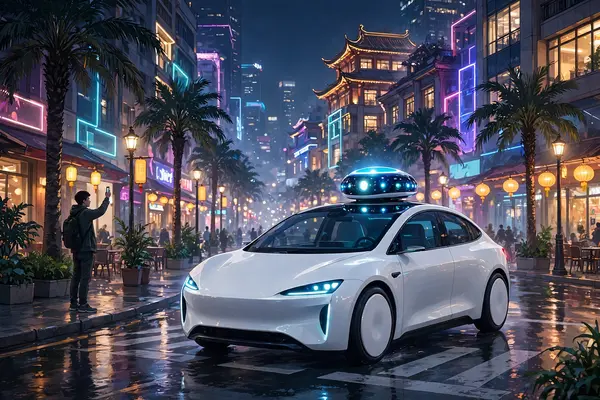
Pony.ai and Toyota have switched on fully driverless taxi service in Guangzhou, one of China's biggest cities. The service, which launched on November 15, uses the two companies' jointly developed Gen-7 bZ4X Robotaxi, a Toyota electric car fitted with Pony.ai's self-driving system. Fully driverless means there is no safety driver sitting behind the wheel at all. Passengers can hail a car 24 hours a day through the PonyPilot app or through mini-programs inside WeChat and Alipay, the apps most Chinese phone users already have.
This is not a small test. The first mass-produced version of the vehicle rolled off the production line in February 2026, and the companies say they are testing the model in other major Chinese cities and working toward around 1,000 bZ4X robotaxis across China. That would make this one of the largest driverless fleets in the country. The two companies have worked together on robotaxis since 2019 and set up a joint venture in 2023, with more than RMB 1 billion invested in the partnership.
The timing gives investors a quick follow-up: Pony.ai reports its third-quarter results on Wednesday, November 18, when the company is likely to be asked how fast the Guangzhou fleet is growing and what it costs to run. On Friday, November 13, Pony.ai shares closed at $4.46, up 0.68 percent, while Toyota closed at $212.43, up 1.31 percent. Both moves were small, which suggests the market is waiting to see how the service performs before getting excited.
The car has no driver, the city never sleeps, and the meter is now running.
Why It Matters
Robotaxis matter because they turn a car from a product into a service. Toyota sells cars once; a robotaxi earns money every day it drives, with no driver to pay. For Pony.ai, a working commercial service in a major city is proof its software is ready for the real world, not just a test track. For Toyota, it is a way into the self-driving business without having to build the whole system itself.
Guangzhou is a serious place to prove it. It is a huge, busy city with dense traffic, rain, and complicated roads, so a car that works there all day and night has passed a hard test. Running 24 hours a day also matters for the economics: a robotaxi that never sleeps can earn far more per day than a human-driven taxi, which is the whole point of removing the driver.
The open question is scale. Around 1,000 cars across China is still small next to the millions of taxis and ride-hailing cars on the road, and each city has its own rules and permits. But the pieces are now in place: a mass-produced car, a live commercial service, and a partner with Toyota's manufacturing muscle. The next year will show whether this grows from a showcase into a business.
Analyst's Take
Our call is Bullish. A fully driverless commercial service running 24 hours a day in Guangzhou, built on a mass-produced Toyota, is a real milestone rather than a demo. The partnership has seven years of work behind it and more than RMB 1 billion invested, which is the kind of foundation that survives the hard part: scaling up.
The thing to watch is Wednesday's results from Pony.ai on November 18. Listen for how many rides the Guangzhou fleet is doing, how fast the 1,000-car target is moving, and whether the economics per ride are improving. Toyota's small share gain on Friday tells us the market has not priced in a robotaxi future yet, which leaves room for good news to matter.
For readers, the simple test is whether you would get in one. The technology is now carrying paying passengers in a major city with no driver at all, and that was science fiction not long ago. The business case still has to prove itself, but the cars are already on the road. Reader poll: Would you ride in a driverless taxi? Vote: Yes, sign me up, Maybe someday, Not yet.
Are you bullish or bearish on this story?
By The Numbers
FAQ
What does fully driverless mean?
It means there is no safety driver behind the wheel at all. The car drives itself, picks up passengers and handles traffic on its own, and riders hail it through an app just like a normal taxi.
How do you hail a bZ4X Robotaxi?
Passengers in Guangzhou can book one 24 hours a day through the PonyPilot app or through mini-programs inside WeChat and Alipay, the apps most people in China already use every day.
Why is Toyota involved?
Toyota builds the car and Pony.ai supplies the self-driving system. Toyota gets into the robotaxi business without building the software itself, and Pony.ai gets a mass-produced vehicle from one of the world's biggest carmakers.
👁
Source: HeyGoTrade