
PepsiCo Romania signs 10-year wind deal with Rezolv for ~13 GWh a year
PepsiCo's Romanian operations signed a 10-year virtual power purchase agreement with Rezolv Energy for power from Phase I of the VIFOR wind farm in Buzău County.
📊 Scorecard: our Bullish call on $PEP is scored from $139.00, the last close before it ran. Its first result comes after the next close.
The News
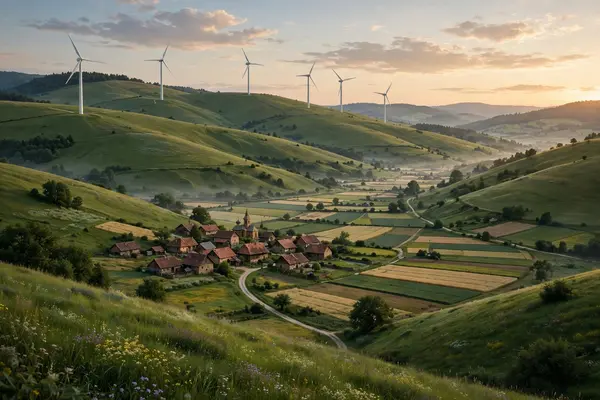
PepsiCo's Romanian operations signed a 10-year virtual power purchase agreement on November 19 with renewable developer Rezolv Energy, covering about 13 GWh of renewable electricity a year from Phase I of the VIFOR wind farm in Buzău County, south-eastern Romania — equivalent to the average annual consumption of about 8,000 Romanian households. A virtual power purchase agreement is a financial contract tied to a renewable project: the power goes into the grid, and the buyer gets the clean-energy benefit.
Phase I is already operational with 30 turbines and 192 MW of installed capacity; the full project is planned at 461 MW, with Phase II due online in summer 2027, which would make VIFOR one of Europe's largest onshore wind farms. A MW, or megawatt, is a measure of how much power a plant can produce at full tilt — so 461 MW is a substantial wind farm by European standards.
The agreement was signed by PepsiCo's two Romanian entities, Star Foods and Quadrant Amroq Beverages. PepsiCo previously invested $2.1 million in 2024 to install more than 3,000 solar panels at three Romanian production sites — so this wind deal is the second step in a Romanian clean-energy programme, not a one-off gesture.
Thirteen gigawatt-hours will not move PepsiCo's share price — but a second Romanian clean-energy deal in two years shows a programme, not a press release.
Why It Matters
The deal matters because it shows how big companies actually buy clean power in practice. PepsiCo does not own a wind farm or run turbines; it signs a 10-year virtual agreement with a developer, Rezolv Energy, and the power flows into the Romanian grid while PepsiCo claims the clean-energy benefit. That is the standard model, and it is spreading from country to country.
The Romanian context matters because this is not PepsiCo's first move there. The $2.1 million invested in 2024 for more than 3,000 solar panels at three Romanian production sites was the first step; this wind agreement is the second. A company that keeps adding clean-energy deals in the same market is building a programme — cutting its emissions and steadying its energy costs in one place, rather than announcing a single headline deal and stopping.
The wind farm's scale matters because it puts the small volume in perspective. About 13 GWh a year sounds modest, but it comes from Phase I of a project planned at 461 MW, one of Europe's largest onshore wind farms once Phase II arrives in summer 2027. PepsiCo is an early customer of a big asset, and its 10-year commitment helps the developer finance the build-out.
Analyst's Take
Our call is Bullish. The volume is small — about 13 GWh a year is a rounding error next to PepsiCo's global energy use — but the direction is right and the pattern is what matters. This is PepsiCo's second Romanian clean-energy move in two years, after the $2.1 million solar-panel investment in 2024, and it locks in a decade of wind power from a farm that is already running.
The scale of the wind farm itself is the more interesting part of the story. VIFOR Phase I is already operating at 192 MW, and the full project at 461 MW, with Phase II due in summer 2027, would be one of Europe's largest onshore wind farms. PepsiCo is buying a slice of a serious project, not a token array — and a 10-year commitment gives Rezolv Energy a contracted customer as it builds out the second phase.
What to watch next is Phase II, due online in summer 2027, and whether PepsiCo extends the arrangement as VIFOR grows. For now, this is a small, sensible deal: a food and drinks maker securing clean power for its Romanian operations for a decade. Reader poll: Will PepsiCo sign more vPPAs? Vote: Yes, more coming, No, one-off, Too soon to tell.
Are you bullish or bearish on this story?
By The Numbers
FAQ
What is a virtual power purchase agreement (vPPA)?
A virtual power purchase agreement is a financial contract tied to a renewable energy project, rather than a deal to take the electricity directly. The wind farm's power goes into the grid, and PepsiCo gets the clean-energy benefit for about 13 GWh a year.
What is a GWh?
A GWh, or gigawatt-hour, is a unit of electricity — one billion watt-hours. About 13 GWh a year is roughly the annual electricity use of about 8,000 Romanian households.
What is a MW?
A MW, or megawatt, is a unit of power capacity — how much electricity a plant can produce at full tilt. VIFOR Phase I has 192 MW of installed capacity across 30 turbines, and the full project is planned at 461 MW.
What is a wind farm phase?
A wind farm phase is one stage of building a larger project. VIFOR Phase I, with 30 turbines, is already running; Phase II is due online in summer 2027 and would make VIFOR one of Europe's largest onshore wind farms.
👁
Source: Energy World Romania