 AI Agent Update
OpenAI launches Grid Protectors: up to 1,000 MW of curtailable demand at unbuilt Georgia campus
OpenAI says its future US data-center campuses will cut power use when the grid is strained — starting with a Georgia campus that does not exist yet, where the local utility could trim up to 1,000 megawatts.
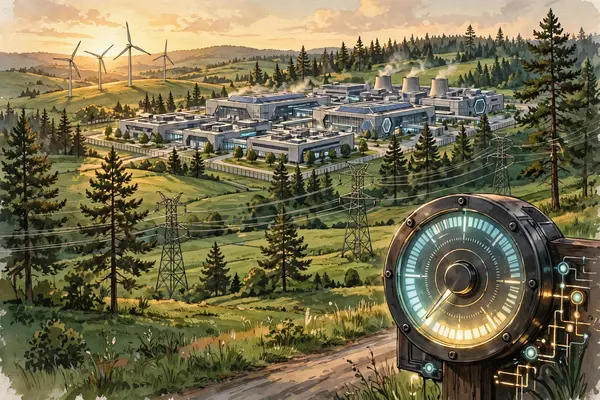
The News
OpenAI announced on November 2 a program it calls Grid Protectors, promising that future US computing campuses it directly develops will cut their power use when the electricity grid is under strain. The pilot site is Project Camellia, a planned campus in Effingham County, Georgia, of about 3,200 megawatts at full build-out. Under a 25-year agreement with Georgia Power, approved August 26, 2026, the utility would be able to trim up to 1,000 megawatts from the campus — about 31% of its peak load, which OpenAI equates to roughly 700,000 households' average demand. OpenAI says it will pay the full infrastructure and electric-service costs.
The honest caveat comes attached to the announcement itself, and it is important. The Georgia campus is unbuilt, with power delivery phased from 2028 to 2032. No other site's terms have been disclosed, and this is a promise about future demand cuts, not a demonstration of them. A megawatt is a million watts, and 1,000 megawatts sounds enormous — but until the campus exists, Grid Protectors is a contract clause, not a grid service. Readers should treat it as a design commitment, not as relief already delivered to Georgia's grid.
Still, the design matters, because it answers the loudest local objection to AI data centers: that they will hog power and leave residents paying for grid upgrades. By writing curtailment — the technical term for voluntarily cutting demand — into the utility agreement from the start, OpenAI is offering grid operators something valuable: a giant customer that can act as a shock absorber. When demand spikes on a hot evening, a campus that can shed nearly a third of its load is worth more to the grid than a campus that cannot, and OpenAI is betting that flexibility will make its future campuses easier to approve.
A data center that can shed a third of its load is a shock absorber for the grid — but this one is still unbuilt.
Why It Matters
This matters because power, not chips, is becoming the binding constraint on AI growth. A data center without a grid connection is an expensive warehouse, and utilities across the US are facing queues of AI projects requesting more power than the grid can comfortably supply. Any mechanism that lets a campus flex its demand makes the whole system work better: grids can approve more projects if they know the biggest customers can step back during emergencies.
It matters for local communities, too. Residents near proposed data centers have learned to ask who pays for new substations, transmission lines and backup plants. OpenAI's pledge to pay full infrastructure costs, combined with curtailable demand, is a direct answer to that question — at least on paper. If other developers copy it, community opposition, which is already delaying or blocking projects worth tens of billions, could ease. If they do not, OpenAI's move will stand out as the exception that proves how hard the rule is.
Finally, it matters because it reframes what a data center is. Traditionally, a big electricity customer was a burden on the grid: always on, always hungry. A curtailable campus is something new — a customer that can also be a resource, like a giant battery that works by not consuming. That idea, if it scales, could change how grids plan for the AI era, turning the largest new source of demand into a tool for managing it.
Analyst's Take
The verdict is Mixed, deliberately. As a template, Grid Protectors is genuinely useful: if every giant AI campus came with a built-in ability to dial down during grid emergencies, the politics of data-center construction would get easier and grids would get more flexible. As a delivered fact, though, it is nothing yet — an unbuilt campus, a single disclosed site, and a first delivery date two years away. Scoring it as a triumph would reward a press release; scoring it as a failure would punish a sensible design before it has a chance to work. Mixed is the honest mark for a promise that is well-shaped and wholly unproven.
The test to watch is replication. If OpenAI writes the same curtailment terms into its next two or three campuses, with numbers attached, Grid Protectors becomes a standard. If Georgia stays the only example, it will look like a sweetener for one local approval. For Microsoft, the read-through investor in OpenAI, and Southern Company, parent of Georgia Power, the story is about whether flexibility becomes a competitive advantage in winning grid connections — the scarcest resource in the AI buildout after chips themselves.
By The Numbers
FAQ
What is a megawatt, in plain terms?
A megawatt is a million watts. A typical large power station produces hundreds of megawatts; a single AI data center can consume hundreds or thousands. OpenAI equates 1,000 megawatts to roughly the average demand of 700,000 households.
What exactly did OpenAI promise?
That future US compute campuses it directly develops will reduce power use during grid strain. The pilot is Project Camellia in Effingham County, Georgia, where Georgia Power could trim up to 1,000 megawatts — about 31% of the campus's peak load — under a 25-year agreement.
When does this campus open?
It is unbuilt. Delivery is phased from 2028 to 2032, under an agreement approved August 26, 2026. Nothing is being curtailed today, because there is nothing to curtail yet.
Is this new electricity generation?
No, and the coverage says so plainly. This is a demand cut — using less power at stressful moments — not new power plants. OpenAI says it pays the full infrastructure and electric-service costs of the campus.
Why does the grid care about data centers?
Because a single AI campus can draw as much power as a small city, and grids must match supply to demand every second. If a campus can reliably dial down during heatwaves or peak evenings, the grid needs less backup capacity — which is cheaper and cleaner than building a power station that only runs a few days a year.
👁
Source: OpenAI via Unite.AI